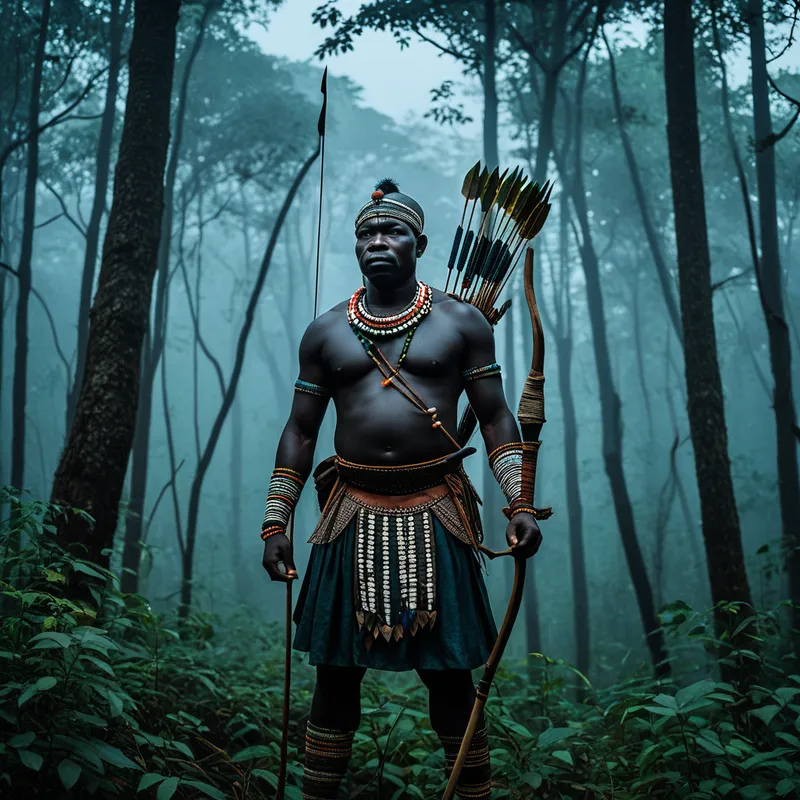
Ososi Myth Meaning & Symbolism
The myth of Ososi, the solitary hunter-orisha, embodies the sacred tension between wild nature and human order, and the psychic power of focused, patient pursuit.
The Tale of Ososi
Listen. In the time when the world was still wet with creation, when the breath of [Olodumare](/myths/olodumare “Myth from Yoruba culture.”/) still stirred the leaves, there walked a power that was not of the bustling town nor entirely of the untamed bush. His name was Ososi. While his brothers forged kingdoms and stirred the passions of the marketplace, Ososi turned his face to the green, whispering depths. His feet knew the secret paths where sunlight fell in dappled coins. His ears were tuned to the rustle in the thicket, the snap of a twig a league away. His was the kingdom of silence and sudden, decisive motion.
He was clad not in royal robes, but in the hides of his respectful pursuits, his body lean and coiled like a spring. In his hand, he carried the bow—an arc of tension and potential—and at his side, the arrow, a sliver of focused destiny. He was the provider who came from the unknown, bringing meat from the wilderness to the edge of the village. He was the protector who stood guard where the ordered world of Ilé frayed into the chaotic vitality of Igbo. Children would peek from doorways to see his silent form pass, a shadow against the setting sun, the scent of damp earth and ozone clinging to him.
The great conflict was not one of clashing armies, but of a creeping silence. A strange malaise fell upon the land. The game grew scarce and wary. The forests became too quiet, the silence itself a palpable, hungry thing. The people’s prayers to the more sociable orisha seemed to dissipate before they reached the canopy. The boundary between village and bush grew thin, threatening to dissolve. Fear, a cold vine, began to climb the walls of homes.
Ososi did not rally speeches. He simply knelt at the threshold of the world, placed his palm upon the soil, and listened. For days and nights, he became a statue of attention. He heard not with his ears, but with his spirit—the imbalance in the heartbeat of the land. The wilderness was not empty; it was holding its breath, offended by a forgotten accord. The pact of respect between hunter and hunted, between human need and wild sovereignty, had been fractured by greed and careless taking.
The resolution came not with a shout, but with a release. On the dawn of the seventh day, Ososi stood. He did not look back to the village. He walked into the deepest grove, where the oldest trees stood as pillars to a green cathedral. There, he did not raise his weapon. Instead, he laid his bow upon a stone altar of roots. He sang a hymn of apology, not in words, but in the language of the forest—a whisper of wind, the pattern of falling leaves. He made an offering not of conquest, but of recognition. He acknowledged the spirit of the game, the sovereignty of the wild.
And the forest exhaled. From the shadows, a magnificent stag emerged, not in fear, but in solemn ceremony. It met Ososi’s gaze. In that moment, the arrow was no longer a tool of death, but a needle sewing the torn fabric between worlds. With a motion that was both sacrifice and sacrament, the pact was renewed. Ososi returned to the boundary, and the game followed, a sustainable bounty restored. He resumed his eternal vigil, no longer just a hunter, but the living hinge between two realms, his solitude the price of their balance.
Cultural Origins & Context
The myth of Ososi springs from the rich soil of Yoruba civilization, one of Africa’s most influential cultural and philosophical systems. As an orisha, Ososi belongs to a vast pantheon of divine forces that personify aspects of nature, human endeavor, and cosmic principle. His stories were not mere entertainment; they were vital psycho-spiritual maps, passed down through the sacred oral traditions of Itan (history/myth) by priests, elders, and master storytellers known as Arokin.
In the Yoruba worldview, which profoundly shaped diasporic traditions like Santería and Candomblé, human life exists in a dynamic, sometimes precarious, balance. The clearings of towns and cities (Ilé) represent order, culture, and community. The surrounding bush (Igbo) represents the untamed, potent, and spiritually dense wilderness—the source of both resources and dangers. Ososi’s primary societal function was to embody and manage this critical relationship. He was the patron of hunters, yes, but more deeply, he was the guardian of the threshold. His myths taught the ethics of the hunt: respect, gratitude, and the avoidance of waste. He modeled the necessity of the individual who operates outside the group’s center, whose lonely expertise safeguards the whole. In a culture deeply communal, Ososi sanctified the strategic, essential solitude.
Symbolic Architecture
Ososi is the [archetype](/symbols/archetype “Symbol: A universal, primordial pattern or prototype in the collective unconscious that shapes human experience, behavior, and creative expression.”/) of the focused will, the [consciousness](/symbols/consciousness “Symbol: Consciousness represents the state of awareness and perception, encompassing thoughts, feelings, and experiences.”/) that operates at the edge of the known. He is not the [warrior](/symbols/warrior “Symbol: A spiritual archetype representing inner strength, discipline, and the struggle for higher purpose or self-mastery.”/) who confronts [chaos](/symbols/chaos “Symbol: In Arts & Music, chaos represents raw creative potential, uncontrolled expression, and the breakdown of order to forge new artistic forms.”/) head-on in the [open field](/symbols/open-field “Symbol: The open field symbolizes freedom, potential, and possibilities, representing a space where one can explore new opportunities.”/); he is the scout who moves within it, guided by [intuition](/symbols/intuition “Symbol: The immediate, non-rational understanding of truth or insight, often described as a ‘gut feeling’ or inner knowing that bypasses conscious reasoning.”/) and acute [perception](/symbols/perception “Symbol: The process of becoming aware of something through the senses. In dreams, it often represents how one interprets reality or internal states.”/). His domain is the liminal [space](/symbols/space “Symbol: Dreaming of ‘Space’ often symbolizes the vastness of potential, personal freedom, or feelings of isolation and exploration in one’s life.”/)—the borderland where definitions blur and transformation is possible.
The hunter’s true prey is not the external game, but the moment of perfect alignment between intention, action, and the unseen pattern of the world.
His bow represents [tension](/symbols/tension “Symbol: A state of mental or emotional strain, often manifesting physically as tightness, pressure, or unease, signaling unresolved conflict or anticipation.”/), potential, and the directed [application](/symbols/application “Symbol: An application symbolizes engagement, integration of knowledge, or the pursuit of goals, often representing self-improvement and personal development.”/) of [energy](/symbols/energy “Symbol: Energy symbolizes vitality, motivation, and the drive that fuels actions and ambitions.”/). The [arrow](/symbols/arrow “Symbol: An arrow often symbolizes direction, purpose, and the pursuit of goals, representing both the journey and the destination.”/) symbolizes focused intent, a thought or [action](/symbols/action “Symbol: Action in dreams represents the drive for agency, motivation, and the ability to take control of situations in waking life.”/) released into the world to find its [mark](/symbols/mark “Symbol: A ‘mark’ often symbolizes identity, achievement, or a defining characteristic in dreams.”/) with unerring [precision](/symbols/precision “Symbol: The quality of being exact, accurate, and meticulous. It represents control, clarity, and the elimination of error in thought or action.”/). His solitude is not [loneliness](/symbols/loneliness “Symbol: A profound emotional state of perceived isolation, often signaling a need for connection or self-reflection.”/), but the necessary [condition](/symbols/condition “Symbol: Condition reflects the state of being, often focusing on physical, emotional, or situational aspects of life.”/) for this hyper-attuned state. He cannot hear the subtle [guidance](/symbols/guidance “Symbol: The act of receiving or seeking direction, advice, or leadership in a dream, often representing a need for clarity, support, or a higher purpose on one’s life path.”/) of the [forest](/symbols/forest “Symbol: The forest symbolizes a complex domain of the unconscious mind, representing both mystery and potential for personal growth.”/)—the whispers of the unconscious—amidst the [noise](/symbols/noise “Symbol: Noise in dreams signifies distraction, confusion, and the need for clarity amidst chaos.”/) of the crowd.
Psychologically, Ososi represents the faculty of introverted intuition coupled with [sensation](/symbols/sensation “Symbol: Sensation in dreams often represents the emotional and physical feelings experienced in waking life, highlighting one’s intuition or awareness.”/). He is the part of the psyche that can withdraw from collective demands, enter the “inner [wilderness](/symbols/wilderness “Symbol: Wilderness often symbolizes the untamed aspects of the self and the unconscious mind, representing a space for personal exploration and discovery.”/)” of the personal and [collective unconscious](/symbols/collective-unconscious “Symbol: The Collective Unconscious refers to the part of the unconscious mind shared among beings of the same species, embodying universal experiences and archetypes.”/), and there, through patient observation, discern the patterns, resources, and threats that are invisible to the everyday ego. He is the tracker of inner truths.

The Dreamer’s Resonance
When the pattern of Ososi stirs in the modern dreamer, it often manifests as dreams of being a tracker, a watcher at the edge of a wild place, or of holding a tool of precise aim (a bow, a rifle, a camera, a laser). There is a somatic quality of heightened alertness, a “pricking of the ears” in the psyche. The dreamer may find themselves following faint trails, interpreting obscure signs, or waiting in absolute stillness for a crucial moment.
This dream motif signals a psychological process where the conscious ego is learning to navigate the inner Igbo—the wild, untamed, and often repressed aspects of the self. The “game” being tracked could be a nascent talent, a buried memory, a complex emotion, or an insight necessary for growth. The dreamer is in the Ososi phase: the stage of patient reconnaissance, of gathering intelligence from the unconscious without immediate action or interpretation. There may be a feeling of healthy isolation, of needing to step back from social engagements to attend to this inner process. The challenge is to maintain the hunter’s respect—to approach these inner contents not to violently conquer or consume them, but to understand their nature and place in the ecosystem of the self.

Alchemical Translation
The alchemical journey modeled by Ososi is one of precise distillation. It is not the grand, fiery fusion of the lover, nor the crushing weight of the hero’s labors. It is the slow, careful process of separating the essential from the peripheral, of aiming the arrow of consciousness with such care that it transmutes confusion into clarity.
The modern individual embarks on this process when they must find a singular truth or direction amidst the cacophony of life’s demands and their own internal chaos. The first step is Ososi’s withdrawal: consciously creating periods of solitude and silence to step away from the “village” of one’s social identity and obligations. The second is the patient listening: engaging in practices that still the ego’s chatter—meditation, journaling, walking in nature—to perceive the subtle movements of the deeper self.
Individuation often requires the courage to become a boundary-dweller, to hold the tension between who you are in society and who you are in the wilds of your own soul.
The “offering” Ososi makes is the sacrifice of the ego’s presumption—the belief that we can simply take what we need from life (or from our psyche) without reciprocity. In our inner work, this translates to offering respect to our shadow, our wounds, and our instincts, rather than trying to dominate them. The final release of the arrow is the act of commitment: once the target is clear—be it a decision, a creative project, or a path of healing—the focused will must be released into action. The transmutation is complete when what was once a vague, haunting presence in the inner wilderness (anxiety, potential, a calling) is brought into the light of conscious life with precision and integrity, restoring balance to the inner world.
Associated Symbols
Explore related symbols from the CaleaDream lexicon:
- Forest — The symbolic realm of the unconscious, the untamed psyche, and the place of testing and initiation where Ososi operates and gathers his wisdom.
- Arrow — Represents focused intent, a destiny in motion, and the precise application of will to bridge the gap between desire (the bow) and manifestation (the target).
- Boundary — The sacred threshold Ososi guards, symbolizing the necessary and permeable line between conscious order and unconscious chaos, between ego and shadow.
- Solitude — The essential condition for Ososi’s power, representing the introverted space where deep perception and inner tracking occur, away from collective noise.
- Hunter — The archetypal role of Ososi, embodying the pursuit of elusive truths, resources, or aspects of the self with patience, skill, and respect.
- Shadow — The unseen realm Ososi navigates; psychologically, it represents the repressed contents of the personal unconscious that must be acknowledged and integrated.
- Silence — Ososi’s primary tool, the state of receptive listening that allows for the perception of subtle patterns and guidance from the deeper self or environment.
- Precision — The quality of Ososi’s action, symbolizing the clarity and exactitude required to successfully navigate complex inner landscapes and achieve psychic aims.
- Journey — The ongoing process of moving between the inner wilderness and the outer world of consciousness, a core dynamic of the Ososi archetype within the psyche.
- Spirit — The animating force of the wilderness that Ososi communes with, representing the numinous, living intelligence of the unconscious that guides the seeker.