Oro Society Ritual Myth Meaning & Symbolism
A myth of the Oro, the voice of divine justice, descending to cleanse and restore order through a terrifying and necessary ritual of truth.
The Tale of Oro Society Ritual
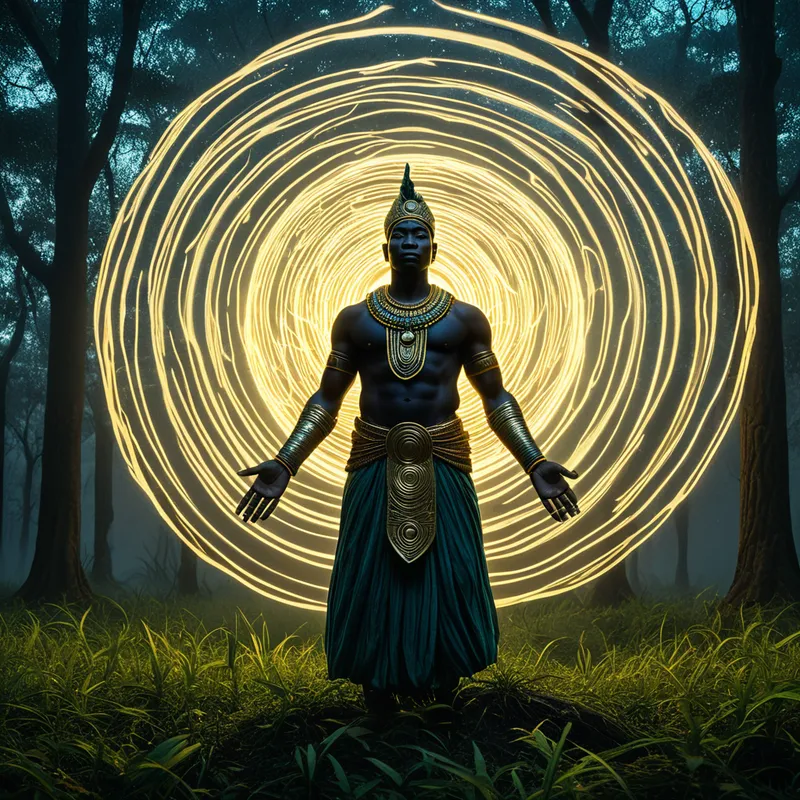
Listen. When the sun’s last ember drowns in the west and the world is painted in the indigo of not-day and not-night, a silence falls. It is not a peaceful silence. It is a held breath, a waiting. The birds cease their chatter. The wind itself lies still. In this pregnant hush, a sound begins. It starts as a distant murmur, a deep-throated hum that seems to rise not from the earth but from beneath it, from the very bones of the world. It is the voice of Oro.
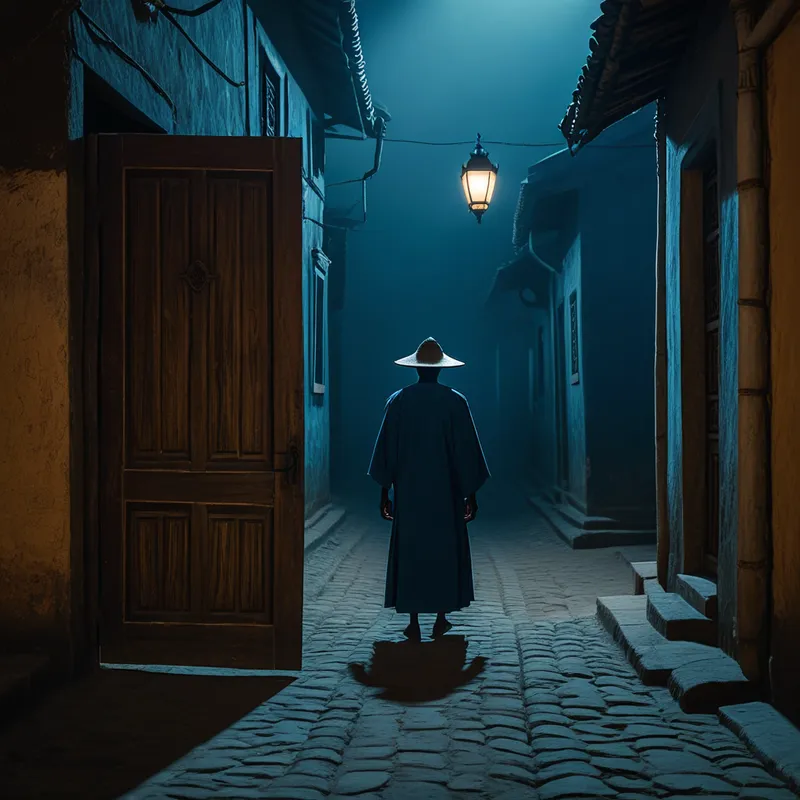
He does not walk as men walk. He is the whirlwind given purpose, a coalescence of shadow and sound. His voice is the bullroarer—the igba oro—spun through the air, a resonant drone that vibrates in the chest, in the teeth, a sound that speaks of ancient law and unyielding judgment. When Oro descends, the town belongs to him and to the fathers who came before. Every door is shut tight. Every shutter is fastened. No firelight may leak into the street. No woman may set eyes upon his form, for his mystery is the province of the initiated men, the Oro Society.
On this night, the hum is not merely ceremonial. A great wrong festers in the community. A betrayal of trust, a crime that has poisoned the well of fellowship. The elders have deliberated in the sacred grove, and the verdict has been given to the wind. Oro has come to execute it.
Through the empty streets he moves, a terrifying presence felt more than seen. The hum grows to a roar, shaking the thatch of roofs, speaking directly to the spirit. To the guilty, the sound is a needle in the soul, pulling at the threads of their concealment. To the righteous, it is the terrible, comforting sound of order being restored, of a balance too long tilted being set right.
They say you can hear the moment he finds his target. The omnipresent hum focuses into a singular, piercing note outside one particular compound. There is no door that can bar him. No plea he will hear. His justice is swift, final, and cleansing. It is not cruelty; it is the surgery of the community soul, the removal of a malignancy so the whole may live.
As the first hint of dawn bleeds into the sky, the sound begins to recede. It withdraws, fading back into the earth, back into the realm of the ancestors. The silence that returns is different now. It is the silence of exhaustion, of release, of a deep and collective breath finally exhaled. The air itself feels washed. Order, however harsh its coming, has been restored. The sun rises on a town that has been judged, and in its light, life continues, humbled and whole.
Cultural Origins & Context
The myth and ritual of the Oro Society are deeply embedded in the fabric of traditional Yoruba social and spiritual life, primarily among subgroups like the Egba and Ijebu. It represents one of the most powerful expressions of ancestral authority and communal justice. The Oro was not merely a story; it was a living, breathing institution. Its “myth” was performed, its truth enacted.
The custodians of this tradition were the initiated men of the Oro Society, a secretive and influential body that functioned as a judicial and executive arm. The ritual’s performance—the sounding of the bullroarer, the curfew, the exclusion of women—was a periodic reaffirmation of social and cosmic order. It served multiple functions: as a means of executing capital punishment for severe crimes like witchcraft or murder, as a mechanism for enforcing taboos and laws, and as an annual festival to honor the ancestors and cleanse the community.
The myth was passed down not through public storytelling but through initiation and participation. To be initiated was to learn the secrets of Oro’s voice, to move from one who hears the terror to one who understands (and wields) its necessity. This created a profound psychological boundary within the society, separating the uninitiated (women and children) who experienced the myth as an external, divine force, from the initiated men who were its agents. The myth thus reinforced social structures while providing a terrifyingly effective system for maintaining order and resolving deep communal conflicts.
Symbolic Architecture
At its core, the Oro myth is a profound [drama](/symbols/drama “Symbol: Drama signifies narratives, emotional expression, and the exploration of human experiences.”/) of the Logos in its most raw and judicial form. Oro is not a god of creation or [fertility](/symbols/fertility “Symbol: Symbolizes creation, growth, and abundance, often representing new beginnings, potential, and life force.”/), but of [verdict](/symbols/verdict “Symbol: A formal judgment or decision, often legal or moral, representing closure, accountability, and societal evaluation.”/) and consequence. He symbolizes the inescapable voice of conscience, the collective superego of the culture, and the terrifying [aspect](/symbols/aspect “Symbol: A distinct feature, quality, or perspective of something, often representing a partial view of a larger whole.”/) of the [Father](/symbols/father “Symbol: The father figure in dreams often symbolizes authority, protection, guidance, and the quest for approval or validation.”/) [archetype](/symbols/archetype “Symbol: A universal, primordial pattern or prototype in the collective unconscious that shapes human experience, behavior, and creative expression.”/) that severs and judges.
The voice that cleanses is the same voice that terrifies; true justice resides not in comfort, but in the resonant hum that shakes loose all falsehood.
The sacred [grove](/symbols/grove “Symbol: A grove symbolizes a sacred space of nature, tranquility, and introspection, often associated with spiritual growth and connection.”/) represents the unconscious, the place where judgments are formed away from the light of daily [life](/symbols/life “Symbol: The symbol of ‘Life’ represents a journey of growth, interconnectedness, and existential meaning, encompassing both the joys and challenges that define human experience.”/). The bullroarer’s sound is the manifestation of that unconscious [decision](/symbols/decision “Symbol: A decision in a dream reflects the choices one faces in waking life and can symbolize the pursuit of clarity and resolution.”/) into audible, unavoidable [reality](/symbols/reality “Symbol: Reality signifies the state of existence and perception, often reflecting one’s understanding of truth and life experiences.”/). The enforced seclusion of women and the uninitiated symbolizes the necessary boundaries around certain realms of [knowledge](/symbols/knowledge “Symbol: Knowledge symbolizes learning, understanding, and wisdom, embodying the acquisition of information and enlightenment.”/) and power—the [mystery](/symbols/mystery “Symbol: An enigmatic, unresolved element that invites curiosity and exploration, often representing the unknown or hidden aspects of existence.”/) that cannot be fully integrated into the conscious, communal sphere without losing its transformative, awe-full potency.
The [ritual](/symbols/ritual “Symbol: Rituals signify structured, meaningful actions carried out regularly, reflecting cultural beliefs and emotional needs.”/)’s nocturnal setting is crucial. It represents the “dark [night](/symbols/night “Symbol: Night often symbolizes the unconscious, mystery, and the unknown, representing the realm of dreams and intuition.”/) of the [soul](/symbols/soul “Symbol: The soul represents the essence of a person, encompassing their spirit, identity, and connection to the universe.”/)” of the [community](/symbols/community “Symbol: Community in dreams symbolizes connection, support, and the need for belonging.”/), the necessary descent into [shadow](/symbols/shadow “Symbol: The ‘shadow’ embodies the unconscious, repressed aspects of the self and often represents fears or hidden emotions.”/) to confront what daylight civility has failed to resolve. Oro’s justice is a kind of sacred violence, a psychic [surgery](/symbols/surgery “Symbol: A dream symbol representing transformation, healing, or intervention, often tied to emotional or psychological processes needing attention or change.”/) that is traumatic but aimed at the [health](/symbols/health “Symbol: Health embodies well-being, vitality, and the balance between physical, mental, and spiritual states.”/) of the whole organism.
The Dreamer’s Resonance
When the pattern of the Oro myth stirs in the modern psyche, it often manifests in dreams of profound, impersonal judgment. One might dream of a deep, omnipresent hum or vibration that shakes the dream landscape, a sound that induces both dread and a strange sense of inevitability. The dreamer may find themselves hiding, compelled to stay indoors, or paralyzed as this sound seeks something out.
Somatically, this can feel like a tightening in the chest, a vibration in the bones—anxiety made archetypal. Psychologically, this dream signals that a long-ignored inner “crime” is being called to account. It is the psyche’s own justice system activating. Perhaps a pattern of self-betrayal, a buried guilt, or a toxic adaptation that has poisoned one’s inner community is now being confronted by a deeper, impersonal authority within—the Self in its judicial aspect. The dreamer is not the judge in this scenario; they are the town awaiting verdict. The process is one of being forced to listen to a truth too loud to ignore, a call to surrender a part of the ego that has grown corrupt.
Alchemical Translation
For the individual on the path of individuation, the Oro myth models the critical, often feared stage of discrimination and sacrifice. This is the alchemical separatio and mortificatio. We build an ego-structure, a “town” of our personality. Over time, elements within it—habitual lies, inflated self-images, destructive complexes—can become entrenched, poisoning our inner well.
The conscious ego, like the daytime town, often cannot or will not evict these tenants. Then, from the deeper Self (the ancestral council in the sacred grove), a verdict is reached. The Oro—the voice of the Self’s own ruthless integrity—descends. In psychological terms, this is the eruption of a depression, a crisis, a sudden and devastating insight that shatters a long-held self-concept. It is terrifying. It feels like an attack from the universe.
The alchemical fire does not ask if the ore is ready to be purified; it simply burns away all that is not gold.
Yet this process is not destruction for its own sake. It is the restoration of inner order. The “guilty” element—the persistent cowardice, the consuming pride, the festering resentment—is identified and excised. The ritual demands seclusion (introversion) and silence (cessation of the ego’s chatter) so this sacred, terrible work can be done. The dawn that follows is the albedo, the washing white. It is the clarity and peace that comes after a necessary, painful truth has been faced and integrated. The individual emerges not unscathed, but reconfigured—their inner community cleansed, their personal law restored to align with a deeper, more authentic destiny.
Associated Symbols
Explore related symbols from the CaleaDream lexicon:
- Ritual — The structured, sacred performance of the Oro myth, transforming abstract law into tangible, awe-inspiring reality that cleanses the communal body.
- Shadow — Oro represents the terrifying, judicial aspect of the collective shadow, the necessary force that enforces boundaries and eliminates psychic poison.
- Justice — The core purpose of Oro’s descent; an impersonal, ancestral law that restores balance through a verdict that is final and transformative.
- Father — Oro embodies the archetypal Father principle in its aspect of authority, law, judgment, and the establishment of conscious order.
- Fear — The primal, somatic response to Oro’s voice, representing the necessary terror that precedes a profound psychological reordering.
- Order — The ultimate goal of the ritual; the cosmic and social harmony restored through the traumatic but precise application of ancestral law.
- Sacrifice — The ritual entails the sacrifice of the individual transgressor for the health of the whole, mirroring the psyche’s sacrifice of a complex for the sake of wholeness.
- Voice — Manifested through the bullroarer’s hum, it is the inescapable, non-verbal announcement of a truth that comes from a realm beyond ordinary speech.
- Death — The literal and symbolic outcome for the target of Oro, representing the necessary end of a corrupted pattern so new life can flow for the community.
- Spirit — Oro is a powerful ancestral spirit, a manifestation of collective will and wisdom acting as an executive force in the material world.
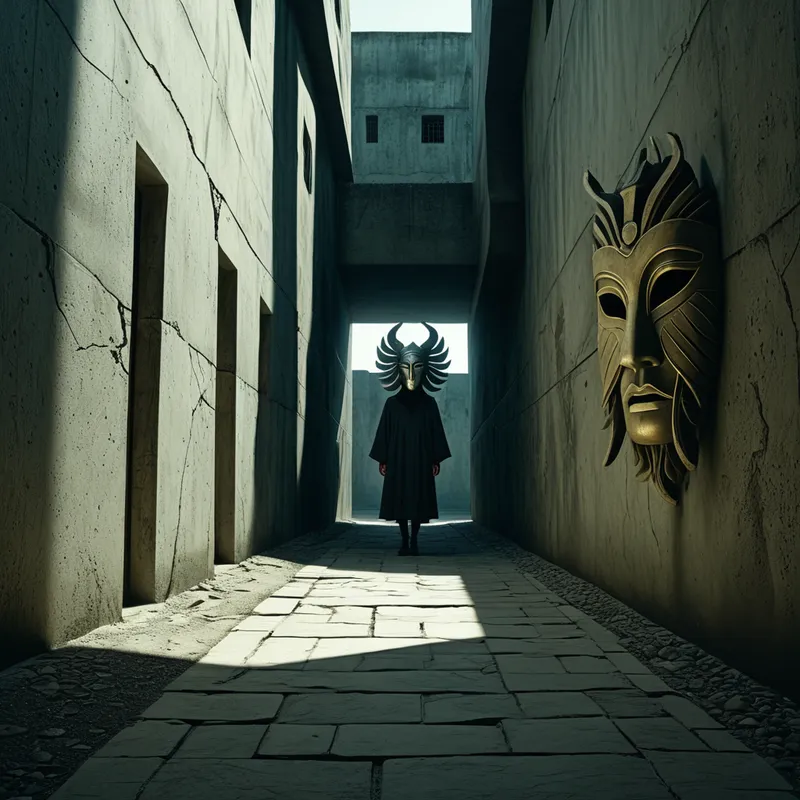
- Ritual Mask — The unseen, terrifying “face” of Oro, representing the impersonal nature of true justice, which is not about personality but principle.
- Ritual Drum — Symbolized by the bullroarer, it is the instrument that calls forth the sacred time and space, its sound being the very body of the law.