Orion's Dog Myth Meaning & Symbolism
The tale of the faithful hound placed among the stars, forever chasing its master across the heavens, a symbol of unwavering loyalty and cosmic grief.
The Tale of Orion’s Dog
Listen, and let the night sky tell its oldest story. It begins not with a god, but with a man—a giant of a man, born from the hide of a bull and the blessing, or perhaps the curse, of three gods. His name was [Orion](/myths/orion “Myth from Greek culture.”/). He walked [the earth](/myths/the-earth “Myth from Hindu culture.”/) with a stride that shook the mountains, and his laughter boomed like thunder. But for all his strength, his heart held a loneliness as vast as the wilds he roamed.
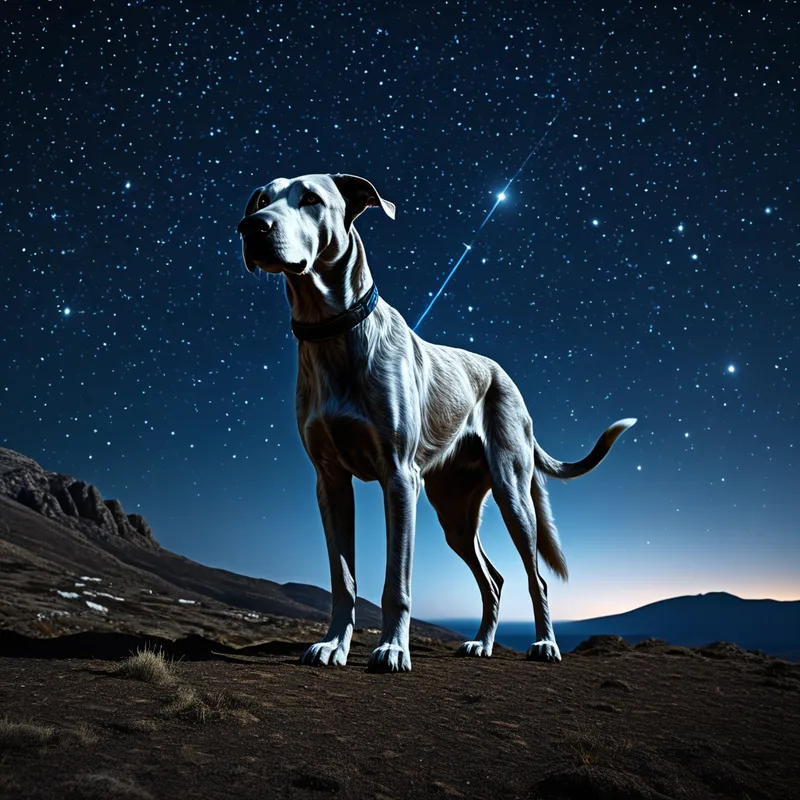
Into that loneliness came a companion. Not a fellow hunter, nor a lover, but a hound. He was no ordinary dog. Some say [Hephaestus](/myths/hephaestus “Myth from Global/Universal culture.”/) forged him from living bronze and breath. Others whisper he was a gift from Artemis herself, a pup from her own sacred pack. He was named Sirius, or simply, the Dog. His coat was the color of a storm cloud, his eyes held the keen intelligence of the predator, and his loyalty was as unshakable as the earth.
Together, they were a symphony of pursuit. Orion’s mighty frame would crash through the undergrowth, and Sirius would flow beside him like a silent, grey shadow. They spoke a language without words—a glance, a pointed ear, a shared stillness before the strike. The Dog was his scout, his guardian, the other half of his wild soul. Under the cold light of [the moon](/myths/the-moon “Myth from Tarot culture.”/), they hunted, and for a time, the giant’s loneliness was kept at bay.
But [the Fates](/myths/the-fates “Myth from Greek culture.”/) weave dark threads. Orion’s boast that he would hunt every beast on earth drew the ire of Gaia. Or perhaps it was his fateful encounter with Artemis, a bond that sparked a divine jealousy. The stories diverge, but the end is the same. Whether by the sting of a giant scorpion sent from the earth, or by a trick of the gods, Orion fell. The great hunter, who feared nothing in the forest, was laid low.
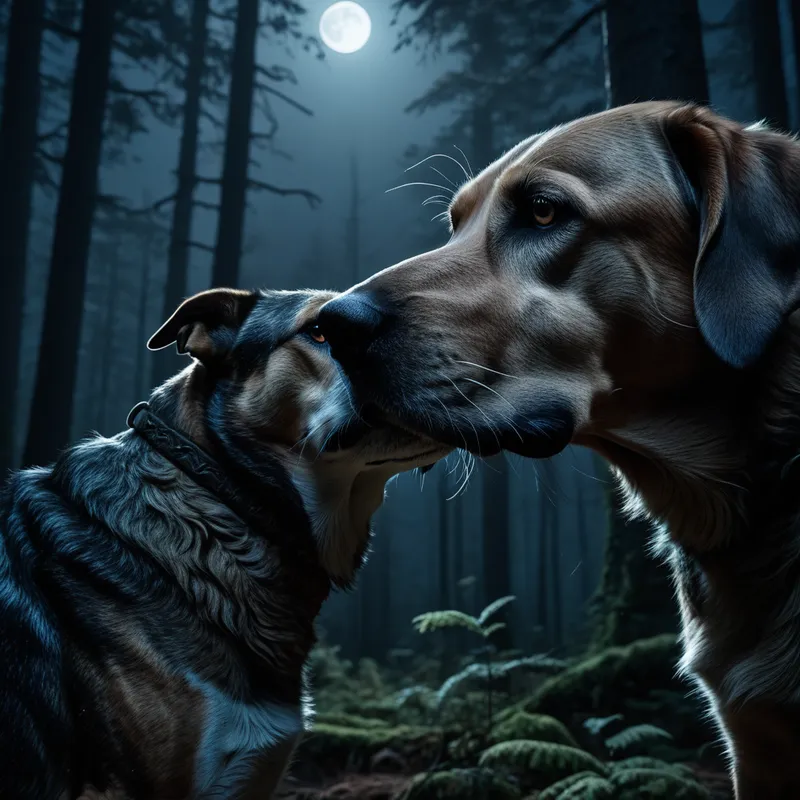
And here, the tale turns from the hero to the hound. As Orion’s life bled into the soil, Sirius did not flee. He did not howl in panic. He stood vigil. He nuzzled the cold hand, whined a low, broken sound that held all the grief of the animal world, and refused to leave his master’s side. He would not eat. He would not drink. He simply lay his great head upon Orion’s chest and waited, his bright eyes growing dim.
The gods, who are so often cruel, were for once moved by a fidelity purer than any oath sworn on the Styx. Zeus looked upon the tragic pair—the fallen giant and his faithful, dying companion—and took pity. Or perhaps, in his divine calculus, he saw a lesson worth preserving for all eternity. With a gesture, he gathered them up. He placed Orion among the stars, his belt a glittering marker in the winter sky. And right at his heels, forever chasing [the horizon](/myths/the-horizon “Myth from Various culture.”/) he can never reach, Zeus set the Dog.
So, on the clearest winter night, look up. See [the hunter](/myths/the-hunter “Myth from African culture.”/), frozen in his eternal stride. And just behind him, blazing with a fierce, blue-white light, you will see Sirius—Orion’s Dog. He runs still, a celestial ghost, his loyalty translated into starlight, his grief into the brightest flame in the heavens.
Cultural Origins & Context
The myth of Orion’s Dog is not a single, codified epic, but a narrative constellation itself, its pieces scattered across the works of poets like Hesiod and the later star-myth compilations of pseudo-Eratosthenes. It functioned as an aition—a story explaining the origin of a natural phenomenon, in this case, the prominent constellations of Orion and Canis Major.
For the ancient Greeks, the night sky was not random; it was a divine tapestry illustrating their myths and governing their lives. The heliacal rising of Sirius just before dawn in late summer coincided with the hottest, most difficult days of the year, often called the “Dog Days.” This period was associated with drought, fever, and madness. Thus, the myth of the Dog in [the sky](/myths/the-sky “Myth from Persian culture.”/) was not just a pretty story; it was a cosmological anchor. It explained a tangible, annual environmental challenge by linking it to the eternal, poignant drama overhead. The Dog’s fierce light in the sky was a reminder of its potent, double-edged nature: a symbol of loyal companionship, but also a bringer of scorching heat.
Symbolic Architecture
At its [heart](/symbols/heart “Symbol: The heart symbolizes love, emotion, and the core of one’s existence, representing deep connections with others and self.”/), this is a myth of the bond that transcends [the self](/myths/the-self “Myth from Jungian culture.”/). Orion, the archetypal [Hero](/symbols/hero “Symbol: A hero embodies strength, courage, and the ability to overcome significant challenges.”/), is incomplete. His brute [strength](/symbols/strength “Symbol: ‘Strength’ symbolizes resilience, courage, and the ability to overcome challenges.”/) and solitary [pursuit](/symbols/pursuit “Symbol: A chase or being chased in dreams often reflects unresolved anxieties, unfulfilled desires, or internal conflicts demanding attention.”/) are not enough. The Dog represents the instinctual, faithful, and protective [aspect](/symbols/aspect “Symbol: A distinct feature, quality, or perspective of something, often representing a partial view of a larger whole.”/) of the [psyche](/myths/psyche “Myth from Greek culture.”/) that the conscious ego (the Hunter) must integrate to be whole.
The true companion is not an accessory to the self, but the missing part of its soul. The hunter is only complete when he is followed by his shadow, which is also his guide.
[Sirius](/symbols/sirius “Symbol: Sirius, the brightest star in the night sky, symbolizes guidance, clarity, and a beacon for those seeking direction.”/) is the animal daimon, the guiding [spirit](/symbols/spirit “Symbol: Spirit symbolizes the essence of life, vitality, and the spiritual journey of the individual.”/) in animal form. He is loyalty incarnate, but also wild intelligence. He does not obey blindly; he cooperates. He is the bridge between [human](/symbols/human “Symbol: The symbol of a human represents individuality, complexity of emotions, and social relationships.”/) [consciousness](/symbols/consciousness “Symbol: Consciousness represents the state of awareness and perception, encompassing thoughts, feelings, and experiences.”/) and the untamed, instinctual world. His [death](/symbols/death “Symbol: Symbolizes transformation, endings, and new beginnings; often associated with fear of the unknown.”/) from [grief](/symbols/grief “Symbol: A profound emotional response to loss, often manifesting as deep sorrow, yearning, and a sense of emptiness.”/) is not a failure, but the ultimate testament to this bond—it states that without the other, the self cannot, and will not, continue to exist in its old form.
The celestial [translation](/symbols/translation “Symbol: The process of converting meaning from one form or language to another, representing communication, adaptation, and the bridging of differences.”/) is the key. Their earthly [story](/symbols/story “Symbol: The symbol of ‘Story’ represents the narrative woven through our lives, embodying experiences, lessons, and emotions that shape our identities.”/) ends in tragedy and [dissolution](/symbols/dissolution “Symbol: The process of breaking down, dispersing, or losing form, often representing transformation, release, or the end of a state of being.”/), but the [cosmos](/symbols/cosmos “Symbol: The entire universe as an ordered, harmonious system, often representing the totality of existence, spiritual connection, and the unknown.”/) absorbs and transmutes it. The bond is not broken by death; it is eternalized, made into a permanent fixture of [reality](/symbols/reality “Symbol: Reality signifies the state of existence and perception, often reflecting one’s understanding of truth and life experiences.”/). The [chase](/symbols/chase “Symbol: Dreaming of a chase often symbolizes avoidance of anxiety or confrontation, manifesting as fleeing from something threatening or overwhelming in one’s waking life.”/) across the heavens is no longer a hunt for prey, but a sublime, endless dance of [connection](/symbols/connection “Symbol: Connection symbolizes relationships, communication, and bonds among individuals.”/).
The Dreamer’s Resonance
When the motif of Orion’s Dog appears in the modern dreamscape, it often signals a profound process of psychic realignment around the theme of loyalty and instinctual guidance. To dream of a faithful, powerful dog—especially one that is lost, mourning, or leading you through darkness—suggests the dreamer is grappling with a deep, perhaps neglected, part of their own nature.
Somatically, this may feel like a tug in the gut, a primal knowing, or a sense of being “dogged” by a truth you’ve tried to outrun. The dream dog might represent a neglected talent (your inner “hound” for a craft), a relationship of profound mutual trust that has been damaged, or your own body’s wisdom you have ignored. The grief of the Dog in the myth mirrors the dreamer’s own unconscious grief over a split within themselves—the part that is loyal to societal expectations versus the part loyal to its own wild, instinctual truth.
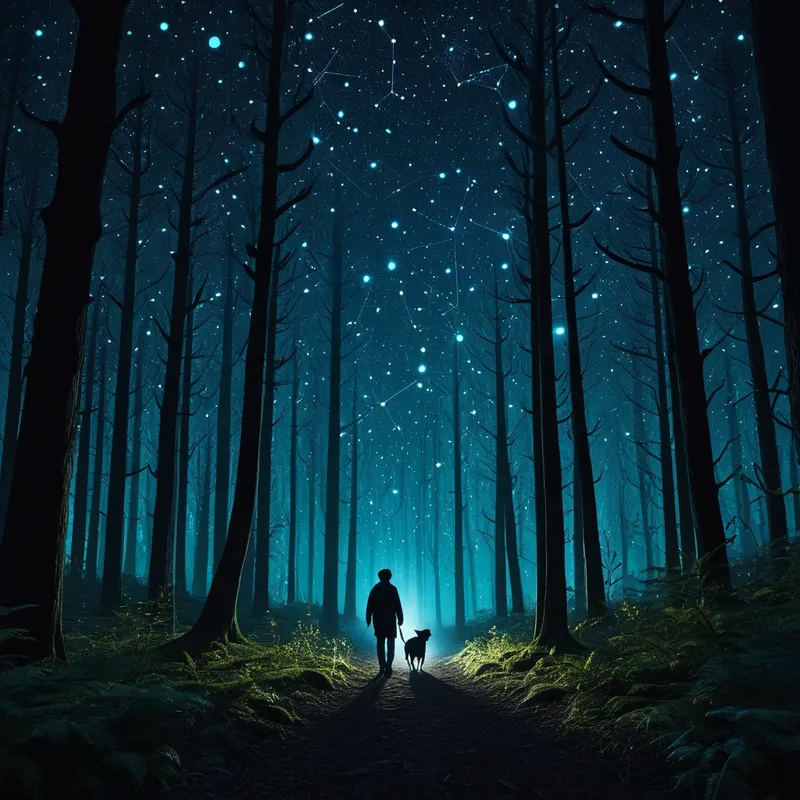
The celestial aspect of the dream—seeing stars form a dog, or the dream having a vast, night-sky quality—elevates the personal struggle to an archetypal one. It tells the dreamer: this is not a small problem. This is about the fundamental architecture of your soul and your place in the larger order of things. The process is one of re-membering: putting the fragmented self back together by honoring the loyal companion within.
Alchemical Translation
The alchemical journey modeled here is the coniunctio—[the sacred marriage](/myths/the-sacred-marriage “Myth from Various culture.”/)—not of opposites, but of the conscious self with its most faithful, instinctual counterpart. Orion (the striving ego) must unite with his Dog (the instinctual Self) to achieve wholeness. Their earthly demise is the [nigredo](/myths/nigredo “Myth from Alchemical culture.”/), the blackening, the necessary death of the old, separated way of being.
The psyche’s most profound transmutation begins when the ego stops hunting for external validation and turns to heed the loyal companion it has always had within.
The grieving vigil is the mortificatio, a period of dissolution and despair where the old identity crumbles. But Zeus’s act is the albedo and [rubedo](/myths/rubedo “Myth from Alchemical culture.”/)—the whitening and reddening—the sublimation. The raw, painful, earthly emotion (grief, loyalty) is not discarded; it is distilled and elevated into a permanent, guiding principle. The chase is eternalized.
For the modern individual, this translates to the process of individuation where one stops viewing their deep instincts, bodily wisdom, or “animal” nature as a servant or a beast to be controlled. Instead, one recognizes it as the most loyal ally. The “[triumph](/myths/triumph “Myth from Roman culture.”/)” is not a conquest, but a reconciliation. It is the moment you realize your deepest wounds (your griefs, your loneliness) and your most faithful strengths (your resilience, your gut instincts) are two aspects of the same, inseparable creature. To honor one is to honor the other. You place that bond at the center of your personal cosmos, making it the fixed star by which you navigate. You become, like the night sky, a vessel for an eternal, luminous story of connection.
Associated Symbols
Explore related symbols from the CaleaDream lexicon: