Orion Myth Meaning & Symbolism
A giant hunter, blinded and restored, whose pride and passion lead to his celestial fate, forever pursued by the scorpion and guarded by the dawn.
The Tale of Orion
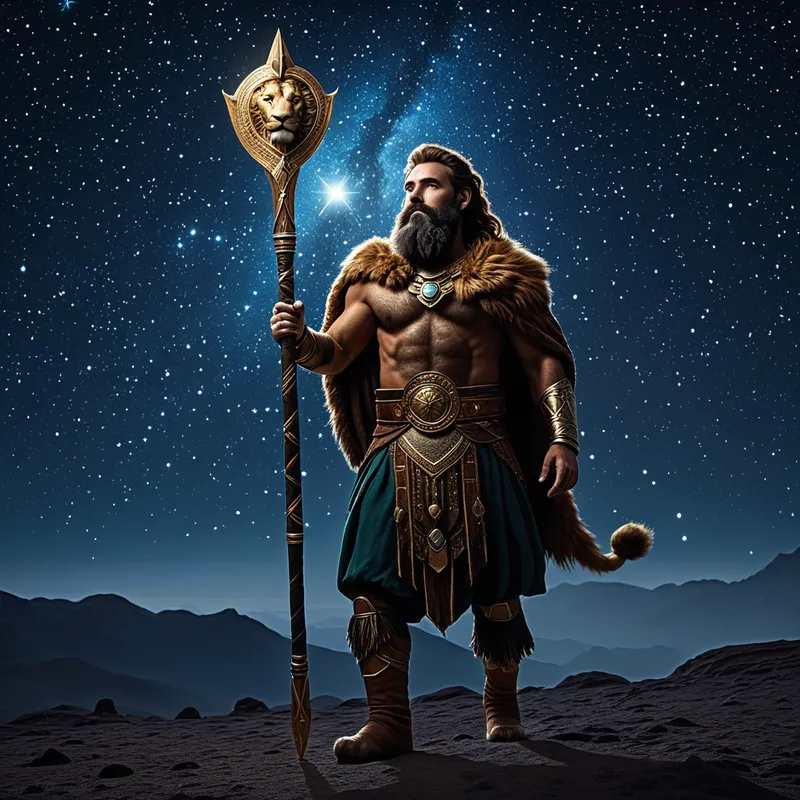
Hear now the story written in the night sky, a tale of fire and earth, of a man who became a legend, and a legend who became a constellation. It begins not with a birth, but with an act of the gods. From the hide of a great bull, or from the seed of Zeus, [Poseidon](/myths/poseidon “Myth from Greek culture.”/), and [Hades](/myths/hades “Myth from Greek culture.”/)—the stories whisper differently—came Orion. He was a giant among men, a hunter whose shoulders could bear the weight of [the world](/myths/the-world “Myth from Tarot culture.”/), whose stride could cross mountains. He walked the wild places of Boeotia and beyond, his companion a loyal hound, Sirius, whose breath was the scorching summer wind.
His pride was as vast as his form. He boasted to the goddess Artemis that he would hunt every beast on [the earth](/myths/the-earth “Myth from Hindu culture.”/) and leave none alive. The earth, personified as the goddess Gaia, heard this hubris and stirred in her deep, silent wrath. But before her vengeance, there was light. Orion, in his wanderings, came to the island of Chios. There, he served King Oenopion, clearing the island of fearsome beasts. For his labor, he desired the king’s daughter, Merope. In a night shadowed by wine and desire, he took what was not freely given. For this transgression, the king, with the aid of the god Dionysus, had the giant hunter blinded and cast out upon the shore.
Now the world was darkness. The great hunter who chased light and movement was trapped in a silent, black prison. Desperate, an oracle’s voice came to him on the salt air: seek the rising sun. And so Orion, the blinded titan, turned his face east. He journeyed, guided not by sight but by sound—the rhythmic, thunderous hammering of the Cyclopes at their forge in the volcanic isle of Lemnos. He lifted a young boy, Cedalion, onto his shoulders, and [the child](/myths/the-child “Myth from Alchemy culture.”/) became his eyes, directing him toward the dawn. They reached the edge of the world where Eos, the rosy-fingered dawn, fell in love with the broken giant. She carried him to her brother, [Helios](/myths/helios “Myth from Greek culture.”/), whose radiant gaze restored Orion’s sight.
Sight returned, but his fate was sealed. He returned to his old ways, hunting alongside Artemis, the goddess who valued skill above all. Some say a romance blossomed between the mortal hunter and [the immortal](/myths/the-immortal “Myth from Taoist culture.”/) virgin; others say it was pure, competitive fellowship. But her twin brother, Apollo, saw a threat. He could not bear the thought of his sister’s devotion turning to a mortal. Tricking Artemis, he pointed to a distant speck far out at sea—Orion, swimming—and challenged her archery. “Can you hit that?” he taunted. Without hesitation, the peerless huntress drew her bow and let fly a single, perfect arrow. It found its mark. The great hunter sank beneath the waves, slain by the one being he revered.
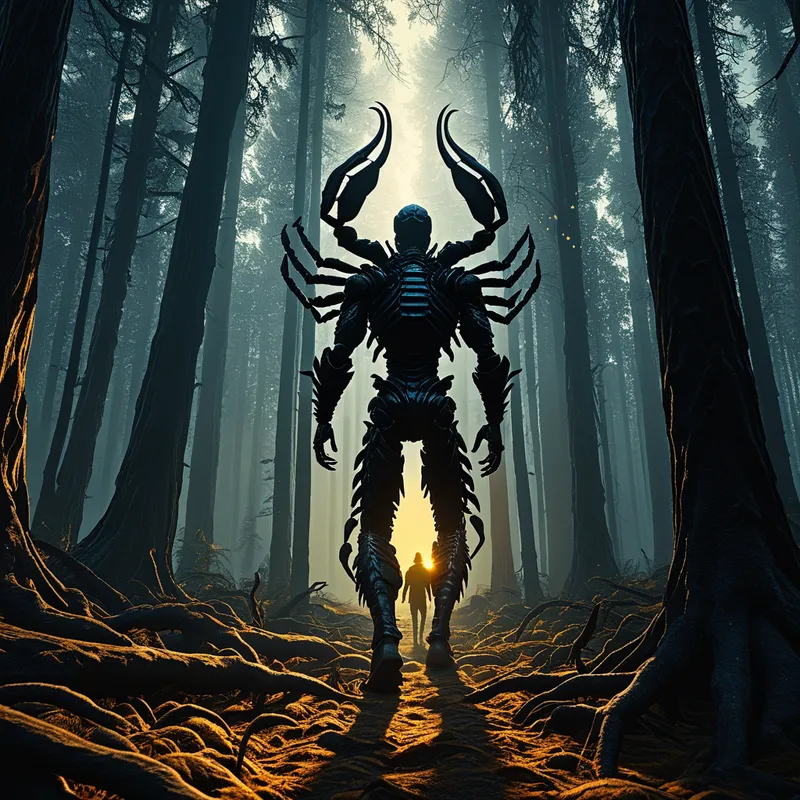
In her grief, Artemis placed him among the stars, his form forever etched in brilliant points of light. Yet Gaia’s wrath was not appeased. She sent a giant scorpion, its carapace black as [the void](/myths/the-void “Myth from Buddhist culture.”/) between stars, to forever chase [the hunter](/myths/the-hunter “Myth from African culture.”/) across the celestial dome. Thus, as Scorpius rises in the east, Orion flees, setting in the west, locked in an eternal, silent pursuit—a cosmic drama of crime, punishment, and remembrance written in fire for all time.

Cultural Origins & Context
The myth of Orion is a palimpsest, a story written and rewritten across centuries of Greek oral tradition. It lacks a single, canonical version in early sources like [Homer](/myths/homer “Myth from Greek culture.”/), who mentions him only as a constellation. His full narrative emerges from a tapestry of local Boeotian legends, later poetic fragments, and the synthesizing work of mythographers like Hesiod and the Bibliotheca. This variability speaks to its function: Orion was a paradeigma, a teaching story, used to explain natural phenomena. His constellation’s seasonal movements marked the agricultural and sailing calendars; his rise heralded stormy weather, and his flight from the scorpion explained the celestial dance. The myth served as an aiton (a cause-origin story) for the night sky itself, teaching that the cosmos is not random but a narrative of divine forces, human passions, and inevitable consequences.
Symbolic Architecture
Orion embodies the [archetype](/symbols/archetype “Symbol: A universal, primordial pattern or prototype in the collective unconscious that shapes human experience, behavior, and creative expression.”/) of the primal, embodied Self in its raw, unintegrated form. He is potency, desire, and [action](/symbols/action “Symbol: Action in dreams represents the drive for agency, motivation, and the ability to take control of situations in waking life.”/) untempered by [reflection](/symbols/reflection “Symbol: Reflection signifies self-examination, awareness, and the search for truth within oneself.”/) or [relationship](/symbols/relationship “Symbol: A representation of connections we have with others in our lives, often reflecting our emotional state.”/). His [blindness](/symbols/blindness “Symbol: Represents a lack of awareness, insight, or refusal to see truth, often tied to emotional avoidance or spiritual ignorance.”/) is not merely a [punishment](/symbols/punishment “Symbol: A dream symbol representing consequences for actions, often tied to guilt, societal rules, or internal moral conflicts.”/) but a profound symbolic necessity.
The hero must be blinded by his own light before he can learn to see by a different one.
His physical prowess represents the untamed libido and will-to-power. His hubris—the boast to kill all beasts—is [the ego](/myths/the-ego “Myth from Jungian culture.”/)’s [inflation](/symbols/inflation “Symbol: A dream symbol representing feelings of diminishing value, loss of control, or expansion beyond sustainable limits in one’s life or psyche.”/), the belief that the conscious self can conquer and consume the totality of [nature](/symbols/nature “Symbol: Nature symbolizes growth, connectivity, and the primal forces of existence.”/) (the unconscious, represented by Gaia). The blinding is the necessary humiliation, the dark [night](/symbols/night “Symbol: Night often symbolizes the unconscious, mystery, and the unknown, representing the realm of dreams and intuition.”/) of the [soul](/symbols/soul “Symbol: The soul represents the essence of a person, encompassing their spirit, identity, and connection to the universe.”/) where [the ego](/myths/the-ego “Myth from Jungian culture.”/)’s projects collapse. His [journey](/symbols/journey “Symbol: A journey in dreams typically signifies adventure, growth, or a significant life transition.”/) east, guided by a [child](/symbols/child “Symbol: The child symbolizes innocence, vulnerability, and potential growth, often representing the dreamer’s inner child or unresolved issues from childhood.”/) (Cedalion) toward the healing sun, is the journey toward [consciousness](/symbols/consciousness “Symbol: Consciousness represents the state of awareness and perception, encompassing thoughts, feelings, and experiences.”/)—not the brute consciousness of [sight](/symbols/sight “Symbol: Sight symbolizes perception, awareness, and insight, representing both physical and inner vision.”/), but the illuminated consciousness of [insight](/symbols/insight “Symbol: A sudden, deep understanding of a complex situation or truth, often arriving unexpectedly and illuminating hidden connections.”/), earned through [vulnerability](/symbols/vulnerability “Symbol: A state of emotional or physical exposure, often involving risk of harm, that reveals authentic self beneath protective layers.”/) and [guidance](/symbols/guidance “Symbol: The act of receiving or seeking direction, advice, or leadership in a dream, often representing a need for clarity, support, or a higher purpose on one’s life path.”/). His relationship with Artemis is the tantalizing possibility of marrying this raw potency (Orion) with disciplined, instinctual wisdom (Artemis). Apollo’s intervention represents [the principle](/symbols/the-principle “Symbol: A fundamental truth, law, or doctrine that serves as a foundation for a system of belief, behavior, or reasoning, often representing moral or ethical standards.”/) of [logos](/myths/logos “Myth from Christian culture.”/) and order that ultimately cannot tolerate such a [fusion](/symbols/fusion “Symbol: The merging of separate elements into a unified whole, often representing integration of self, relationships, or conflicting aspects of identity.”/) of mortal and divine, of unconscious power and conscious discipline, leading to a tragic, necessary [separation](/symbols/separation “Symbol: A spiritual or mythic division between realms, states of being, or consciousness, often marking a transition or loss of connection.”/).
The Dreamer’s Resonance
When the pattern of Orion stirs in the modern [psyche](/myths/psyche “Myth from Greek culture.”/), it often manifests in dreams of grandiose pursuit or profound disorientation. The dreamer may find themselves in a vast, dark landscape, tasked with an impossible hunt, or conversely, paralyzed, watching a magnificent but distant hunter-figure. The somatic signature is often in the shoulders and eyes—a feeling of carrying a great weight or a literal sense of visual obscurity or frustration.
Psychologically, this signals a confrontation with the “giant” aspect of [the Self](/myths/the-self “Myth from Jungian culture.”/)—the part that feels destined for greatness but is currently “blinded” by its own ambitions, outdated identities, or unintegrated shadow material (the Merope transgression). The dream is an expression of the psyche’s corrective process: it is orchestrating a necessary failure, a humbling, to dismantle an inflated ego-structure. The presence of a guiding child or a distant, healing light in the dream points to the nascent, intuitive self (the [puer aeternus](/myths/puer-aeternus “Myth from Roman culture.”/) or divine child) that can lead the blinded giant toward a new kind of vision, one based on internal guidance rather than external conquest.
Alchemical Translation
The myth of Orion is a precise alchemical map for the individuation process, specifically the stages of [nigredo](/myths/nigredo “Myth from Alchemical culture.”/) (blackening) and albedo (whitening). The hunter’s initial state is the [prima materia](/myths/prima-materia “Myth from Alchemical culture.”/): raw, unconscious potential brimming with energy but lacking integration. His boast is the inflation of the ego, which must be dissolved.
The scorpion’s sting is not death, but the catalyzing poison that initiates the transformation of leaden pride into golden awareness.
The blinding on Chios is the nigredo—the descent into the blackness of despair, guilt, and meaninglessness. This is not a mistake but the essential first step in the opus. The journey to the dawn, guided by the sound of the Cyclopes’ hammer (the rhythmic, shaping force of the unconscious) and the child (the emerging symbol of the true Self), is the beginning of the albedo. Helios’s restoration of sight is not a return to the old vision, but the granting of a new, solar consciousness—an awareness illuminated by the central, guiding principle of the Self.
His final fate—death by Artemis’s arrow and ascension to the stars—completes the transmutation. The mortal ego (Orion the man) is sacrificed by the very archetype of instinctual purity he sought to join. This death is not an end, but a sublimation. He becomes fixed in the celestial realm, a permanent symbol ([lapis philosophorum](/myths/lapis-philosophorum “Myth from Alchemical culture.”/)) in the psyche’s firmament. The eternal chase by the scorpion (Gaia’s creature, the embodied unconscious) ensures the process is never static. It models the lifelong individuation journey: the integrated Self (the constellation) is a stable pattern, but it exists in dynamic, eternal tension with the primal, chthonic forces from which it was forged, a reminder that wholeness includes acknowledging what forever pursues us.
Associated Symbols
Explore related symbols from the CaleaDream lexicon: