Ori and Personal Destiny Myth Meaning & Symbolism
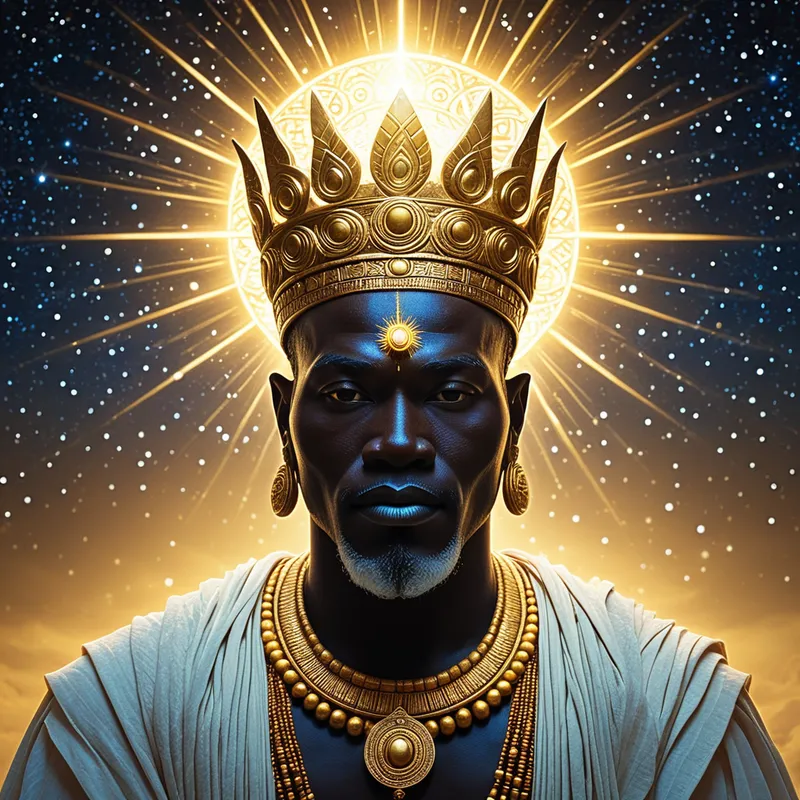
Before birth, each soul chooses their destiny and Ori, their inner head, before Olodumare, navigating life's trials with this divine compass.
The Tale of Ori and Personal Destiny
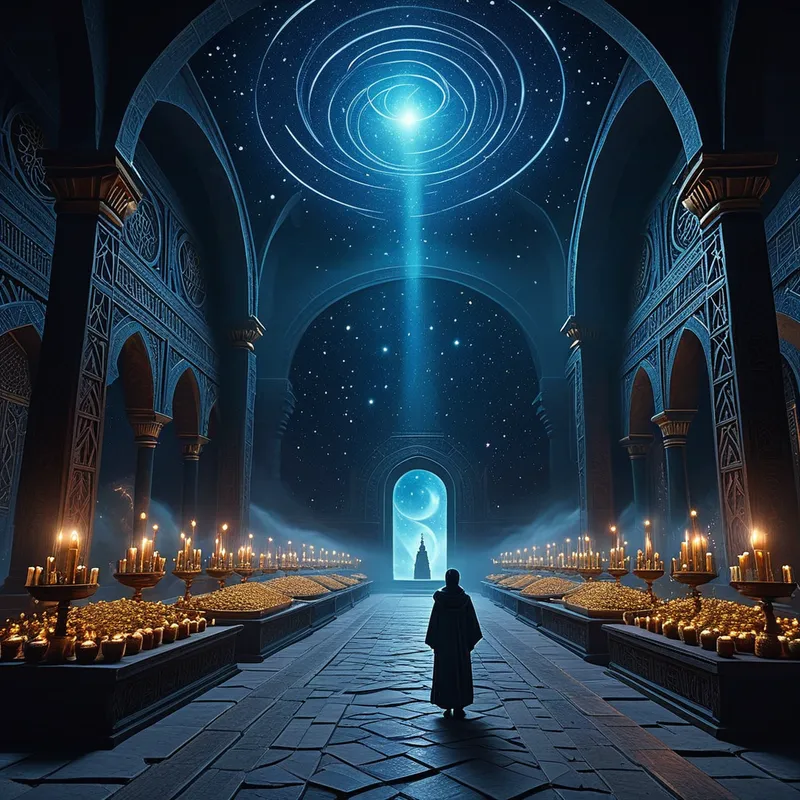
Before time was counted, in the realm of Orun, the air hummed with potential. Here, in the silence before being, the emi—the spark of life—awaited its great choosing. Before the mighty throne of [Olodumare](/myths/olodumare “Myth from Yoruba culture.”/), the source of all, stretched a marketplace unlike any other. It was not a place of goods, but of fates.
Each luminous emi floated, a consciousness without form, before the vast array of possibilities. Here lay the tools of a king, there the staff of a healer, yonder the anvil of a smith. Each object glimmered with the weight of a complete life—its joys, its sorrows, its triumphs, and its inevitable hardships. The air was thick with the whispered promises of glory and the silent acknowledgment of suffering to come. This was the choosing of ipin, one’s portion.
But to hold this destiny, to carry it into the world of Aye, the emi needed a vessel, a captain for the journey. And so, they proceeded to the hall of Ajala, the potter of heads. Ajala’s workshop was a cavern of clay and spirit, where countless Ori sat upon shelves, each unique. Some Ori shone with a steady, wise light; others flickered with passion or curiosity. Some were finely crafted, others seemingly rough-hewn.
The emi had to choose. In that moment of profound solitude, with only its own nascent awareness as guide, it selected the Ori that called to it. A bond was forged—an eternal pact between the soul and its inner head, the bearer of its chosen lot. With Ori as its guide and advocate, the emi knelt before Olodumare to receive final approval and the breath of life.
Then came the descent, the forgetting. Plunging into the river of birth, the emi, now housed within its physical body, forgot the celestial marketplace. It forgot the weight of its own choice. But Ori did not forget. Ori remembered the path, the chosen ipin. And so life in Aye began, a long journey of navigating thorns and finding flowers, with Ori as the inner compass whispering of the destiny chosen in the realm of light, a destiny now to be lived, and earned, in the world of earth and struggle.
Cultural Origins & Context
This myth forms a cornerstone of Yoruba cosmology, a people whose civilization flourished in what is now southwestern Nigeria and parts of Benin and Togo. It was not a story told merely for entertainment, but a fundamental theological and philosophical framework passed down through oral tradition by priests (Babalawo), elders, and griots. Its primary function was explanatory and ethical.
It answered the deepest human questions: Why is there suffering? Why do fortunes differ? The myth places the ultimate responsibility for one’s life circumstances not on a capricious god, but on the individual’s own pre-existent choice, mediated through their Ori. This fostered a culture of profound personal responsibility and resilience. One’s Ori could be consulted and appeased through ritual, sacrifice, and right action, making destiny (ayanmo) a collaborative venture between the individual and their spiritual essence, rather than a fixed, unchangeable script. The myth underpinned the practice of Ifa divination, which seeks to discern the will of one’s Ori and align one’s actions with one’s chosen ipin.
Symbolic Architecture
At its [heart](/symbols/heart “Symbol: The heart symbolizes love, emotion, and the core of one’s existence, representing deep connections with others and self.”/), the myth of Ori is a profound [allegory](/symbols/allegory “Symbol: A narrative device where characters, events, or settings represent abstract ideas or moral qualities, conveying deeper meanings through symbolic storytelling.”/) for the [paradox](/symbols/paradox “Symbol: A contradictory yet true concept that challenges logic and perception, often representing unresolved tensions or profound truths.”/) of [human](/symbols/human “Symbol: The symbol of a human represents individuality, complexity of emotions, and social relationships.”/) existence: the [tension](/symbols/tension “Symbol: A state of mental or emotional strain, often manifesting physically as tightness, pressure, or unease, signaling unresolved conflict or anticipation.”/) between [fate](/symbols/fate “Symbol: Fate represents the belief in predetermined outcomes, suggesting that some aspects of life are beyond human control.”/) and free will, between the given and the made.
Ori represents the divine spark of individuality—the god within. It is not the physical head, but the inner, spiritual self that contains the blueprint of one’s potential and the authority to navigate toward it.
The celestial marketplace of Orun symbolizes the field of pure potentiality, the [collective unconscious](/symbols/collective-unconscious “Symbol: The Collective Unconscious refers to the part of the unconscious mind shared among beings of the same species, embodying universal experiences and archetypes.”/) where all archetypal [life](/symbols/life “Symbol: The symbol of ‘Life’ represents a journey of growth, interconnectedness, and existential meaning, encompassing both the joys and challenges that define human experience.”/) patterns exist. The [choice](/symbols/choice “Symbol: The concept of choice often embodies decision-making, freedom, and the multitude of paths available in life.”/) of ipin is the [soul](/symbols/soul “Symbol: The soul represents the essence of a person, encompassing their spirit, identity, and connection to the universe.”/)‘s commitment to a specific set of challenges and gifts, a unique curriculum for spiritual development. Ajala, the potter, represents the formative forces—genetic, ancestral, and karmic—that shape the [vessel](/symbols/vessel “Symbol: A container or structure that holds, transports, or protects something essential, representing the self, emotions, or life journey.”/) of our [personality](/symbols/personality “Symbol: Personality in dreams often symbolizes the traits and characteristics of the dreamer, reflecting how they perceive themselves and how they believe they are perceived by others.”/), but the emi’s [choice](/symbols/choice “Symbol: The concept of choice often embodies decision-making, freedom, and the multitude of paths available in life.”/) signifies the ultimate autonomy of the [soul](/symbols/soul “Symbol: The soul represents the essence of a person, encompassing their spirit, identity, and connection to the universe.”/) in selecting its [vehicle](/symbols/vehicle “Symbol: Vehicles in dreams often symbolize the direction in life and the control one has over their journey, reflecting personal agency and decision-making.”/).
The final, critical element is the forgetting. This descent into [amnesia](/symbols/amnesia “Symbol: A dream symbol representing loss of memory, identity, or connection to one’s past, often linked to emotional trauma, avoidance, or transformation.”/) is necessary for the [journey](/symbols/journey “Symbol: A journey in dreams typically signifies adventure, growth, or a significant life transition.”/) to be authentic. If we remembered our [blueprint](/symbols/blueprint “Symbol: A blueprint represents the foundational plan or design for something, often symbolizing potential, structure, and the mapping of one’s inner self or future.”/), life would be a mere performance of a memorized [script](/symbols/script “Symbol: The symbol of ‘script’ indicates a narrative or roadmap for one’s life, representing the conscious and unconscious stories we tell ourselves.”/). The forgetting forces us to seek, to struggle, to remember through lived experience, making the realization of our ipin a hard-won [achievement](/symbols/achievement “Symbol: Symbolizes success, mastery, or reaching a goal, often reflecting personal validation, social recognition, or overcoming challenges.”/) rather than a passive inheritance.
The Dreamer’s Resonance
When this mythic pattern stirs in the modern psyche, it often manifests in dreams of profound choice at a crossroads, of being presented with a series of doors, tools, or masks. One may dream of shopping in a strange, infinite bazaar where every item feels laden with significance. The somatic sensation is often one of weighted gravity, of a deep, internal pressure to choose correctly.
Psychologically, this signals a critical juncture in the individuation process—a confrontation with one’s Shadow and potential. The dreamer is encountering their own “celestial marketplace,” the unconscious array of unlived lives and dormant potentials. The anxiety of the choice reflects the ego’s fear of committing to a singular path, of taking full responsibility for one’s destiny. These dreams ask: What ipin did I choose? And more importantly, what ipin will I choose now, with the consciousness I have?

Alchemical Translation
The alchemical process modeled by the Ori myth is the transmutation of unconscious destiny into conscious fate. The prima materia is the raw, forgotten ipin—the suffering, the talents, the patterns we are born into. The first stage (nigredo) is the suffering and confusion of life in Aye, the “forgetting,” where we feel victim to circumstances.
The work of individuation is the slow, often painful, recollection of one’s Ori. It is the process of moving from blaming the outer world for one’s lot to recognizing the inner author of one’s story.
Through introspection, therapy, creative work, and confronting life’s trials (the albedo and citrinitas), we begin to polish our inner head. We start to see our struggles not as random punishments, but as the specific curriculum we signed up for. The final stage (rubedo) is not the effortless achievement of the chosen destiny, but the full, conscious embrace of it. It is the moment when the individual can look at their life—the wounds and the wonders—and say, “This is mine. I chose this journey. And I cooperate with it.” The Ori, once a forgotten guardian, becomes the conscious seat of the Self, guiding the personality toward its authentic, pre-ordained, and yet freely realized, completion.
Associated Symbols
Explore related symbols from the CaleaDream lexicon:
- Destiny — The core theme of ipin or ayanmo, representing the unique life-pattern chosen before birth, which Ori is tasked to navigate and fulfill.
- Choice — The critical, pre-incarnate act in Orun where the emi selects its destiny and its Ori, representing the soul’s fundamental autonomy.
- Head — The direct physical counterpart to the spiritual Ori, symbolizing the seat of consciousness, personality, and the vessel for one’s destiny.
- Key — Ori itself functions as the inner key that unlocks the potential of one’s chosen destiny within the labyrinth of earthly life.
- Door — The moment of choice in the celestial marketplace, where each potential destiny is a door to a different complete life experience.
- Journey — The entire arc from Orun to Aye and back, representing the soul’s expedition through incarnation to realize its chosen ipin.
- Soul — The emi, the immortal spark that makes the primordial choice and partners with Ori for the duration of the earthly journey.
- God — Reflective of Olodumare, the supreme source who witnesses and approves the soul’s choice, representing the ultimate cosmic context for personal destiny.
- Fate — The intertwined concept of ayanmo, the portion one receives, which is shaped by both pre-birth choice and earthly action in partnership with Ori.
- Circle — The cyclical nature of the myth, from Orun to Aye and the potential return, symbolizing the completeness of the soul’s journey and the wholeness sought through fulfilling one’s destiny.
- Temple — The physical body and the conscious life, which become the sacred space where the chosen destiny, guarded by Ori, is enacted and realized.