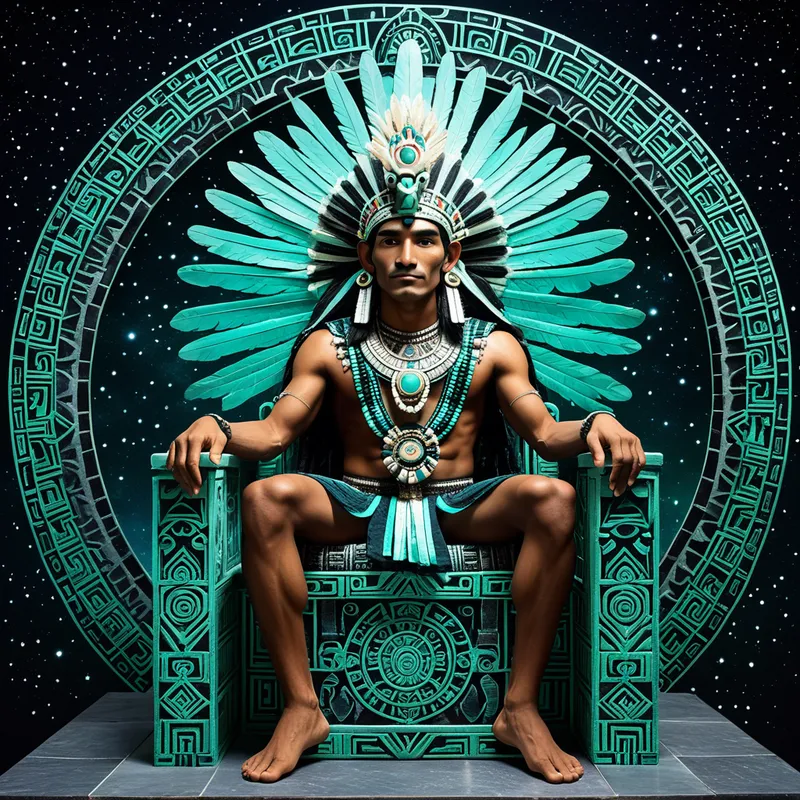
Ometecuhtli and Omecihuatl Myth Meaning & Symbolism
The story of the primordial dual-gendered deity, the source of all life and cosmic order, embodying the ultimate unity of opposites.
The Tale of Ometecuhtli and Omecihuatl
Before time had a name, before the sun learned to rise, there was only the great, silent breath of the void. It was not an empty void, but a pregnant one, a darkness thick with unspoken potential. In this place beyond places, in the highest heaven they called Omeyocan, the Place of Duality, a presence stirred.
It was not one presence, but two. And yet, it was not two, but one. From the eternal stillness emerged Ometecuhtli, the Lord of Duality. His essence was the principle of order, the structuring force, the father-thought that gives shape to chaos. And with him, inseparable, was Omecihuatl, the Lady of Duality. Her essence was the generative womb, the fertile darkness, the mother-dream that births all possibilities. They were not separate beings sitting side by side, but a single, profound unity—a divine androgyny, the original pair who were also the original whole.
They dwelled in a timeless chamber woven from starlight and silence. There was no conflict here, for conflict requires separation. There was only the perfect, dynamic equilibrium of complementary forces: light and shadow, heat and cold, sound and silence, masculine and feminine, all held in a single, conscious embrace. Their throne was not of stone or gold, but of this very equilibrium, a nexus of cosmic law.
From this still center, the first movement began. It was not an act of will, but an act of being. The unity of Ometecuhtli and Omecihuatl thought. And in that divine thought, the potential for all things trembled. The concept of “above” and “below” crystallized. The idea of the four cardinal directions was born from their mutual gaze. The seeds of time—past, present, and future—sprang from the rhythm of their shared breath.
Their creative act was not one of laborious building, but of effortless emanating. From their unified essence, the other great gods were dreamed into existence: the fierce Huitzilopochtli, the feathered serpent Quetzalcoatl, the dark lord of the underworld Mictlantecuhtli. Each carried a fragment of the original duality within them—a spark of order from the Lord, a ember of substance from the Lady. They did not send these gods forth with commands, but released them as a parent releases a child to find its own path, to enact the great drama of creation, preservation, and destruction in the realms below.
And so, Ometecuhtli and Omecihuatl remained in Omeyocan, the ultimate source, the unwavering foundation. While the world of the Fifth Sun raged with sacrifice and struggle, while gods fought and humans toiled, the primordial pair endured in their silent, generative unity. They were the cosmic parents who, having given birth to reality itself, now sustained it simply by continuing to be—the eternal, dual-gendered heart at the center of all that is, was, and ever could be.
Cultural Origins & Context
The myth of Ometecuhtli and Omecihuatl occupies a unique and somewhat elusive space in the tapestry of Mexica cosmology. Unlike the vivid, action-oriented stories of Huitzilopochtli or Quetzalcoatl, this was a philosophical and theological cornerstone, likely preserved and discussed by the tlamatinime (the wise men, the philosophers) and high priests. It was not a populist tale for the market square, but a foundational truth for the intellectual and spiritual elite, explaining the ultimate origin of a universe that was otherwise explained through a cycle of violent godly conflicts.
Their primary role was as the progenitors of the gods, residing in Omeyocan, the 13th and highest heaven. This placed them above the immediate fray of cosmic politics. They did not receive grand temples or widespread public worship with regular sacrifices; their nature was too abstract, too fundamentally remote. Instead, they were invoked in the deeper layers of ritual and creation mythology as the ultimate source. Every act of creation by a lesser god was, in essence, an extension of Ometecuhtli and Omecihuatl’s primordial generative power. This myth served to anchor the often-chaotic and blood-soaked Aztec cosmos in a principle of original, stable unity. It answered the profound question: “Before the gods who made our world, what was there?” The answer was not a single force, but a relational, complementary principle—Duality itself as the source of all.
Symbolic Architecture
At its core, this myth is a profound [symbol](/symbols/symbol “Symbol: A symbol can represent an idea, concept, or belief, serving as a powerful tool for communication and understanding.”/) of the coincidentia oppositorum—the coincidence of opposites. Ometecuhtli and Omecihuatl are not warring factions, but essential partners whose union is existence.
The first truth is not one, but two. And the deepest truth of two is that they are one.
Psychologically, they represent the primordial archetypes of the masculine and feminine principles in their pure, undifferentiated state within the [collective unconscious](/symbols/collective-unconscious “Symbol: The Collective Unconscious refers to the part of the unconscious mind shared among beings of the same species, embodying universal experiences and archetypes.”/). Ometecuhtli symbolizes the Logos principle: [structure](/symbols/structure “Symbol: Structure in dreams often symbolizes stability, organization, and the framework of one’s life, reflecting how one perceives their environment and personal life.”/), [differentiation](/symbols/differentiation “Symbol: The process of distinguishing or separating parts of the self, emotions, or identity from a whole, often marking a developmental or psychological milestone.”/), [consciousness](/symbols/consciousness “Symbol: Consciousness represents the state of awareness and perception, encompassing thoughts, feelings, and experiences.”/), and active ordering. Omecihuatl symbolizes the Eros principle: relatedness, nurturance, the unconscious, and generative potential. In their unified state in Omeyocan, they model a state of [psychic wholeness](/symbols/psychic-wholeness “Symbol: A state of complete integration between conscious and unconscious aspects of the psyche, representing spiritual unity and self-realization.”/) that precedes the [fragmentation](/symbols/fragmentation “Symbol: The experience of breaking apart, losing cohesion, or being separated into pieces. Often represents disintegration of self, relationships, or reality.”/) of the ego. They are the Self before the [birth](/symbols/birth “Symbol: Birth symbolizes new beginnings, transformation, and the potential for growth and development.”/) of the conscious “I.”
The World [Tree](/symbols/tree “Symbol: In dreams, the tree often symbolizes growth, stability, and the interconnectedness of life.”/) of Mesoamerican thought has its roots in this myth. The dual-gendered deity is the unseen seed from which the great [tree of life](/symbols/tree-of-life “Symbol: Embodies the interconnectedness of all living things and the cycle of life, death, and rebirth.”/), with all its branching conflicts and harmonies, grows. Their androgyny is not a negation of [gender](/symbols/gender “Symbol: Gender in arts and music represents the expression, performance, and cultural construction of identity through creative mediums.”/), but a transcendence of it, pointing to a state of being where all potentialities are contained and balanced.
The Dreamer’s Resonance
When this myth stirs in the modern psyche, it often manifests in dreams of profound reconciliation or searching for a lost center. One might dream of a room with two doors that are actually the same door, or of a parent figure who is both mother and father. The dream atmosphere is typically one of deep, silent peace or awe-inspiring, numinous mystery, not of action.
Somatically, this can correlate with a felt sense of inner alignment—a release of tension held from perpetually identifying with only one pole of an inner opposition (e.g., only logic and never intuition, only strength and never vulnerability). The dream is an expression of the Self’s intent to restore the original, inner “Place of Duality.” It signals a move away from inner civil war between competing aspects (the inner critic vs. the inner child, the masculine vs. the feminine within) toward a state where these opposites are seen as necessary and complementary forces of a single, greater personality.

Alchemical Translation
The journey of individuation, in its ultimate sense, is a return to Omeyocan. It is not a journey to become one-sided, but to consciously re-inhabit the unity that Ometecuhtli and Omecihuatl represent. The modern individual begins life in a state of unconscious wholeness (the primal unity), then experiences the necessary fragmentation of the ego (the descent into the world of the gods, of conflict and differentiation). The alchemical work is the opus contra naturam—the work against nature—which in this context means striving to regain that unified state consciously.
The goal is not to go back to the womb, but to carry the wisdom of the womb and the world in one integrated being.
This involves several transmutations: recognizing the shadow not as an enemy to be destroyed, but as the Omecihuatl to one’s conscious Ometecuhtli (or vice versa)—the complementary opposite that completes the self. It means holding the tension of opposites within (order/chaos, activity/receptivity) without rushing to prematurely resolve it in favor of one side. The “throne” one builds is not a position of dominance over others, but this hard-won internal equilibrium. To achieve this is to become, in a psychological sense, a “creator” in one’s own right: no longer merely reacting to life’s dualities, but emanating one’s existence from a centered, self-sustaining source, having integrated the Lord and Lady of Duality within.
Associated Symbols
Explore related symbols from the CaleaDream lexicon:
- God — The ultimate, abstract principle of divinity as a unified duality, representing the source of all archetypal patterns and cosmic order.
- Goddess — The generative, containing principle of divinity, representing the womb of all potential and the substance of creation.
- Sky — The realm of Omeyocan, the highest heaven of pure potential and cosmic law from which all else emanates.
- Earth — The manifested, material reality born from the union of the celestial principles, representing the realized potential of the divine duality.
- Circle — The symbol of wholeness, totality, and the seamless unity of Ometecuhtli and Omecihuatl, containing all opposites without conflict.
- Seed — The primordial, undifferentiated potential held within the dual-gendered deity, containing the blueprint for all of existence.
- Light — The active, ordering, masculine principle of consciousness and differentiation embodied by Ometecuhtli.
- Shadow — The receptive, generative, feminine principle of the unconscious and potentiality embodied by Omecihuatl, not as evil but as essential complement.
- Temple — The inner sanctum of Omeyocan itself, the archetypal model for a sacred space where opposites are held in harmonious balance.
- Order — The structuring, masculine principle that gives form and law to the cosmos, emanating from the Lord of Duality.
- Chaos — The fertile, feminine principle of unformed potential and creative possibility, emanating from the Lady of Duality.
- Aztec Sun Stone — The great cosmic diagram that manifests in time and space the eternal, balanced principles established by the primordial duality.