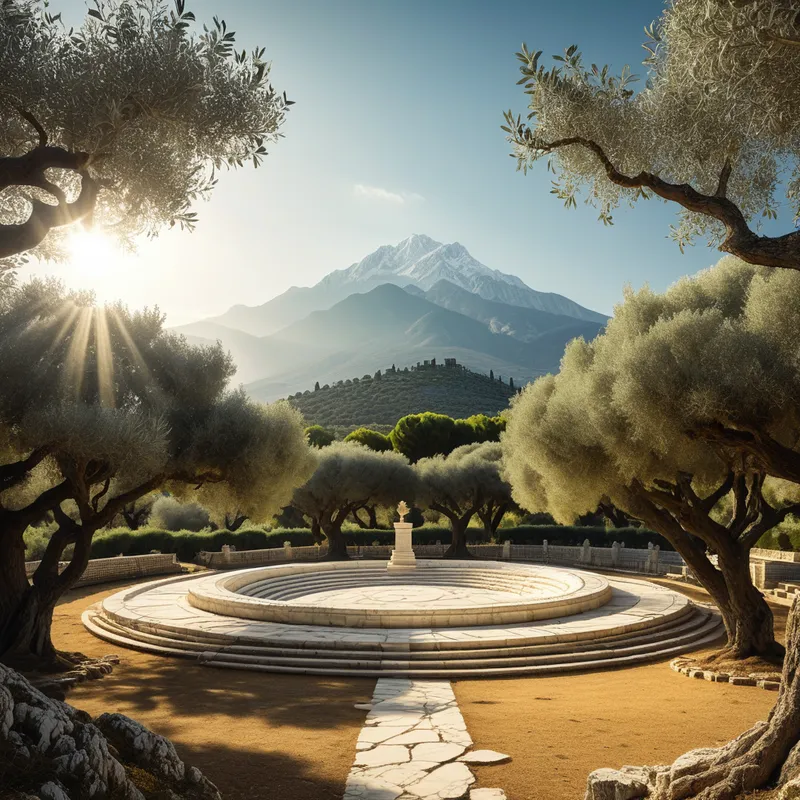
Olympia Stadium Myth Meaning & Symbolism
A mortal architect challenges the gods to build a stadium of impossible perfection, forging a sacred space where humanity meets the divine.
The Tale of Olympia Stadium
Hear now, you who seek the echo of the divine in the works of mortal hands. In the age when gods walked the earth in disguise and heroes were forged in fire, there lived a man named Daedalus. His mind was a labyrinth of angles and proportions, his hands capable of giving stone the grace of a living thing. Yet, a restless fire burned in his chest—a hunger not for fame, but for a perfection that would silence even the whispering winds.
The kings of Elis came to him, their faces etched with pious ambition. “Daedalus,” they said, “the great Zeus demands games in his honor. We need a stadium, a sacred temenos for the contest of bodies and wills. Build us not an arena, but a hymn in marble.”
Daedalus looked to the sky, to the distant, cloud-wreathed peak where the gods dwelled. A dangerous thought, a spark of hubris, took root. He would not merely build for the gods; he would build to them. A challenge. A stadium so perfect in its acoustics that a whisper at the starting line would be a roar at the finish. A track so flawlessly measured that a runner’s time would be a prayer counted in heartbeats. Seats carved so that every spectator, from king to commoner, would have a direct, unimpeded line of sight to the altar of Zeus at the center—a single, unifying axis between mortal gaze and divine flame.
For ten years, under a sun that blistered bronze and moons that silvered the limestone, he labored. He quarried Pentelic marble that held the dawn within it. He plotted lines with cords dipped in starlight and measured curves against the arc of the sun chariot. The stadium rose from the sacred plain of Olympia, not as a building imposed upon the land, but as the land itself given exalted form. The river Alpheus seemed to slow its flow to admire its reflection in the perfect stone.
But as the final cornerstone was to be set, a great stillness fell. The measuring rod, Daedalus’s own creation of polished ebony and gold, shattered in his hands. The perfect proportions he had calculated for the final, crucial curve—the turn of the track that would complete the sacred circuit—eluded him. Every calculation came up short or long by the width of a hair. The stadium was a sublime body awaiting its soul, and the soul was a geometry he could not grasp. Despair, cold as mountain snow, filled him. His challenge to the gods had been met, and he was found wanting.
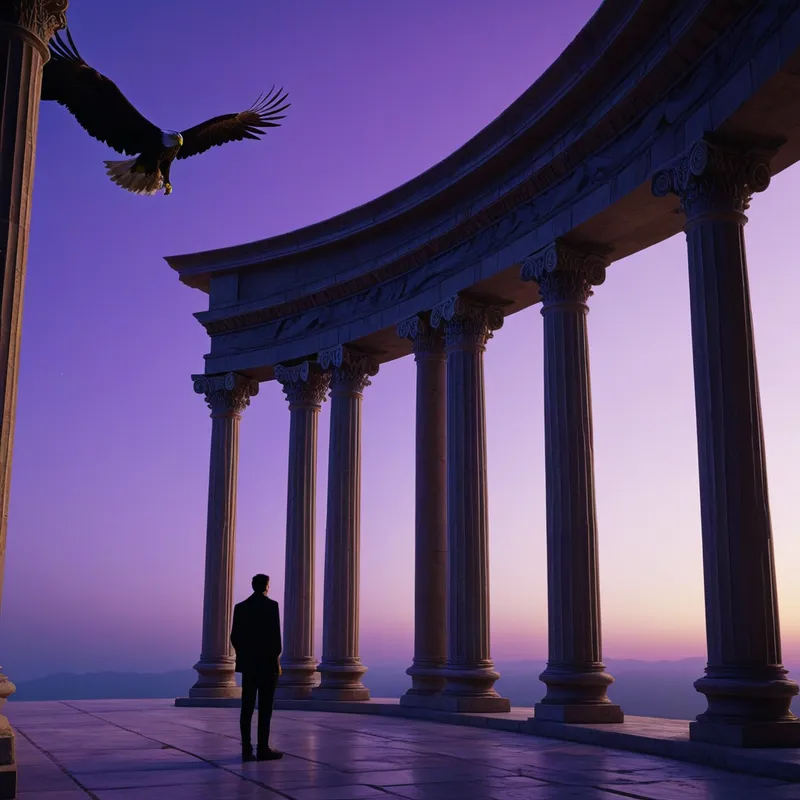
On the third night of his vigil, as he sat amidst the silent, accusing geometry of his unfinished masterpiece, a shadow greater than any mountain passed over the moon. The air grew heavy with the scent of ozone and eagle’s down. Before him landed not a bird, but the Eagle, the companion and emblem of Zeus himself. In its talons it held not a thunderbolt, but a new measuring rod, forged from a single beam of sunlight solidified. It dropped the rod at Daedalus’s feet. No voice spoke, but a knowledge entered the craftsman’s mind as clear as a struck bell: The final measure is not in the hand, but in the acceptance. Perfection belongs to the cosmos; order is the gift mortals may borrow.
With the divine rod, Daedalus laid the final curve. And as he did, the stadium breathed. The whisper traveled the track as a clear proclamation. The sightlines converged not just on the altar, but seemed to pull the very sky down to it. The Olympia Stadium was complete—not as a monument to one man’s genius, but as a covenant. A place where mortal striving, in its highest form, could touch the hem of the divine order.
Cultural Origins & Context
The myth of the Olympia Stadium is not found in a single epic like the Iliad, but was woven into the local lore of Elis and the sacred traditions surrounding the Olympic Games. It was a ktisis myth—a story of foundation—told by priests and heralds to pilgrims and athletes who gathered every four years for the Panhellenic games. Its function was multifaceted: to sanctify the physical space as divinely sanctioned, to explain the uncanny acoustics and perfect proportions that visitors marveled at, and to embed a crucial psychological warning within the celebration of human excellence.
The tale served as a societal check on the very ambition it celebrated. The Games were a temporary suspension of war, a realm where arete (excellence) was pursued with god-like intensity. The myth of Daedalus’s near-failure and divine intervention reminded all—the athlete straining for an impossible record, the city-state seeking glory—that ultimate perfection is the province of the gods. Human achievement finds its highest meaning and truest success not in surpassing the divine, but in aligning with the cosmic order (kosmos) it represents. The stadium, therefore, was a physical model of the universe: a bounded, ordered space where chaos (war, discord) was excluded, and a microcosm of harmonious competition could unfold under the eye of Zeus.
Symbolic Architecture
At its core, the stadium is a symbol of the individuation vessel. It is a defined, sacred boundary (the temenos) within the wilderness of the undifferentiated psyche. The track is the circuit of the self, the path one must run repeatedly, confronting one’s own limits and shadows on each turn.
The perfect curve that Daedalus could not calculate is the archetypal pattern of the Self, which the conscious ego cannot design alone.
Daedalus represents the brilliant, creative ego—the architect of one’s own life. His hubris is not evil, but necessary; it is the inflation that drives us to attempt greatness beyond our known limits. The shattered measuring rod is the inevitable failure of the ego’s tools when faced with the totality of the psyche. The Eagle of Zeus is the symbol of the transcendent function, the mediating archetype from the collective unconscious that brings the reconciling symbol (the sunbeam rod). It does not give the answer, but provides the means to embody it.
The altar of Zeus at the center, the focal point of all lines of sight, is the Self. Every aspect of the personality, every “seat” of consciousness, is oriented toward this central, numinous point. The games themselves symbolize the dynamic, often competitive, interaction of psychic forces (complexes, instincts) within the contained space of the individual’s awareness, all ultimately in service of offering one’s best effort (arete) to this central, ordering principle.
The Dreamer’s Resonance
To dream of Olympia Stadium is to dream of being in a profound process of self-measurement and re-orientation. The somatic feeling is often one of both awe and acute anxiety—the vast, empty space can feel exhilaratingly free or terrifyingly exposed.
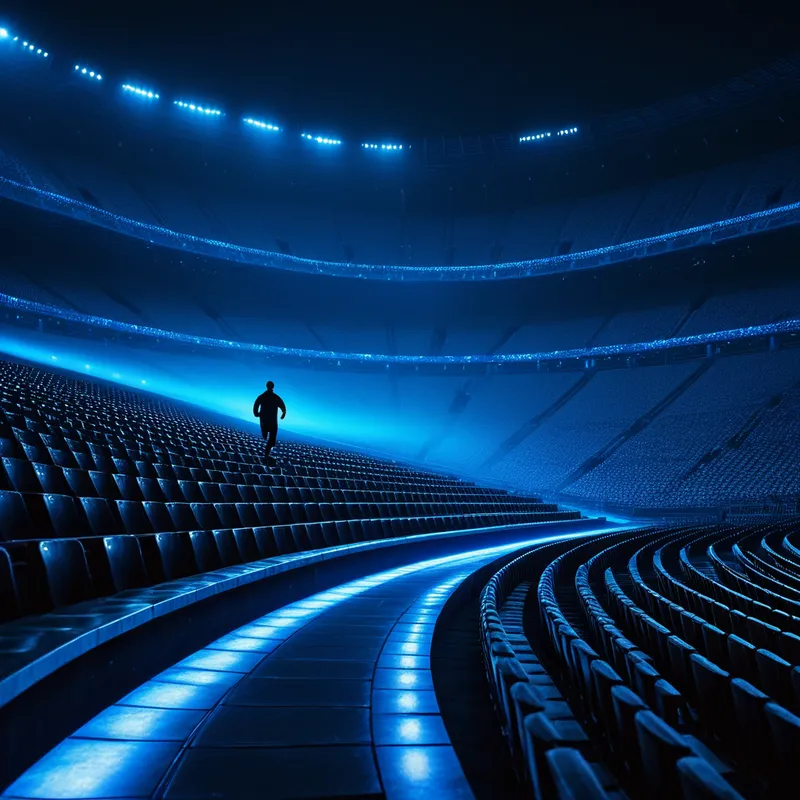
If one dreams of running the track, the psyche is working through a cycle of effort, perhaps feeling stuck in repetitive patterns (“running in circles”). The condition of the track—is it pristine, cracked, overgrown?—mirrors the dreamer’s sense of their own life path. The elusive “perfect turn” Daedalus sought often manifests as a dream obstacle: a hurdle that changes shape, a lane that disappears, or a finish line that recedes.
Dreaming of building or repairing the stadium signals a conscious effort at restructuring the ego or one’s life. The frustration of the dream-builder mirrors Daedalus’s despair, pointing to an aspect of the Self that the conscious mind cannot yet grasp or integrate. The appearance of a divine animal or guide (an eagle, a radiant stranger) suggests the unconscious is ready to offer the missing “measure,” if the dreamer can relinquish total conscious control.
Alchemical Translation
The myth models the alchemical opus perfectly. Daedalus’s initial ambition is the nigredo—the blackening, the burning, ambitious drive that isolates the material (his skill, the marble) from its natural state. The years of labor are the albedo, the endless washing and purifying through calculation and effort, striving for white, lunar purity of form.
The crisis of the shattered rod is the crucial mortificatio—the death of the ego’s tool, the realization that will and intellect alone are insufficient. This despair is not an end, but the necessary precondition for a divine intervention, which in alchemy is the influxus divinus.
The sunbeam measuring rod is the lapis philosophorum, the Philosopher’s Stone—not a thing, but a principle of measurement that aligns the mortal with the cosmic.
Receiving and using the rod is the rubedo, the reddening, where the divine “sun” principle is integrated. The completed stadium is the caelum (the heaven), the creation of a permanent, ordered psychic structure—a conscious personality now correctly aligned with the archetypal Self. The individual is no longer just a builder, but a steward of a sacred space within. The ongoing “Games” represent the continuous, dynamic life of the integrated psyche, where conflicts are not eliminated but are contained, ritualized, and transformed into displays of authentic living, offered up from the bounded, mortal self to the boundless, ordering mystery at its center.
Associated Symbols
Explore related symbols from the CaleaDream lexicon: