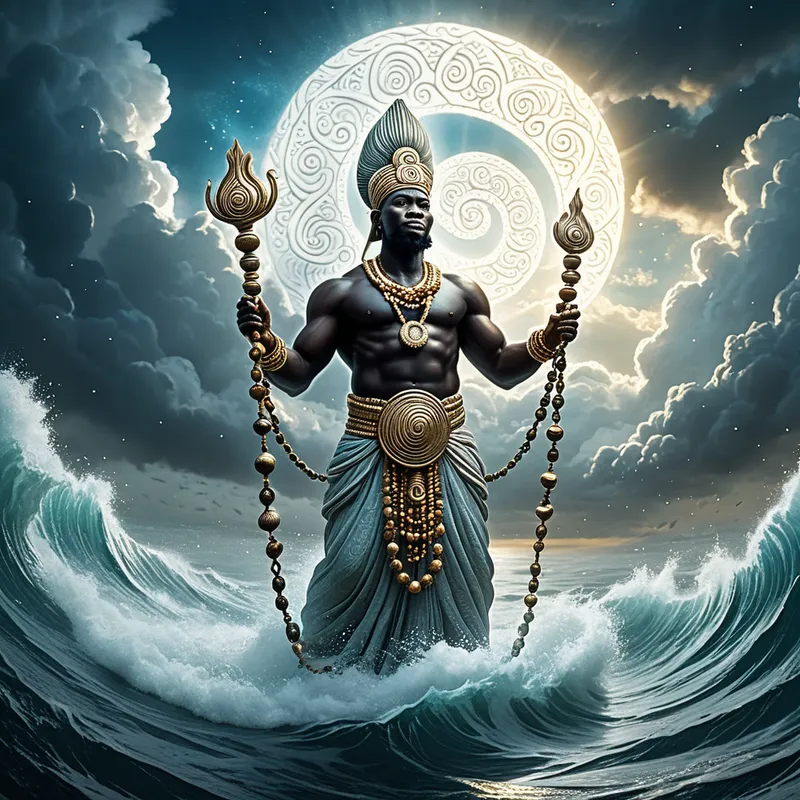
Olorun and the Creation of the Earth Myth Meaning & Symbolism
The story of how the supreme sky god Olorun, through divine delegation and sacrifice, brought forth solid earth from the primeval waters of chaos.
The Tale of Olorun and the Creation of the Earth
In the beginning, there was only the sky above and the waters below. The sky was the vast, infinite domain of Olorun, the Owner of the Sky, a presence of pure consciousness, light, and breath. Below him stretched Okun, the endless, roiling ocean of possibility, dark, deep, and without form.
And Olorun looked upon the watery chaos and conceived of solidity, of a place where life could take root. But the nature of the Supreme is to reign, not to toil in the mud of manifestation. So Olorun called a great council in the realm of Orun. Before the assembled Orisha, he declared his intention: an earth must be made below, a firmament to separate the waters and provide a home for beings yet unborn.
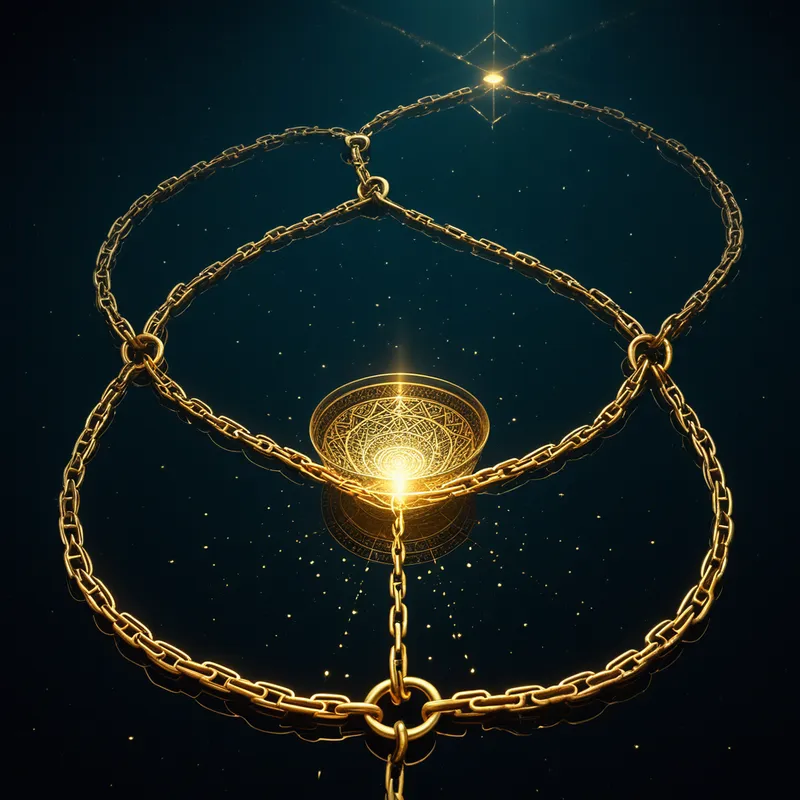
The task was given to Obatala, the King of the White Cloth, whose mind was clear and whose hands were wise. Olorun provided the tools of creation: a long, golden chain, a snail shell filled with loose, sacred earth, a five-toed hen, a palm nut, and a chameleon. The instructions were solemn: descend the chain, pour the earth upon the waters, and release the hen.
Obatala began the long climb down the golden links, from the brilliance of Orun into the deepening gloom above the primeval sea. For days he descended, the chain singing a faint, metallic hymn against the silence of the cosmos. Finally, he hung above the dark, ceaseless motion of Okun. Holding the snail shell aloft, he poured the earth in a wide arc. The brown grains scattered upon the waters… and simply floated.
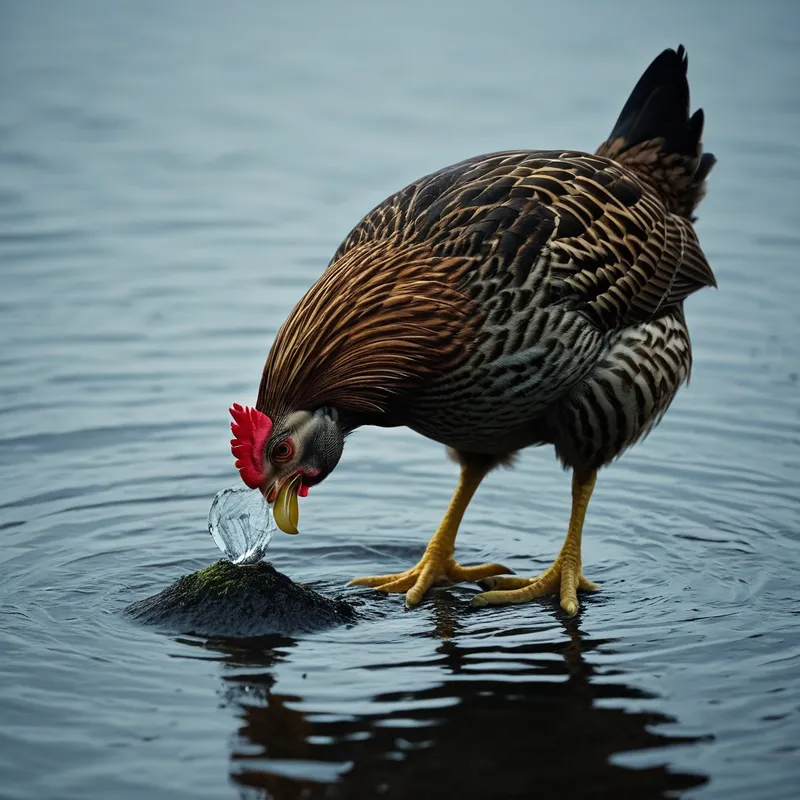
Then, he set the five-toed hen upon the scattered earth. The bird, driven by a divine instinct, began to scratch and scatter, to claw and spread. Where its feet touched, the loose earth multiplied and solidified, pushing back the waters, spreading wider and wider until a great expanse of dry land lay firm upon the deep. The chameleon was sent next, to test the solidity of this new earth. With careful, deliberate steps, it walked across the fresh soil, and finding it firm, it signaled back to Obatala.
The creator then descended onto the very earth he had facilitated. He planted the palm nut, which swiftly grew into a mighty tree, its roots anchoring the new world. Here, at the foot of this first tree, Obatala founded the sacred city of Ile-Ife, the place where the world spread wide. And from this earth, with Olorun’s breath of life, Obatala would later begin to mold the first human forms. But that is a story for another telling. The world was born not from a solitary act, but from a sacred delegation: the will of the sky meeting the work of the hand upon the face of the deep.
Cultural Origins & Context
This creation narrative is central to the spiritual and cosmological worldview of the Yoruba people of West Africa, primarily in present-day Nigeria, Benin, and Togo. It was not preserved in a single, canonical text but lived and breathed within the oral tradition, recited by Babalawo and Akpalo during rituals, festivals, and rites of passage. Its primary function was ontological—it explained the nature of reality, the relationship between the supreme deity (Olorun), the other deities (Orisha), humanity, and the world itself.
The myth established Ile-Ife as the cosmological navel, the point of origin for all Yoruba people and, by extension, all humanity. It reinforced a hierarchical yet interconnected cosmic order: Olorun as the ultimate, somewhat distant source of authority and life-force; Obatala as the divine executor and principle of conscious, careful creation; and the earth as a sacred trust, formed from divine materials and labor. This story was the foundational bedrock of identity, law, and kingship, as earthly rulers were seen as descendants of this primordial creative act.
Symbolic Architecture
The myth presents a profound blueprint of cosmic and psychological ordering. Olorun represents transcendent consciousness, the unmanifest potential, the “I Am” that precedes all action. He is the sky of the mind—vast, aware, but requiring a medium through which to realize its visions.
Creation is not a singular eruption from the void, but a sacred collaboration between the will of the heavens and the work of the hands.
Okun, the primal waters, symbolizes the unconscious—formless, teeming with potential, but also chaotic and without direction. The golden chain is the axis mundi, the connecting link between spirit and matter, intention and manifestation. Obatala embodies the conscious ego or the creative self, tasked with the difficult, perilous journey of bringing order from chaos. His tools are precise: the earth is substance, the hen is instinctual action (scratching, working, spreading), the chameleon is cautious testing, and the palm tree is the anchoring of life and growth. The creation of solid land is the birth of the conscious psyche—a stable ground of identity formed from the endless flux of unconscious material.
The Dreamer’s Resonance
When this mythic pattern stirs in the modern dreamer, it often signals a profound process of inner foundation-building. Dreams of being suspended above a vast, dark ocean may reflect a confrontation with the formless, chaotic depths of the personal or collective unconscious. The feeling is one of potential anxiety, of being untethered.
Dreams of finding or scattering soil on water, or of a bird or animal diligently working earth, point to the psyche’s innate drive to create structure. This is the somatic feeling of “getting a grip,” of finding purchase. It is the psychological process of integration—taking scattered thoughts, emotions, and experiences (the loose earth) and, through consistent, almost instinctual work (the hen’s scratching), forming them into a coherent worldview, a stable sense of self, or a tangible life project. The dream may manifest as constructing something in a void, or finally understanding a previously confusing situation. It is the ego (Obatala) successfully undertaking its divine mandate to create order, guided by a higher, transpersonal authority (Olorun).

Alchemical Translation
For the individual, this myth models the alchemical opus of individuation. The prima materia is the chaotic, watery state of an unexamined life or a psychic crisis (Nigredo). Olorun represents the Self, the central, organizing archetype of the total psyche, which issues a silent, compelling call toward wholeness.
The conscious personality must then undertake the descent (the golden chain), moving from familiar light into the unknown to engage with the shadowy, unstructured material within. This is the perilous journey of self-confrontation. The act of pouring the earth is the commitment to give form to this material—through art, journaling, therapy, or deep reflection. The hen’s scratching is the diligent, daily, often mundane work of analysis and integration (Albedo—the whitening, recalling Obatala’s association with white cloth and purity).
The solid earth of the soul is not discovered fully formed; it is patiently fashioned from the raw materials of chaos by the steadfast labor of consciousness.
The resulting firm land is the lapis philosophorum, the achieved personality—grounded, cohesive, and fertile, capable of sustaining the tree of life (the palm nut). The individual becomes their own Ile-Ife, a centered, authentic point from which their world meaningfully expands. The myth teaches that creation is a cooperative act between our highest potential (the sky) and our committed, conscious effort (the hand upon the waters).
Associated Symbols
Explore related symbols from the CaleaDream lexicon:
- Earth — The fundamental substance of manifestation, representing the solid ground of consciousness formed from the formless waters of the unconscious.
- Water — The primordial, chaotic ocean of Okun, symbolizing the unformed potential, the emotional and psychic depths of the unconscious mind.
- Sky — The domain of Olorun, representing transcendent consciousness, divine authority, and the source of all life-giving breath and inspiration.
- Chain — The golden chain of descent, symbolizing the sacred connection between spirit and matter, the divine will and its earthly execution.
- Bird — The five-toed hen whose instinctual scratching solidifies the earth, representing diligent, necessary action that transforms potential into reality.
- Tree — The first palm tree planted by Obatala, symbolizing life, growth, stability, and the anchoring of the created world in a sacred center.
- God — Olorun as the supreme, transcendent source whose will initiates the creative process, representing the archetype of the ultimate origin.
- Creation — The core act of the myth, modeling the psychological process of bringing order, form, and conscious structure from inner chaos.
- Order — The ultimate goal of the creative act, the establishment of a stable, habitable world from watery chaos, reflecting the psyche’s need for structure.
- Seed — The palm nut carried by Obatala, representing latent potential, the origin point of growth, and the promise of future life within the new creation.
- Mountain — Symbolic of the first solid land rising from the waters, representing achievement, stability, and a sacred meeting point between heaven and earth.
- Spirit — The divine breath and consciousness of Olorun that animates the entire process, representing the non-material force that guides and empowers creation.