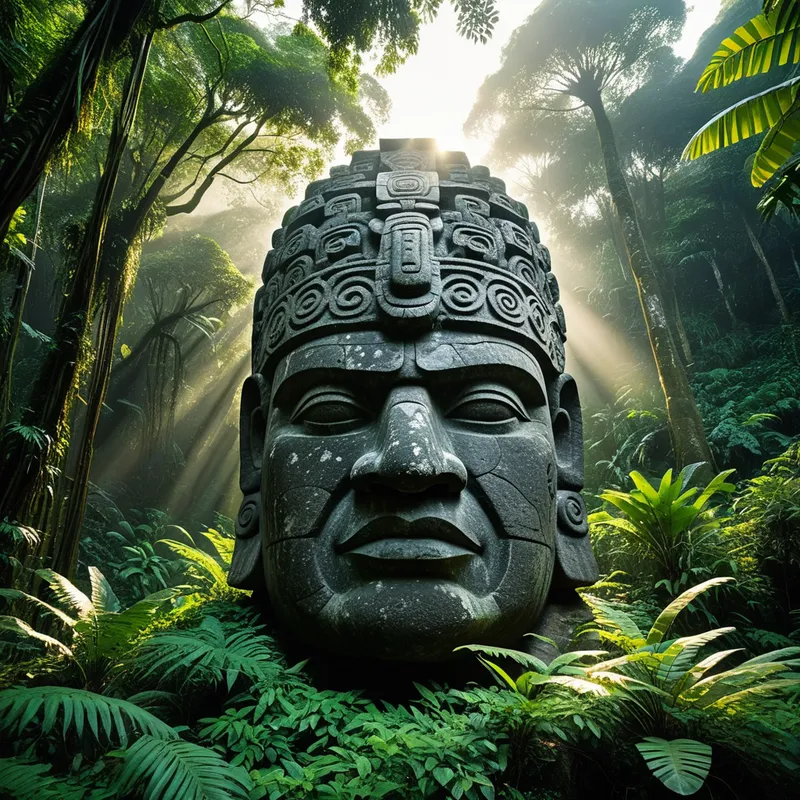
Olmec Colossal Heads Myth Meaning & Symbolism
A myth of stone giants emerging from the earth, embodying ancestral memory, the weight of identity, and the soul's call to remember its foundation.
The Tale of Olmec Colossal Heads
Before [the world](/myths/the-world “Myth from Tarot culture.”/) knew its name, in the time when [the earth](/myths/the-earth “Myth from Hindu culture.”/)’s skin was still soft and the rivers spoke in the tongues of serpents, there was a silence. It was not an empty silence, but a full one, pregnant with the memory of what was to come. In the green, steaming heart of the land, where the ceiba tree touched the belly of [the sky](/myths/the-sky “Myth from Persian culture.”/), the people lived with the rhythm of the jaguar’s breath and the turning of the maize.
But a forgetting began to creep in, subtle as a vine. The stories of the First Ones, those who emerged from the cracks in the stars and taught the people to shape clay and read the path of [Venus](/myths/venus “Myth from Alchemical culture.”/), grew faint. Names became whispers; deeds became echoes. The people felt unmoored, like canoes cut loose on a wide, dark river.
Then, the earth itself began to dream. In the sacred quarries, where the black basalt slept, a rumbling was felt—not in the ears, but in the bones. It was a call, deep and resonant. The master carvers, their hands guided by visions in the steam of the sweatbath, heard it clearest. They went to the stone not as makers, but as listeners. “The mountain remembers its children,” the oldest carver said, his voice like grinding stone. “It holds the faces of those who first walked here, who carried the world on their shoulders. We must help them breathe.”
For generations, they labored. They did not carve from imagination, but from recollection. With stone tools and [water](/myths/water “Myth from Chinese culture.”/), they coaxed forth the visages that the mountain held within: faces of immense calm and terrible power. Broad, flat noses that smelled the first rains. Lips set in a line of unshakable will. Eyes that had witnessed the birth of [the Fifth Sun](/myths/the-fifth-sun “Myth from Aztec culture.”/). Helmets adorned with symbols of the jaguar and the eagle, marking them as those who walked between the world of men and the world of spirit.
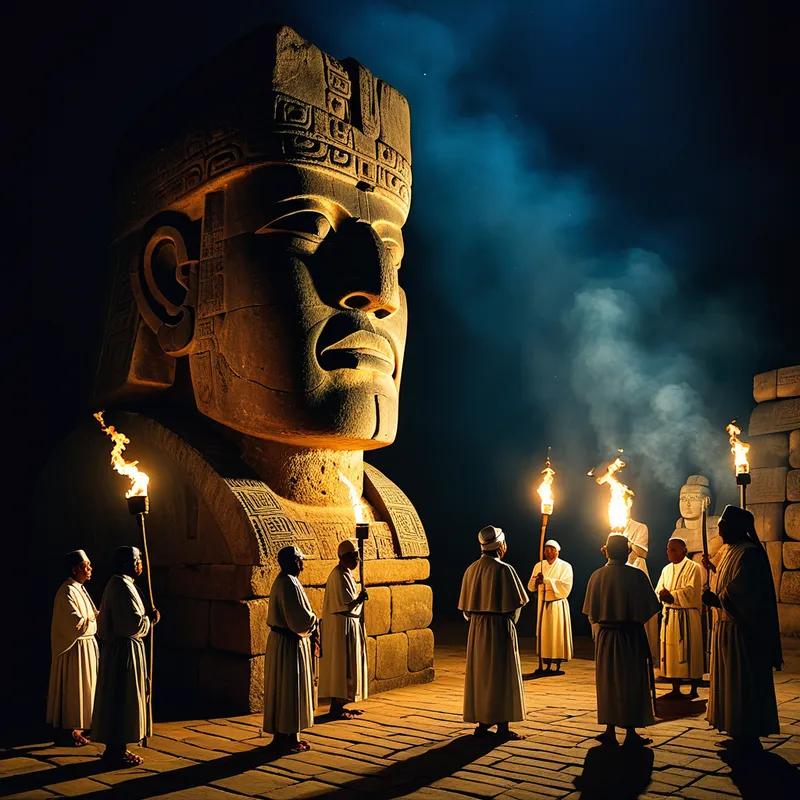
When a head was born from the stone, the entire people would gather. They would sing it from the quarry, a river of muscle and chant pulling the giant on rollers of log and rope, a journey of weeks under the watchful eye of the ceiba. They brought it to the heart-places, the ceremonial grounds, and set it to face the cardinal directions. As the head was settled into the earth, a great sigh seemed to move through the crowd. It was not placed upon the land; it was revealed from it. The forgotten ruler, the ancestral guardian, had returned. Its gaze was not on the people, but through them, to [the horizon](/myths/the-horizon “Myth from Various culture.”/) of time from whence it came, anchoring the present to the deep past. In that silent, stone gaze, the people remembered who they were. The forgetting was banished, not by a shout, but by a profound and enduring presence.
Cultural Origins & Context
The Olmec civilization, flourishing from roughly 1500 to 400 BCE along the Gulf Coast of Mexico, is widely considered the “mother culture” of Mesoamerica. The seventeen known Colossal Heads, ranging from 1.5 to over 3 meters tall and weighing up to 20 tons, are their most iconic legacy. Archaeologists generally interpret them as portraits of powerful individual rulers, perhaps commemorating reign, lineage, or achievements in the sacred ballgame.
Crucially, these were not myths written on [papyrus](/myths/papyrus “Myth from Egyptian culture.”/) or parchment, but myths inscribed directly onto the landscape. The myth of the heads is a myth of materiality and place. The narrative of their emergence from the earth, of being “remembered” rather than “made,” reflects a worldview where identity, authority, and history are not abstract concepts but literal, tangible forces rooted in the very soil and stone. The act of transporting these monoliths across miles of swamp and jungle was itself a ritual of immense communal effort, a physical enactment of bringing the ancestral past into the living present. The myth was told through the act of creation and installation, a story understood by every person who strained at a rope or chanted in procession. Its societal function was foundational: to legitimize rulership through connection to primordial forces, to create a permanent, unmovable anchor for collective identity, and to demonstrate the community’s power to collaborate with the earth itself.
Symbolic Architecture
Psychologically, the Colossal Heads represent the [archetype](/symbols/archetype “Symbol: A universal, primordial pattern or prototype in the collective unconscious that shapes human experience, behavior, and creative expression.”/) of the [collective unconscious](/symbols/collective-unconscious “Symbol: The Collective Unconscious refers to the part of the unconscious mind shared among beings of the same species, embodying universal experiences and archetypes.”/) made monumentally conscious. They are the [psyche](/myths/psyche “Myth from Greek culture.”/)’s insistence that what is foundational must be made visible, must be faced.
The head is the seat of identity, but the colossal head is identity weighed down by the gravity of its own origins, emerging slowly and with great effort from the dark earth of the forgotten.
The heads are not “heroes” in an active sense; they are sovereigns, the Ruler archetype in its most elemental form. Their power lies in their immovable [presence](/symbols/presence “Symbol: Presence in dreams often signifies awareness or acknowledgment of something significant in one’s life.”/), their silent gaze. Symbolically, they negotiate the core [human](/symbols/human “Symbol: The symbol of a human represents individuality, complexity of emotions, and social relationships.”/) [tension](/symbols/tension “Symbol: A state of mental or emotional strain, often manifesting physically as tightness, pressure, or unease, signaling unresolved conflict or anticipation.”/) between the individual and the collective. The unique, personalized features (each head is distinct) speak to individual [lineage](/symbols/lineage “Symbol: Represents ancestral heritage, family connections, and the transmission of traits, values, and responsibilities across generations.”/) and [achievement](/symbols/achievement “Symbol: Symbolizes success, mastery, or reaching a goal, often reflecting personal validation, social recognition, or overcoming challenges.”/), while their [uniform](/symbols/uniform “Symbol: A uniform often signifies authority, conformity, or a role within a group, reflecting one’s identity and societal expectations.”/) monumentality, their shared [material](/symbols/material “Symbol: Material signifies the tangible aspects of life, often representing physical resources, desires, and the physical world’s influence on our existence.”/) from the sacred quarry, and their collective placement speak to the subsumption of the individual into the eternal, ancestral whole. They are the [stone](/symbols/stone “Symbol: In dreams, a stone often symbolizes strength, stability, and permanence, but it may also represent emotional burdens or obstacles that need to be acknowledged and processed.”/) embodiment of the question: “Upon whose shoulders do you stand?” Their helmets symbolize a crafted, cultural [identity](/symbols/identity “Symbol: Identity represents the sense of self, encompassing personal beliefs, cultural background, and social roles.”/) placed upon the raw, natural fact of the head, indicating that rulership and selfhood are constructions, but constructions upon an immutable base.
The Dreamer’s Resonance
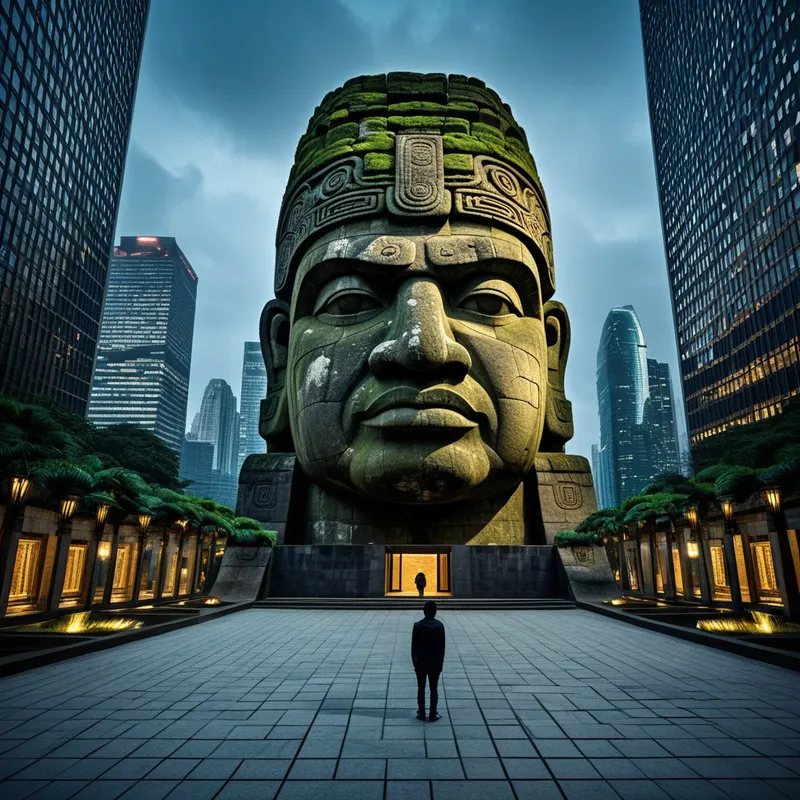
When the motif of the Olmec head appears in a modern dream, it often signals a process of confronting one’s own “colossal” psychological foundations. This is not a gentle process. The dreamer may find themselves in a liminal space—a modern office that suddenly gives way to ancient stone, or a familiar street where the pavement cracks to reveal a staring visage.
Somatically, this can correlate with feelings of immense pressure in the head or a sense of being “weighed down” by responsibility, heritage, or unprocessed family history. The head’s emergence is the psyche’s alchemical work of bringing deeply buried aspects of [the Self](/myths/the-self “Myth from Jungian culture.”/)—inherited traumas, cultural expectations, the forgotten “rules” of one’s personal dynasty—to the surface for recognition. The dream is an internal ceremony where the laborious task of “dragging” this heavy, ancestral identity into the light of consciousness begins. The awe or dread felt before the stone face is [the ego](/myths/the-ego “Myth from Jungian culture.”/)’s reaction to the sheer scale of the unconscious material demanding acknowledgment. The head’s silent gaze asks the dreamer to stop, to be still, and to remember what they have strategically forgotten in order to navigate the modern world.
Alchemical Translation
The myth models the alchemical stage of [nigredo](/myths/nigredo “Myth from Alchemical culture.”/) leading to albedo. The black basalt—dense, volcanic, of the deep earth—is the [prima materia](/myths/prima-materia “Myth from Alchemical culture.”/), the chaotic, unconscious mass of inherited and instinctual identity ([the nigredo](/myths/the-nigredo “Myth from Alchemical culture.”/)). The carver’s work is the focused application of conscious attention (the ego) to this mass, not to create something new from nothing, but to liberate the form already latent within it.
Individuation is not a process of building a new self from scratch, but of patiently, reverently carving away all that is not the true, foundational Self, allowing the colossal presence within to emerge and take its rightful place.
The modern individual’s “quarry” is their own history, their family system, their cultural DNA. The “carving tools” are introspection, therapy, and shadow work. The arduous “transport” is the difficult, often socially isolating work of integrating this rediscovered foundational Self into the current landscape of one’s life. The final “placement” in the ceremonial center is the moment of achieved inner sovereignty, where the once-buried, colossal aspect of the psyche becomes the central, orienting monument. It gazes not inward at the petty dramas of the ego, but outward, toward the horizon of one’s destiny, providing an unshakable sense of rootedness and purpose. One no longer has an identity as a fleeting possession; one is an identity, as solid and enduring as stone, revealed from the very ground of one’s being.
Associated Symbols
Explore related symbols from the CaleaDream lexicon: