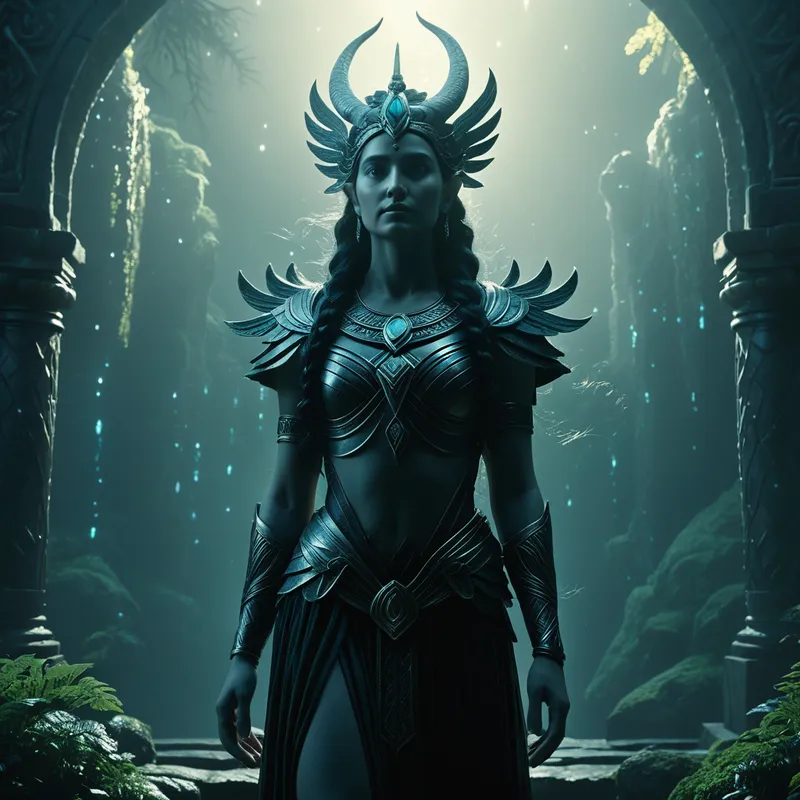
Ogun in Cuba
Ogun, the Yoruba deity of iron and war, evolved in Cuba through syncretism with Catholic saints, embodying resilience and cultural survival in the African diaspora.
The Tale of Ogun in Cuba
In the beginning, there was the forge. In Yorubaland, the god Ogun was born of the union between heaven and earth, a primal force who cleared the first path with his iron machete. He was the master of technology, of war, of civilization’s sharp edge. But then came the great rupture—the [Middle Passage](/myths/middle-passage “Myth from African Diaspora culture.”/), a churning ocean of forgetting. Ogun did not drown. Instead, he crossed the [water](/myths/water “Myth from Chinese culture.”/) in the clenched fists of the enslaved, in the memory of metal, in the stubborn pulse of a heart that refused to break.
He arrived in Cuba, a spirit displaced in a land of sugarcane and shackles. Here, the old ways were forbidden, the drums silenced, the names of the gods whispered only in secret. Ogun found himself in a world dressed in Catholic vestments. To survive, he put on a mask. He saw his own unyielding nature reflected in the figure of [Saint Peter](/myths/saint-peter “Myth from Christian culture.”/), holder of the keys, the rock upon which the church was built. In other regions, he saw himself in Saint George, [the dragon](/myths/the-dragon “Myth from Chinese culture.”/)-slayer, a warrior on horseback. And most profoundly, he found a home in the image of Saint [John the Baptist](/myths/john-the-baptist “Myth from Christian culture.”/), a fierce, ascetic figure in [the wilderness](/myths/the-wilderness “Myth from Biblical culture.”/), a voice crying out for truth. The syncretism was not a surrender, but a strategy of war.
The tale is told not in one epic, but in a thousand acts of resilience. It is the story of the cabildos, the ethnic mutual-aid societies where, under the watchful eyes of colonial [saints](/myths/saints “Myth from Christian culture.”/), Ogun was fed with roasted corn, smoked fish, and red palm oil. It is in the rhythm of the batá drums that call his name: Ogun Onire! It is in the hands of the blacksmith in Havana, whose hammer on the anvil is a prayer, forging not just tools but continuity. It is in the surgeon, the mechanic, the soldier, the taxi driver—all who work with metal and movement, who clear paths through the tangled complexities of daily life.
Ogun in Cuba became the patron of the struggle itself. He is the orisha who opens the roads, but his machete now cuts through the dense thicket of colonial oppression and cultural erasure. His feast day, celebrated alongside Saint John the Baptist on June 24th, is a vibrant, public testament to this hidden survival. The myth is this very transformation: a god of iron learns the alchemy of disguise, and in doing so, forges an unbreakable chain of identity.
Cultural Origins & Context
The story of Ogun in Cuba is born from [the crucible](/myths/the-crucible “Myth from Alchemical culture.”/) of the Transatlantic Slave Trade and the brutal institution of slavery in Spanish Cuba. Enslaved Yoruba and other West African peoples, collectively known as Lucumí, carried their spiritual worldviews across the ocean. Faced with violent suppression of their religions, they engaged in a profound act of cultural cryptography.
Spanish Catholicism, enforced by the colonizer, provided the lexicon. The rich [pantheon](/myths/pantheon “Myth from Roman culture.”/) of Catholic saints, with their vivid iconography and feast days, became a living codex. Ogun’s attributes—strength, [justice](/myths/justice “Myth from Tarot culture.”/), a connection to tools and conflict—found resonant echoes in specific saints. This was not a simple replacement, but a layered synthesis, giving birth to Regla de Ocha (commonly called Santería) and its parallel warrior tradition, Regla de Ifá.
The context is one of profound tension: the need to preserve a sacred essence under constant threat. The cabildos de nación were the incubators of this survival, legally sanctioned as Catholic fraternities while functioning as reservoirs of African theology. Here, Ogun was not forgotten; he was translated. His survival is a direct testament to the resilience of the Lucumí community, who used the master’s symbolic language to keep their own gods alive, ensuring that the spirit of iron—the spirit of foundation, labor, and resistance—would endure.
Symbolic Architecture
Ogun’s [symbolism](/symbols/symbolism “Symbol: The use of symbols to represent ideas or qualities, often conveying deeper meanings beyond literal interpretation. In dreams, it’s the language of the unconscious.”/) in Cuba is a dense [architecture](/symbols/architecture “Symbol: Architecture in dreams often signifies structure, stability, and the framing of personal identity or life’s journey.”/) of survival and power. At its core remains iron (irin): the unyielding [metal](/symbols/metal “Symbol: Metal in dreams often signifies strength, transformation, and the qualities of resilience or coldness.”/) of will, of technology, and of violence contained and directed. His colors are green, black, and red—the green of the [forest](/symbols/forest “Symbol: The forest symbolizes a complex domain of the unconscious mind, representing both mystery and potential for personal growth.”/) he clears, the black of the iron and the [earth](/symbols/earth “Symbol: The symbol of Earth often represents grounding, stability, and the physical realm, embodying a connection to nature and the innate support it provides.”/), the red of [blood](/symbols/blood “Symbol: Blood often symbolizes life force, vitality, and deep emotional connections, but it can also evoke themes of sacrifice, trauma, and mortality.”/), sacrifice, and dynamic [life](/symbols/life “Symbol: The symbol of ‘Life’ represents a journey of growth, interconnectedness, and existential meaning, encompassing both the joys and challenges that define human experience.”/)-force (aché). His numbers are 3 and 7, numbers of dynamism and completeness in Yoruba cosmology.
His tools are his [lexicon](/symbols/lexicon “Symbol: A structured collection of words or symbols representing a system of knowledge, communication, or artistic expression.”/): the machete (ode), the hammer, the anvil, the chain. Each tells a part of the [story](/symbols/story “Symbol: The symbol of ‘Story’ represents the narrative woven through our lives, embodying experiences, lessons, and emotions that shape our identities.”/). The machete is not merely for cutting; it is for opening—opening paths, opening possibilities, cutting through obstacles both physical and spiritual. The chain signifies both the bondage his children endured and the unbreakable link to ancestry and tradition he represents.
Ogun’s syncretism is the ultimate metalwork: he took the heat of persecution and, on the anvil of necessity, hammered his African essence into a Catholic shape without losing his core temper. The saint is the sheath; the orisha is the blade.
This symbolic architecture creates a lived, tactile spirituality. To wear Ogun’s colors is to carry a banner of [resilience](/symbols/resilience “Symbol: The capacity to recover quickly from difficulties, adapt to change, and maintain strength through adversity.”/). To offer him tools is to participate in the ongoing work of building and defending [identity](/symbols/identity “Symbol: Identity represents the sense of self, encompassing personal beliefs, cultural background, and social roles.”/). He embodies the [paradox](/symbols/paradox “Symbol: A contradictory yet true concept that challenges logic and perception, often representing unresolved tensions or profound truths.”/) of the civilized [warrior](/symbols/warrior “Symbol: A spiritual archetype representing inner strength, discipline, and the struggle for higher purpose or self-mastery.”/): the one who destroys to create, who uses the instruments of oppression (metal, technology) as instruments of liberation and cultural fortification.
The Dreamer’s Resonance
To encounter Ogun in the Cuban tradition is to confront the archetypal force of focused will within the [psyche](/myths/psyche “Myth from Greek culture.”/). He represents the indomitable aspect of [the Self](/myths/the-self “Myth from Jungian culture.”/) that must act, must forge ahead, must cut through the tangled undergrowth of internal conflict and external oppression. In the dreamscape, Ogun may appear as any figure of relentless determination: the steadfast laborer, the skilled surgeon, the righteous soldier, or simply the unyielding, sharp object that demands attention.
Psychologically, Ogun governs the capacity for boundaries and decisive action. He is the psychic energy required to say “no,” to cleave away what is toxic or stagnant. For those struggling with passivity, victimhood, or a diffused identity, Ogun’s energy offers the machete of discernment. He is the will to survive, not just physically, but culturally and spiritually—the fierce protection of one’s inner truth.
Yet, his shadow is ever-present. Unchecked, Ogun’s energy can manifest as unchecked rage, destructive impulsivity, or a rigid, isolating individualism. The Cuban myth beautifully contains this shadow by placing him within a pantheon and a community; he is one warrior among many, needing the balance of other forces. He resonates with the dreamer’s own battles—the fight for integrity, the labor of self-creation, and the sometimes violent necessity of cutting away the old to make way for the new. He is the archetype that demands we pick up our tools and do the hard, sharp work of becoming who we are.
Alchemical Translation
The journey of Ogun from West Africa to Cuba is a supreme alchemical operation. [The prima materia](/myths/the-prima-materia “Myth from Alchemical culture.”/)—the raw, primal god of iron and blood—was subjected to the unbearable heat and pressure of the colonial crucible. Through the process of syncretism, a transmutation occurred: the lead of persecution was turned into the gold of enduring spiritual power.
This alchemy operated on multiple levels. On the sociological level, it transformed a public-facing Catholic piety into a vessel for private African devotion. On the symbolic level, it translated archetypes: the wilderness of Ogun’s domain became the moral wilderness of Saint John the Baptist; the warrior’s justice became the apostolic authority of Saint [Peter](/myths/peter “Myth from Biblical culture.”/). The essence—the relentless, shaping, foundational force—remained unchanged, but its form adapted to survive in a new elemental environment.
The saint is the materia prima of the colonizer, consecrated and transformed into a vessel for the orisha. In this sacred chemistry, the imposed symbol is hollowed out and filled with the original, living spirit. The mask becomes the face.
The final stage of this translation is not a return to a “pure” origin, but the creation of something entirely new: a Cuban Ogun. He carries the memory of the African forge and the experience of the Caribbean struggle. He is a deity of the diaspora, whose power is precisely in his hybridity. He teaches that identity is not a static artifact to be preserved, but a living metal to be continually forged and reforged in the fires of historical circumstance. His alchemy is the proof that the spirit can not only survive dissolution but emerge from it stronger, more complex, and more potent.
Associated Symbols
Explore related symbols from the CaleaDream lexicon:
- Fire — The transformative element of the forge, representing both destruction and creation, the heat of struggle and the spark of spirit that refuses to be extinguished.
- Key — Symbolizing Ogun’s syncretism with Saint Peter, it represents opening forbidden doors, unlocking hidden knowledge, and accessing the power of cultural survival.
- Mask — The necessary disguise for survival, representing the dual identity of the orisha and the saint, and the protective interface between the sacred and the profane world.
- Warrior — The archetype of focused strength and resilience, embodying the fight to protect one’s community, culture, and inner truth against forces of erasure.
- Chain — A symbol of both the bondage of slavery and the unbreakable links to ancestry, tradition, and the lineage of the [orishas](/myths/orishas “Myth from African Diaspora culture.”/) across the Middle Passage.
- Forge — The sacred workshop of identity, where raw experience and memory are hammered into coherent form, and where the tools for life’s battles are shaped.
- Path — That which Ogun clears with his machete, representing destiny, progress, and the difficult journey toward liberation and self-realization.
- African — The root and source, the ancestral homeland and cultural wellspring from which the essence of the deity flows, despite displacement.
- Resilience — The core quality of the myth, the capacity to endure profound pressure and trauma while maintaining essential integrity and the will to persist.
- Iron — The primary substance of Ogun, symbolizing unyielding will, strength, technology, and the sharp edge of decisive action and truth.