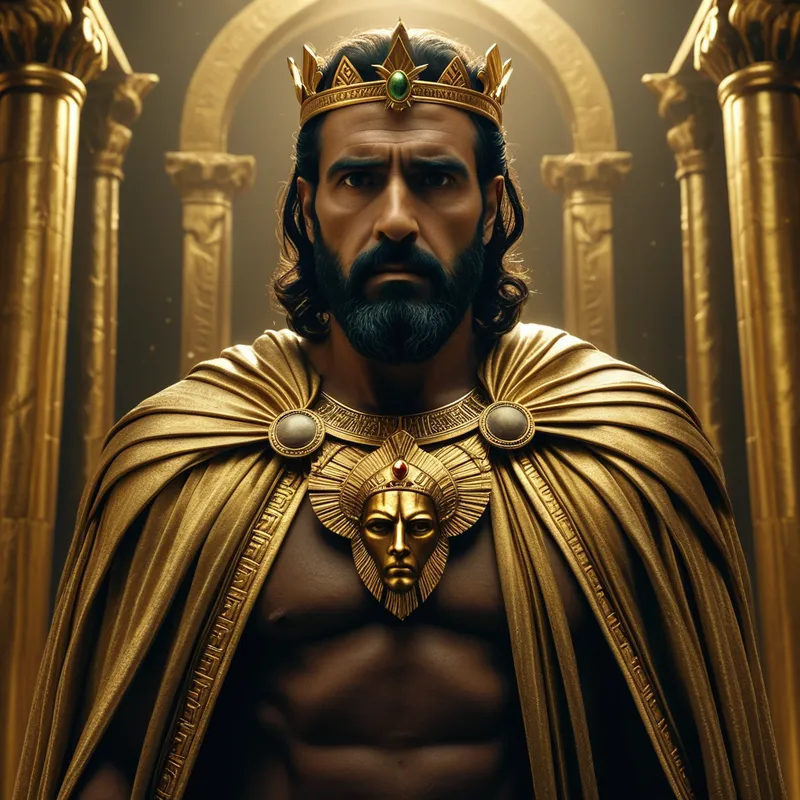
Oedipus Myth Meaning & Symbolism
A king's desperate flight from a terrible prophecy leads him to unknowingly kill his father and marry his mother, revealing the tragic cost of self-discovery.
The Tale of Oedipus
Listen, and hear a tale spun on the loom of the [Moirai](/myths/moirai “Myth from Greek culture.”/), a story where a man’s greatest victory is the key to his ultimate ruin. It begins with a shudder in the house of Laius. An oracle’s voice, cold as a tomb, speaks from the smoke at Delphi: the king’s newborn son will one day kill him. Terror grips the heart. To cheat fate, the infant’s ankles are pierced and bound, and he is given to a herdsman to expose on the wild Cithaeron. But pity is a stronger thread than command. The herdsman passes [the child](/myths/the-child “Myth from Alchemy culture.”/) to a fellow from Corinth, and the boy is carried to the childless King Polybus.
He is named Oedipus, for his wounded feet, and grows into a prince of Corinth. Yet a taunt at a feast—that he is not his father’s true son—drives him, feverish with doubt, to the same Pythian shrine. The oracle gives no comfort, only the same horrific decree: he will kill his father and wed his mother. Horrified, he flees Corinth, vowing never to return, believing he is protecting Polybus and Merope.
On a dusty road where three paths meet, his destiny finds him. A chariot forces him aside; an old man strikes him with a goad. A hot rage, long simmering, boils over. Oedipus strikes back, and in the blur of violence, kills the man and all his attendants, save one who flees into the scrub. He does not know he has just slain Laius, his true father.
He journeys on, arriving at Thebes, a city choking on a curse. The [Sphinx](/myths/sphinx “Myth from Greek culture.”/) crouches on the city’s heights, devouring all who fail her riddle. Oedipus, [the wanderer](/myths/the-wanderer “Myth from Taoist culture.”/), confronts her. “What creature walks on four legs in the morning, two at noon, and three in the evening?” The air itself holds its breath. “Man,” he answers. The creature, defeated, hurls herself to her death. The city, delivered, proclaims him king. As his reward, he is given the hand of the widowed queen, Jocasta. For years, he rules wisely, and she bears him two sons and two daughters. The prophecy, it seems, is defeated by distance and chance.
But the gods are not so easily mocked. A plague descends, a blight on leaf, beast, and womb. The people wail. Oedipus, the savior-king, sends his brother-in-law, Creon, to Delphi. The answer is a knife to the heart: the pollution is the unavenged murder of Laius. The killer must be found and cast out. Oedipus, the relentless investigator, curses the murderer, blind to the curse circling back to him. He summons the blind seer, [Tiresias](/myths/tiresias “Myth from Greek culture.”/), who speaks the unbearable truth to his face. Oedipus rages, accusing Creon and [Tiresias](/myths/tiresias “Myth from Greek culture.”/) of treason. Yet, piece by dreadful piece, the story unravels. The herdsman from the mountain is found. Jocasta, seeing the pattern before her husband, begs him to stop his inquiry. He mistakes her terror for shame. When the final word is spoken—that he is the son of Laius and Jocasta—[the world](/myths/the-world “Myth from Tarot culture.”/) shatters. A cry echoes from the palace. Jocasta has hanged herself. Oedipus stumbles into the chamber, takes the gold brooches from her robe, and plunges them into his own eyes. “They will never see the crime they committed, nor the evil they have suffered,” he declares. Blinded, exiled, led by his daughter Antigone, he becomes a walking embodiment of the suffering he sought to escape, a king who solved [the riddle of the Sphinx](/myths/the-riddle-of-the-sphinx “Myth from Global/Universal culture.”/) but could not solve the riddle of himself until it was too late.

Cultural Origins & Context
The myth of Oedipus is one of the foundational narratives of the Greek world, most famously crystallized in the tragic plays of Sophocles in the 5th century BCE. Its roots, however, sink deeper into the oral tradition, a dark folktale of fate and familial violence that resonated with the Greek [psyche](/myths/psyche “Myth from Greek culture.”/)’s profound anxiety about the capriciousness of the gods and the fragility of human prosperity. In the competitive, public arena of the City Dionysia, these stories were not mere entertainment; they were a form of civic and religious ritual. The audience, seated beneath the open sky, witnessed the terrifying logic of a universe where human effort (hubris) could collide with divine will (moira) with catastrophic results. The function was catharsis—a collective shudder that reaffirmed the boundaries of the knowable and the dangers of overreaching. The myth served as a grim reminder that the past, especially unexamined and unatoned, could fester into a plague upon the present.
Symbolic Architecture
At its core, the myth of Oedipus is a profound [allegory](/symbols/allegory “Symbol: A narrative device where characters, events, or settings represent abstract ideas or moral qualities, conveying deeper meanings through symbolic storytelling.”/) for the [journey](/symbols/journey “Symbol: A journey in dreams typically signifies adventure, growth, or a significant life transition.”/) toward self-[knowledge](/symbols/knowledge “Symbol: Knowledge symbolizes learning, understanding, and wisdom, embodying the acquisition of information and enlightenment.”/) and the brutal price of [consciousness](/symbols/consciousness “Symbol: Consciousness represents the state of awareness and perception, encompassing thoughts, feelings, and experiences.”/). Oedipus is the archetypal knower, the solver of riddles, whose brilliant intellect illuminates every [mystery](/symbols/mystery “Symbol: An enigmatic, unresolved element that invites curiosity and exploration, often representing the unknown or hidden aspects of existence.”/) except the one at the center of his own being.
The greatest blindness is not of the eyes, but of the soul to its own origins.
The [Sphinx](/symbols/sphinx “Symbol: The Sphinx is a mythical creature that embodies the convergence of strength and intelligence, often associated with mystery, protection, and the challenge of riddles.”/)’s [riddle](/symbols/riddle “Symbol: A puzzle or enigmatic statement requiring cleverness to solve, symbolizing hidden truths, intellectual challenge, and the search for meaning.”/) is the riddle of [human](/symbols/human “Symbol: The symbol of a human represents individuality, complexity of emotions, and social relationships.”/) [life](/symbols/life “Symbol: The symbol of ‘Life’ represents a journey of growth, interconnectedness, and existential meaning, encompassing both the joys and challenges that define human experience.”/) itself—the [progression](/symbols/progression “Symbol: Symbolizes forward movement, development, or advancement through stages toward a goal or state of being.”/) from [infancy](/symbols/infancy “Symbol: A symbol of beginnings, vulnerability, and foundational development, often representing a return to origins or a state of pure potential.”/) to old age. Oedipus solves it intellectually, but fails to live its meaning. He does not truly know himself, his own [history](/symbols/history “Symbol: History in dreams often represents the dreamer’s past experiences, lessons learned, or unresolved issues that continue to influence their present.”/), his own [nature](/symbols/nature “Symbol: Nature symbolizes growth, connectivity, and the primal forces of existence.”/). His [flight](/symbols/flight “Symbol: Flight symbolizes freedom, escape, and the pursuit of one’s aspirations, reflecting a desire to transcend limitations.”/) from Corinth is a flight from a perceived [truth](/symbols/truth “Symbol: Truth represents authenticity, honesty, and the quest for knowledge beyond mere appearances.”/), a desperate attempt to outrun the [shadow self](/symbols/shadow-self “Symbol: The unconscious, repressed aspects of personality containing traits, desires, and impulses considered unacceptable or shameful.”/) prophesied by the [oracle](/symbols/oracle “Symbol: An oracle represents wisdom, foresight, and divine communication, often serving as a mediator between the spiritual and physical worlds.”/). In psychological terms, this is [the ego](/myths/the-ego “Myth from Jungian culture.”/)’s refusal to integrate the contents of the unconscious, which are perceived as monstrous and destructive.
The [crossroads](/symbols/crossroads “Symbol: A powerful spiritual symbol representing a critical decision point where paths diverge, often associated with fate, transformation, and life-altering choices.”/) symbolize the critical [moment](/symbols/moment “Symbol: The symbol of a ‘moment’ embodies the significance of transient experiences that encapsulate emotional depth or pivotal transformations in life.”/) of [choice](/symbols/choice “Symbol: The concept of choice often embodies decision-making, freedom, and the multitude of paths available in life.”/), the [intersection](/symbols/intersection “Symbol: An intersection symbolizes the crossroads of decision-making, presenting choices and the potential for change.”/) where [fate](/symbols/fate “Symbol: Fate represents the belief in predetermined outcomes, suggesting that some aspects of life are beyond human control.”/) and free will tragically merge. His murder of Laius is a parricidal act against the “[father](/symbols/father “Symbol: The father figure in dreams often symbolizes authority, protection, guidance, and the quest for approval or validation.”/) principle”—[authority](/symbols/authority “Symbol: A symbol representing power structures, rules, and control, often reflecting one’s relationship with societal or personal governance.”/), law, the old order—an unconscious revolt necessary for his own [identity](/symbols/identity “Symbol: Identity represents the sense of self, encompassing personal beliefs, cultural background, and social roles.”/) to emerge, yet fatally tainted. His [marriage](/symbols/marriage “Symbol: Marriage symbolizes commitment, partnership, and the merging of two identities, often reflecting one’s feelings about relationships and social obligations.”/) to Jocasta represents a regressive union with the “[mother](/symbols/mother “Symbol: The symbol of ‘Mother’ represents nurturing, protection, and the foundational aspect of one’s emotional being, often associated with comfort and unconditional love.”/) principle”—the unconscious, the [source](/symbols/source “Symbol: The origin point of something, often representing beginnings, nourishment, or the fundamental cause behind phenomena.”/) of life, the undifferentiated state from which consciousness must separate to become individual. He becomes [king](/symbols/king “Symbol: A symbol of ultimate authority, leadership, and societal order, often representing the dreamer’s inner power or external control figures.”/), but his rule is founded on this hidden, incestuous bedrock. The [plague](/symbols/plague “Symbol: A symbol of widespread affliction, collective suffering, and uncontrollable forces that threaten social order and personal survival.”/) is the [symptom](/symbols/symptom “Symbol: A physical or emotional sign indicating an underlying imbalance, distress, or message from the unconscious mind.”/) of this buried truth, the psychic sickness that manifests when the core self is built upon a lie. Finally, his self-blinding is the ultimate [symbol](/symbols/symbol “Symbol: A symbol can represent an idea, concept, or belief, serving as a powerful tool for communication and understanding.”/). He blinds the physical eyes that failed to see the truth, forcing a turn [inward](/symbols/inward “Symbol: A journey toward self-awareness, introspection, and the exploration of one’s inner world, thoughts, and unconscious mind.”/). The outer world is shut out so that the inner [reality](/symbols/reality “Symbol: Reality signifies the state of existence and perception, often reflecting one’s understanding of truth and life experiences.”/), however horrific, can be fully confronted. He becomes the [seer](/symbols/seer “Symbol: A spiritual figure with prophetic or divinatory abilities, often representing access to hidden knowledge, fate, or higher consciousness.”/) who, like Tiresias, sees more in darkness than he ever did in light.
The Dreamer’s Resonance
When the Oedipal pattern stirs in the modern dreamscape, it rarely manifests as literal patricide or incest. Instead, it speaks to a profound psychological process of confronting a foundational identity crisis. To dream of being an investigator uncovering a terrible secret about one’s own family or origin is to touch this archetype. Dreams of being falsely accused of a crime you later discover you did commit, or of solving an external puzzle while a deeper, personal catastrophe unfolds unnoticed, echo Oedipus’s dilemma.
Somatically, this may accompany feelings of being an impostor, a deep-seated anxiety that one’s success or relationships are built on a mistake or a hidden flaw. It is the process of the psyche forcing a reckoning with the “family romance”—the unconscious narratives we inherit about who we are supposed to be, who our parents truly are, and what debts we owe to the past. The dreamer is in the stage where the “plague” has manifested—a depression, a relationship breakdown, a creative block—and the unconscious is demanding an inquiry. The resistance felt in the dream (the rage at the Tiresias-figure, the desire to stop the investigation) mirrors the ego’s terror of what it might find if it looks too closely at its own foundations.
Alchemical Translation
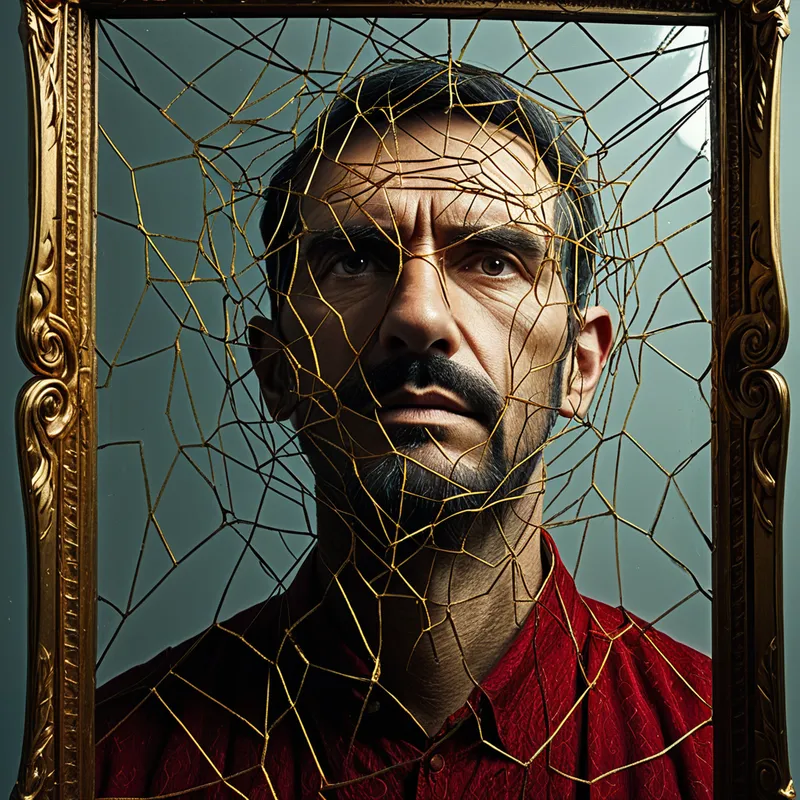
The alchemical journey of Oedipus models the most painful stage of individuation: the [nigredo](/myths/nigredo “Myth from Alchemical culture.”/), the blackening, the descent into [the shadow](/myths/the-shadow “Myth from Jungian culture.”/) and the utter dissolution of the conscious personality. His story is not one of redemption in the sunlight, but of transformation through absolute ruin.
The gold of the self can only be forged in the fire of unbearable truth.
Oedipus begins in a state of unconscious identification. He is the hero, the savior-king, a [persona](/myths/persona “Myth from Greek culture.”/) built on brilliant problem-solving and outward success. The oracle’s prophecy is the first call to consciousness, which he misunderstands and flees, attempting to preserve his false self. The entire myth is the process of that call becoming inescapable. The alchemical operation here is [solutio](/myths/solutio “Myth from Alchemical culture.”/) (dissolution) and [separatio](/myths/separatio “Myth from Alchemical culture.”/) (separation), but of a violent, involuntary kind. His identity is dissolved by the acid of truth. He is separated from his throne, his sight, his mother-wife, his city—everything that constituted his worldly self.
His [triumph](/myths/triumph “Myth from Roman culture.”/) is not in avoiding his fate, but in finally, fully, owning it. By accepting the truth and punishing himself, he takes conscious responsibility for the unconscious actions that shaped his life. This is the beginning of coagulatio—a new, denser, more authentic coagulation of [the self](/myths/the-self “Myth from Jungian culture.”/). The blinded Oedipus of Sophocles’ later play, Oedipus at Colonus, is no longer the arrogant king, but a sacred, weathered, and powerful presence, at peace with his fate and under the protection of the gods. The psychic transmutation is complete: the leaden, cursed fugitive has become, through sheer endurance of the truth, a figure of numinous power. For the modern individual, the myth teaches that the most terrifying knowledge—the knowledge of our deepest wounds, our complicity in our own suffering, the shadow aspects of our lineage and our nature—is not the end of the self, but the only possible beginning of a real one. We must, like Oedipus, have the courage to follow the investigation to its dreadful conclusion, for on the other side of that blinding truth lies not annihilation, but a terrible, hard-won freedom.
Associated Symbols
Explore related symbols from the CaleaDream lexicon: