Odysseus' decade-long journey Myth Meaning & Symbolism
A warrior's ten-year voyage home becomes the ultimate map of the soul's return through trials, temptations, and the deep unconscious.
The Tale of Odysseus' decade-long journey
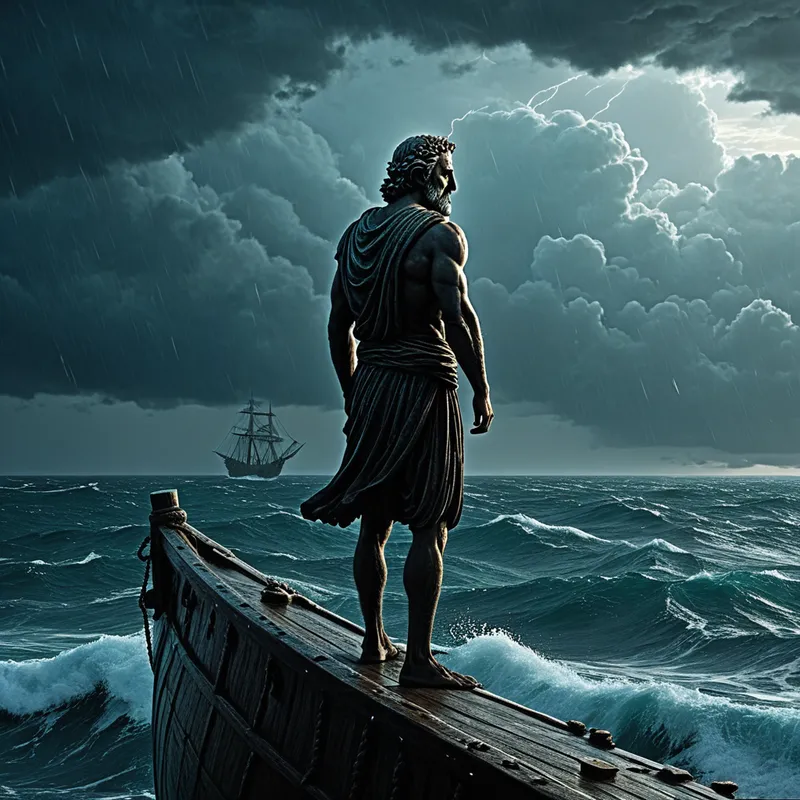
Hear now the tale of the man of twists and turns, the one who was driven time and again off course, after he had plundered the sacred heights of Troy. The wine-dark sea, beloved of Poseidon, was not his friend. For the hero had blinded the god’s son, the Cyclops Polyphemus, and from that moment, the Earth-Shaker vowed his homecoming would be bitter, long, and soaked in salt.
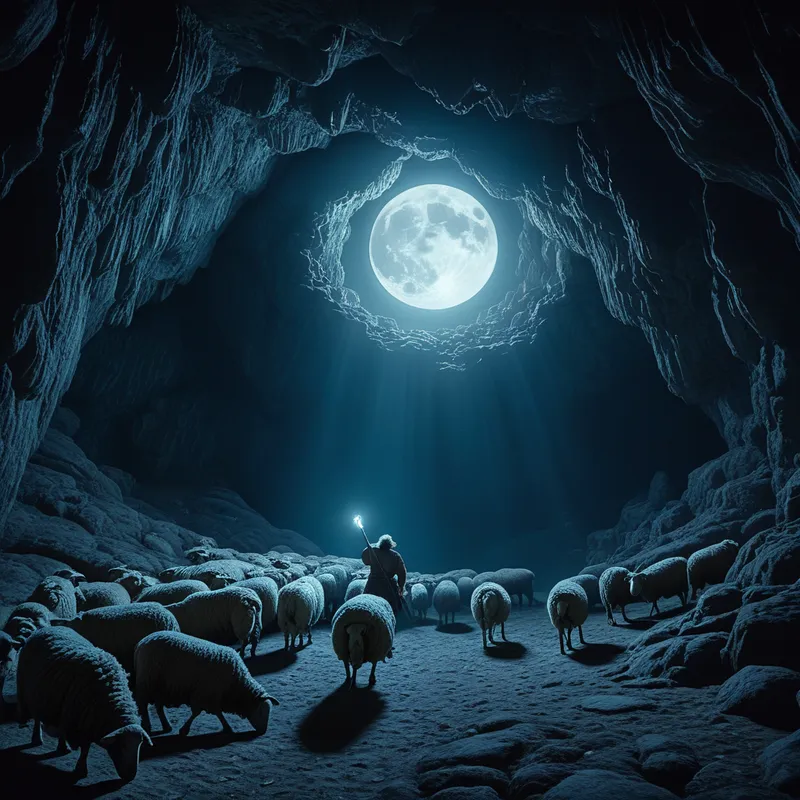
His name was Odysseus, and his heart was a lodestone for the rocky shores of Ithaca. But the gods spun a different thread. His fleet was scattered by wrathful winds to the very edges of the known world. He tasted the fruit of the Lotus-Eaters, which made men lose all desire for return. He outwitted the man-eating giant in his cave, escaping by clinging to the wool of sheep. He held fast against the seductive, soul-dissolving song of the Sirens, lashed to his ship's mast while his crew rowed on, their ears stoppered with wax.
He navigated the impossible strait between the ravenous, six-headed Scylla and the whirlpool Charybdis, losing men to the monster's swift, terrible jaws. He endured a year's captivity on the island of the enchantress Circe, who turned his crew to swine before he won her heart with the help of the god Hermes. He descended to the sunless land of the dead to consult the shade of the blind prophet Tiresias, walking among whispering ghosts to learn his fate.
He alone survived the final, catastrophic wrath of Zeus, who shattered his last ship with a lightning bolt for the sacrilege of his starving crew. For seven years, he was held, a beloved but heartsick guest, by the nymph Calypso, who offered him immortality and eternal youth if he would stay. Each dawn, he would sit on the shore, staring across the empty sea, weeping for a home that seemed a dream. Only by the order of Zeus, delivered by Hermes, was he released to build a raft and set out once more.
Shipwrecked again, naked and exhausted, he washed ashore on the land of the Phaeacians, where he finally told his story. Moved by his trials, they gave him a ship that sailed as swift as thought, carrying him at last to the hidden coves of Ithaca. But his journey was not done. He arrived in disguise, a beggar in his own hall, to find it overrun with arrogant suitors devouring his wealth and courting his faithful wife, Penelope. With the help of his son, Telemachus, and the goddess Athena, he endured insults, planned his vengeance, and in a final, bloody contest of the bow, reclaimed his kingdom, his home, and his identity. The long war was over. The longer journey, at last, was complete.
Cultural Origins & Context
This epic, known as the Odyssey, is attributed to the blind poet Homer and was composed in the 8th century BCE, though its roots stretch back into an older oral tradition of bardic song. It was not mere entertainment; it was the cultural software of the ancient Greek world. Performed at festivals and in the halls of the powerful, it served as a foundational narrative about identity, civilization, and the human condition. It asked: What does it mean to be a man, a king, a husband, in a world governed by capricious gods? The story functioned as a map of proper conduct (xenia, or guest-friendship), a theological inquiry, and a thrilling adventure that defined Hellenic values of cunning (metis), endurance, and the sacred imperative of homecoming (nostos).
Symbolic Architecture
The decade-long voyage is not a geographical detour but a descent into the labyrinth of the self. Ithaca is not just a homeland; it is the symbol of the integrated psyche, the core identity one must struggle to remember and reclaim after being shattered by trauma, temptation, and loss.
The journey home is always a journey inward. The monsters are the unintegrated aspects of the self, and the sea is the vast, unconscious depth from which they arise.
Athena represents the guiding light of conscious intellect and strategy, while Poseidon embodies the raw, chaotic, and destructive power of the unconscious emotions—the rage and grief that can swamp the ego. Each island is a psychic state: the Lotus-Eaters represent blissful forgetfulness and the abandonment of purpose; Circe’s transformation of men into beasts symbolizes the danger of being consumed by base, animal instincts; the Sirens are the seductive call of regressive fantasies, beautiful but fatal to forward movement.
The Dreamer's Resonance
When this myth stirs in the modern dreamer, it often manifests as a profound sense of being lost or obstructed on a vital life path. You may dream of endless commuting, of missing trains, of maps that make no sense, or of being trapped in a maze of bureaucratic hallways. The somatic feeling is one of frustrated propulsion, a deep yearning coupled with immobilization. Psychologically, this indicates a soul in the midst of its own nostos—perhaps after a personal "Troy" such as a divorce, career loss, or illness. The dream-ego is Odysseus, and the dream’s absurd obstacles are the modern equivalents of Scylla and Charybdis: impossible choices, systemic traps, and soul-crushing delays. The dream is not a prediction of failure, but a confirmation of the journey itself. The feeling of being "waylaid" is the process.

Alchemical Translation
The alchemy of the Odyssey is the transmutation of the heroic ego (the victorious sacker of cities) into the wise, tempered king. This is the process of individuation, where one must consciously encounter and integrate the contents of the personal and collective unconscious—the "monsters" and "gods"—to become whole.
The final and most sacred trial is not the slaying of a monster, but the restraint to don the disguise of a beggar. The ultimate victory is not in recognition, but in the patient, painful work of re-membering who you are.
The decade is the necessary time for psychic fermentation. The ego must be humbled, stripped of its fleet and its companions (its old identities and supports), and forced to rely on its innate cunning and the grace of a higher guiding principle (Athena). The return in disguise is critical; one cannot come back to one's "Ithaca" as the same person who left. The old self must "die" so the new, more conscious self can survey the land, understand what has been lost and corrupted (the suitors in the hall), and reclaim sovereignty not through brute force alone, but through strategic, righteous integration. The bow contest is the moment when the differentiated, fully assembled self acts with total, undeniable authority. The journey ends not with arrival, but with reclamation.
Associated Symbols
Explore related symbols from the CaleaDream lexicon: