Odysseus at Scylla and Charybdis Myth Meaning & Symbolism
Odysseus must steer his ship between a six-headed monster and a deadly whirlpool, a timeless allegory for navigating impossible choices.
The Tale of Odysseus at Scylla and Charybdis
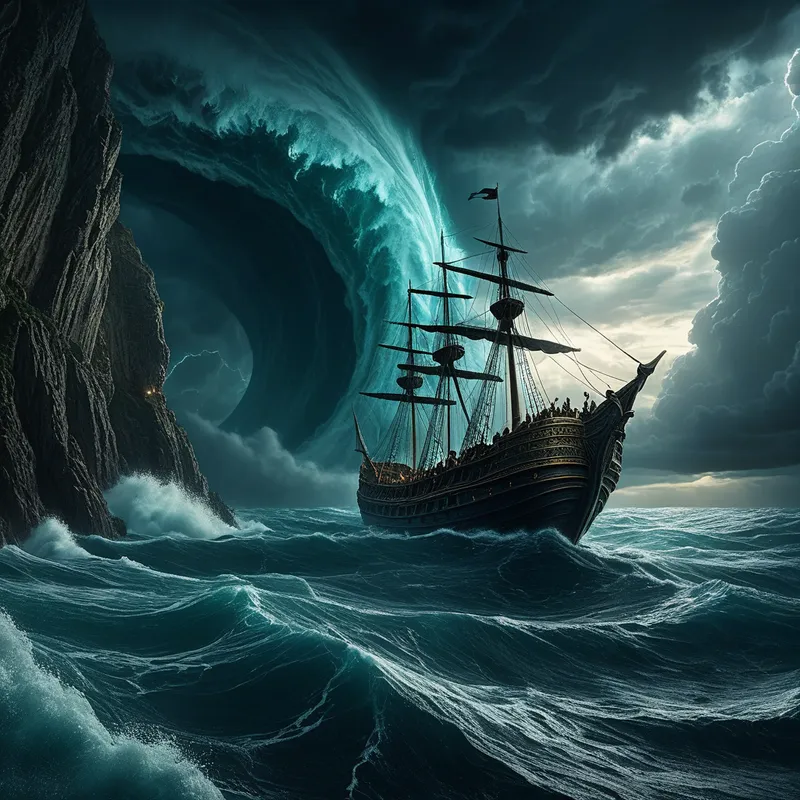
Hear now of the [Odysseus](/myths/odysseus “Myth from Greek culture.”/), weary king, whose heart was a [lodestone](/myths/lodestone “Myth from Greek culture.”/) for the rocky shores of Ithaca. His mind, sharp as a shipwright’s adze, had carved a path past the song of [the Sirens](/myths/the-sirens “Myth from Greek culture.”/), but the gods had saved the cruelest strait for last. [The sea](/myths/the-sea “Myth from Greek culture.”/) itself seemed to hold its breath as his vessel approached the place where no captain sails with hope, only with a prayer to die whole.
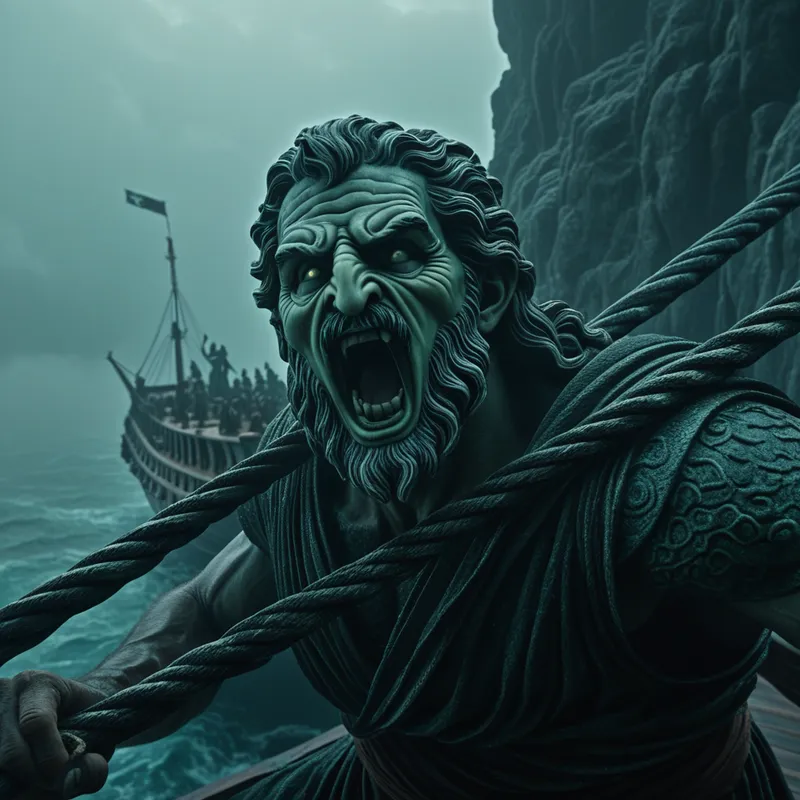
On one side, the sheer cliff of [Scylla](/myths/scylla “Myth from Greek culture.”/). No kindly nymph dwelled there now, but a horror born of divine wrath. From her cavern, six long necks uncoiled, each tipped with a head of nightmare—three rows of teeth like shards of black obsidian, and eyes that burned with a hunger older than the waves. Her voice was the hiss of [water](/myths/water “Myth from Chinese culture.”/) on hot rock, the snap of a breaking spine. She did not hunt; she waited. The cliff was her larder, strewn with the bones of those who dared pass too close.
On the other side churned Charybdis. Thrice a day, the sea would cough her up, a yawning, smooth-walled pit that drank down the ocean itself, pulling timber, foam, and fate into her fathomless gut. The roar was not of water, but of [the earth](/myths/the-earth “Myth from Hindu culture.”/) swallowing the sea, a deep-throated promise of utter dissolution. To be taken by Charybdis was to be unmade, returned to the primal broth from which nothing solid emerges.
Between them lay a channel narrower than a spear’s cast. The water, trapped and frantic, boiled with conflicting currents. The air stank of salt-spray and dread. Circe’s warning echoed in Odysseus’s ears: there is no safe passage, only a choice of horrors. To veer from the whirlpool is to feed the monster; to flee the monster is to be sucked into [the abyss](/myths/the-abyss “Myth from Kabbalistic culture.”/). The only path is the razor’s edge between.
He stood at the helm, his knuckles white on the smooth wood. He did not tell his men of the six-headed death, for what use is a warning when there is no escape? He commanded them to row with all their strength, to steer hard for the cliff of Scylla, and to pray. As they entered the throat of the strait, Charybdis began to drain. The ship shuddered, pulled toward the roaring vortex. All hands strained, muscles cracking, to hold the course toward the looming rock.
Then, from the misty crag, the necks descended. Swift as a striking asp, silent as shadow. Six maws seized six men—the strongest, the bravest—plucking them from [the deck](/myths/the-deck “Myth from Tarot culture.”/) like ripe fruit. Their cries were cut short, a terrible, wet crunching the only epitaph. Odysseus, sword in hand, could only watch, a captain forced to sacrifice his crew to the lesser evil, his heart a cold stone in his chest. The ship, lightened by its terrible toll, surged forward, past the dripping cliffs, as Charybdis belched the sea back up in a geyser of despair behind them. They escaped, but the victory tasted of ash and blood. The strait was behind them, but the memory was now a scar upon the soul of every survivor.
Cultural Origins & Context
This episode is a central pillar of the Odyssey, a foundational text of ancient Greek culture composed in the 8th or 7th century BCE. It was not read, but performed—chanted by a rhapsode to the rhythm of a lyre, in the halls of nobles or at public festivals. The audience, many of them familiar with the sea’s very real perils, would have felt the visceral terror of the narrative. The myth functioned on multiple levels: as a thrilling adventure, a lesson in the cruel, amoral nature of certain cosmic forces, and a meditation on the burdens of leadership. It reinforced the Greek worldview that the journey of life (nostos) is fraught with divinely-sent trials that test mortal wit, endurance, and piety. [Scylla and Charybdis](/myths/scylla-and-charybdis “Myth from Greek culture.”/) represented the ultimate geographical and existential bottleneck, a place where the map ends and raw, tragic choice begins.
Symbolic Architecture
The [strait](/symbols/strait “Symbol: A narrow, often treacherous passage of water connecting two larger bodies, symbolizing transition, constraint, and critical choices.”/) is the archetypal double bind, a [situation](/symbols/situation “Symbol: The ‘situation’ symbolizes the junction between the subconscious and conscious realms, often reflecting the current challenges or dynamics in the dreamer’s waking life.”/) where every available [option](/symbols/option “Symbol: Options in dreams symbolize choices or paths in life, reflecting the dreamer’s current decision-making situations.”/) leads to [loss](/symbols/loss “Symbol: Loss often symbolizes change, grief, and transformation in dreams, representing the emotional or psychological detachment from something or someone significant.”/). It is the psychological [landscape](/symbols/landscape “Symbol: Landscapes in dreams are powerful symbols representing the dreamer’s emotional state, personal journey, and the broader context of life situations.”/) of the impossible [choice](/symbols/choice “Symbol: The concept of choice often embodies decision-making, freedom, and the multitude of paths available in life.”/).
Scylla represents the catastrophe of specificity—a known, tangible, and personal loss. It is the sudden crisis, the acute attack, the betrayal you see coming. It takes its toll in discrete, countable units: a life, a relationship, a part of oneself. Its violence is graphic and intimate.
Charybdis symbolizes the catastrophe of totality—the formless, overwhelming force that threatens complete annihilation of identity, meaning, and structure. It is depression, addiction, existential despair; the force that dissolves the self back into the undifferentiated sea of the unconscious.
Odysseus, the [metis](/myths/metis “Myth from Greek culture.”/)-wielding [hero](/symbols/hero “Symbol: A hero embodies strength, courage, and the ability to overcome significant challenges.”/), embodies the conscious ego navigating the narrows of a [life](/symbols/life “Symbol: The symbol of ‘Life’ represents a journey of growth, interconnectedness, and existential meaning, encompassing both the joys and challenges that define human experience.”/) [crisis](/symbols/crisis “Symbol: A crisis symbolizes turmoil, urgent challenges, and the need for immediate resolution or change.”/). His choice to sail toward Scylla is not a failure, but the essence of the tragic calculus of survival. He chooses the [monster](/symbols/monster “Symbol: Monsters in dreams often symbolize fears, anxieties, or challenges that feel overwhelming.”/) he can survive, even if it means losing parts of his “[crew](/symbols/crew “Symbol: A crew often symbolizes collaboration, teamwork, and collective purpose, suggesting a need for shared goals and support from others in one’s journey.”/)“—the aspects of his [life](/symbols/life “Symbol: The symbol of ‘Life’ represents a journey of growth, interconnectedness, and existential meaning, encompassing both the joys and challenges that define human experience.”/), his [innocence](/symbols/innocence “Symbol: A state of purity, naivety, and freedom from guilt or corruption, often associated with childhood and moral simplicity.”/), or his companions that cannot make the [passage](/symbols/passage “Symbol: A passage symbolizes transition, movement from one phase of life to another, or a journey towards personal growth.”/). The myth asserts that some transitions require sacrifice, and that preservation of the core self (the ship, the [journey](/symbols/journey “Symbol: A journey in dreams typically signifies adventure, growth, or a significant life transition.”/) home) sometimes demands the conscious, agonizing surrender of valued parts.
The Dreamer’s Resonance
When this myth constellates in the modern [psyche](/myths/psyche “Myth from Greek culture.”/), it often manifests in dreams of being trapped between two looming dangers—a raging fire and a collapsing building, a pursuer and a cliff edge, two conflicting authoritative voices. The somatic experience is one of paralysis and heightened alertness, a frozen tension in the chest and gut. Psychologically, the dreamer is likely navigating a real-life situation with no “good” outcome: choosing between two painful career paths, ending a meaningful but destructive relationship, or balancing competing familial duties.
The dream is not providing a solution, but mapping the terrain of the dilemma. The specific forms of Scylla and Charybdis in the dream offer clues. Is one danger a recognizable person (Scylla) and the other a vague, engulfing feeling (Charybdis)? The dream forces the dreamer to consciously acknowledge the bind and the inevitable cost of movement, initiating the painful but necessary process of discernment and grieving that precedes any real choice.

Alchemical Translation
In the alchemy of individuation, the journey through the strait is the confrontation with [the shadow](/myths/the-shadow “Myth from Jungian culture.”/) and the unconscious, not as abstract concepts, as lived, wrenching choices. The “hero” archetype is tempered here, moving from a fantasy of flawless victory to the sober reality of sovereign choice amidst ruin.
The alchemical operation is separatio—the necessary, often violent separation of what must be lost from what must be saved to continue the Great Work of becoming whole.
Odysseus’s passage models the psychic transmutation. [The ego](/myths/the-ego “Myth from Jungian culture.”/)-ship must hold its course toward the known monster (the integrated shadow, the acknowledged flaw) to avoid being dissolved entirely by the unconscious. The six sailors lost to Scylla are the necessary sacrifices—outdated identities, cherished illusions, dependencies that we must let be “snatched away” by the realities of growth. We do not integrate everything; we choose what to carry forward. The [triumph](/myths/triumph “Myth from Roman culture.”/) is not escape unscathed, but passage with consciousness. One emerges from the strait scarred, diminished in one way, but with a hardened, more authentic core—the captain who has looked into the mouth of the impossible and steered through it, bearing the weight of his choice. The journey home continues, but the traveler is irrevocably changed, carrying the strait within him as a benchmark of his endurance.
Associated Symbols
Explore related symbols from the CaleaDream lexicon: