
Oduduwa West African
The celestial creator deity who descended to Earth, formed the land from a shell of sand, and became the first divine king and ancestor of the Yoruba people.
The Tale of Oduduwa West African
In the beginning, there was only the primordial expanse of waters and marsh, a formless, churning chaos. Above it hung the vault of the sky, the domain of the Supreme God, Olodumare. The earth as we know it did not yet exist. From this divine realm, Olodumare dispatched a host of emissaries, the Orisha, to bring order to the watery abyss. To the eldest, Obatala, was given a sacred task: to descend and create solid land. He was equipped with a snail shell filled with earth, a five-toed hen, and a palm nut, all carried in a chain lowered from the heavens.
Obatala began his descent. Yet, the journey was long, and below him, he saw only the endless, inviting blue. Overcome by the beauty and perhaps the solitude, he partook of the palm wine he had brought, falling into a deep, creative slumber. The mission hung in the balance, suspended over the void.
Witnessing this from above, Olodumare turned to another divine presence: Oduduwa. To Oduduwa was entrusted the completion of the work. Taking up the tools—the chain, the shell of sand, the hen, and the palm nut—Oduduwa descended. Where Obatala slept, Oduduwa acted. He reached the end of the chain and found a point of potential. There, he poured the sand from the snail shell onto the watery chaos. He then set the five-toed hen upon the mound. The hen began to scratch and scatter the earth, spreading it outward in all directions, transforming the marshy waters into firm, habitable land. Wherever its claws touched, solid ground emerged. This place would become known as Ile-Ife, the navel of the world, the sacred city of origin.
Oduduwa then planted the palm nut. It sprouted rapidly, becoming a great tree whose roots anchored the new earth and whose fronds provided the first shelter. Having performed this act of cosmic ordering, Oduduwa did not return to the sky. He remained. He became the first occupant and ruler of this new world, establishing his residence at the very spot of creation. He became the first Ooni, the divine king, the progenitor.
From him sprang the lines of kings, the very concept of sacred royalty among the Yoruba. His children and grandchildren, the legendary sixteen sons and grandsons, were sent forth from Ile-Ife, each with a beaded crown, a symbol of delegated authority, to found their own kingdoms across the land. Thus, from a single point of ordered earth, the entire Yoruba civilization—its politics, its spirituality, its sense of identity—radiated outward. Oduduwa, the celestial agent, became the terrestrial ancestor, his essence woven into the very soil and soul of his people.
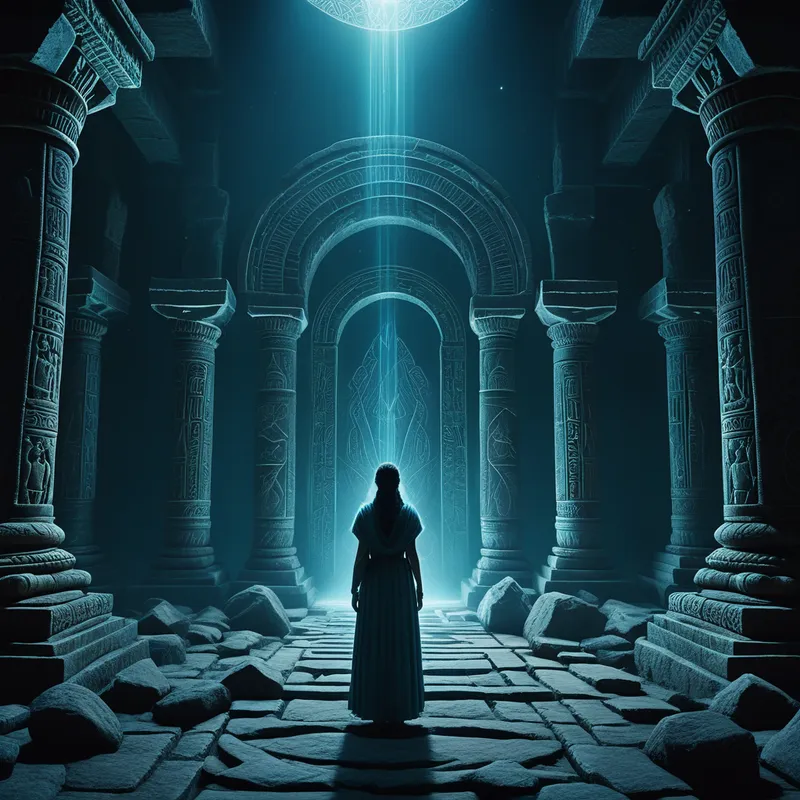
Cultural Origins & Context
The myth of Oduduwa is the foundational narrative of the Yoruba people, one of Africa's largest and most influential ethnic groups, primarily located in what is now southwestern Nigeria, Benin, and Togo. It is not merely a story of creation but the charter myth for divine kingship, social order, and ancestral identity. The city of Ile-Ife remains the spiritual heartland, the site where history and myth converge.
The narrative exists in multiple variants, a testament to its living, oral tradition. In some, Oduduwa is a male deity; in others, particularly those from certain regions and priestly lineages, Oduduwa is understood as a feminine or androgynous cosmic principle, sometimes associated with the earth itself. This duality speaks to the myth's depth—it is about the marriage of sky and earth, the masculine principle of descent and the feminine principle of reception and formation. The most prevalent royal and popular traditions, however, cast Oduduwa as the patriarchal progenitor-king.
The story is intrinsically linked to the institution of the Ooni of Ife, who is considered the direct descendant and living representative of Oduduwa. Every Yoruba kingdom traces its legitimacy back to the dispersal from Ile-Ife, making Oduduwa the common ancestor of all Yoruba kings and, by extension, all Yoruba people. The myth thus provides a sacred template for governance, where political power is legitimized by divine origin and ancestral continuity, not merely by force.
Symbolic Architecture
The myth presents a profound psychological and cosmological blueprint. It moves from undifferentiated chaos (the waters) to ordered reality (the earth) through a decisive act of will and industry. Oduduwa’s descent represents the incarnation of consciousness into the formless potential of the unconscious. He is the archetypal principle that imposes structure, differentiation, and a center upon the psyche’s inner chaos.
The chain from heaven is the axis mundi, the connecting link between the transcendent (Olodumare) and the immanent (the created world). Oduduwa’s act of staying on earth signifies the permanent anchoring of the divine spark within the human realm, the foundation of a world where the sacred and the secular are inseparable.
The sleeping Obatala and the acting Oduduwa can be seen as two modes of engaging with creation: one of contemplative, inward-focused potential that can become lost in its own visions (the drunken sleep), and one of pragmatic, outward-focused actualization that grounds spirit into matter. They are not opposites but a necessary sequence or complementary pair within the creative process.
The five-toed hen is an exquisite symbol of the transformative, detailed work required to build a life or a self. Creation is not a single grand gesture but a continuous process of scratching, scattering, and shaping the raw materials given to us. The palm tree signifies life, resilience, and utility—creation that sustains and provides.

The Dreamer's Resonance
For the individual dreamer or psyche, Oduduwa represents the potent force of individuation—the process of becoming a distinct, grounded, and authoritative self. The chaotic waters mirror the unformed, overwhelming emotions or life circumstances we all face. Oduduwa’s descent is the call to take up our own "shell of sand," our innate gifts and resources, and begin the work of creating solid ground where there seems to be none.
He embodies the archetype of the Founder, the part of us that can establish inner order, set boundaries, and found a stable sense of identity from which to operate in the world. This is not a cold, authoritarian order, but one born of divine mandate and connected to a higher source (the chain from heaven). The myth validates the struggle to create personal structure and meaning as a sacred act.
Furthermore, Oduduwa speaks to the theme of ancestral legacy. He is the internalized "first ancestor," the foundational pattern of our being. Engaging with this myth can prompt questions about one’s own origins, the inherited patterns (both burdens and blessings) from one’s family and culture, and the responsibility to build upon that foundation. It asks: What world are you creating from the materials you’ve been given? What kingdom are you founding within yourself?

Alchemical Translation
In alchemical terms, Oduduwa’s myth is the narrative of coagulatio—the process of making the volatile spirit solid, of giving form to the formless. The watery chaos (solutio, or dissolution) is fixed into the stable earth. The descent down the chain is the distillation of spirit into a point of matter.
The act of pouring sand is the prima materia, the first matter, being placed in the vessel of potential. The scratching hen performs the alchemical operation of separatio and coniunctio simultaneously, separating the solid from the liquid and uniting the elements into a new, third substance: habitable land.
Oduduwa himself undergoes a transmutation: from a celestial messenger, an orisha, he becomes the earthly king, the Ooni. This is the alchemical goal of the rubedo, the reddening, where the spiritual gold is fully embodied in a perfected, royal form. He is the philosopher’s stone of Yoruba cosmology—the point where the divine becomes fully human and the human becomes fully divine, establishing a lineage where this sacred kingship can be perpetuated. His story is the formula for turning leaden chaos into the golden order of a meaningful, anchored existence.
Associated Symbols
Explore related symbols from the CaleaDream lexicon:
- Earth — The primary substance of creation, formed from chaos into solid, life-bearing ground, representing the body, reality, and foundation.
- Chain — The sacred link between heaven and earth, a symbol of connection, descent, and the means by which divine influence reaches the mortal realm.
- King — The embodied principle of sacred order and authority, the human vessel for divine will who establishes structure and lineage for the community.
- Ancestor — The foundational progenitor whose essence and legacy flow through generations, providing identity, legitimacy, and a link to the primordial past.
- Chaos — The primordial, undifferentiated waters that precede creation, representing the unformed potential, confusion, and raw material of existence.
- Order — The principle and act of imposing structure, differentiation, and meaning upon chaos, resulting in a habitable world and a functional psyche.
- Seed — The latent potential carried from the divine realm (the palm nut) that, when planted in the new earth, grows to sustain and shelter the creation.
- Mountain — The first land that rises from the waters, analogous to Ile-Ife as the world-navel, a sacred center and point of emergence.
- Circle — The pattern of the hen scratching the earth outward, symbolizing the expansion of creation from a single point and the cyclical nature of life and lineage.
- Crown — The beaded symbol of authority given to Oduduwa's descendants, representing delegated sovereignty, sacred duty, and the radiant power of kingship.