
Odin's Spear Gungnir Myth Meaning & Symbolism
The myth of the All-Father's spear, forged by dwarves and sworn upon, a symbol of unbreakable oaths, focused will, and the terrible price of wisdom.
The Tale of Odin’s Spear Gungnir
Hear now a tale of the Odin, the All-Father, whose hunger for wisdom was a fire that consumed worlds. In the age when the roots of the Yggdrasil were young, Odin walked the nine realms, his one eye seeing much, but never enough. He knew that the great war, the Ragnarök, was woven into fate’s tapestry, and he sought an edge, a weapon not of mere muscle, but of absolute intent.
His path led him not to the forges of the gods, but down, deep into the stone-veined belly of the earth, to the realm of Svartálfheim. Here, in caverns lit by the glow of molten rivers, dwelt the sons of Ivaldi. The air was thick with the scent of hot metal and ancient stone. Odin, his cloak grey as mountain mist, stood before them, and his presence stilled their hammers. He spoke not of payment, but of a challenge: to craft a spear unlike any other, a weapon that would be an extension of will itself.
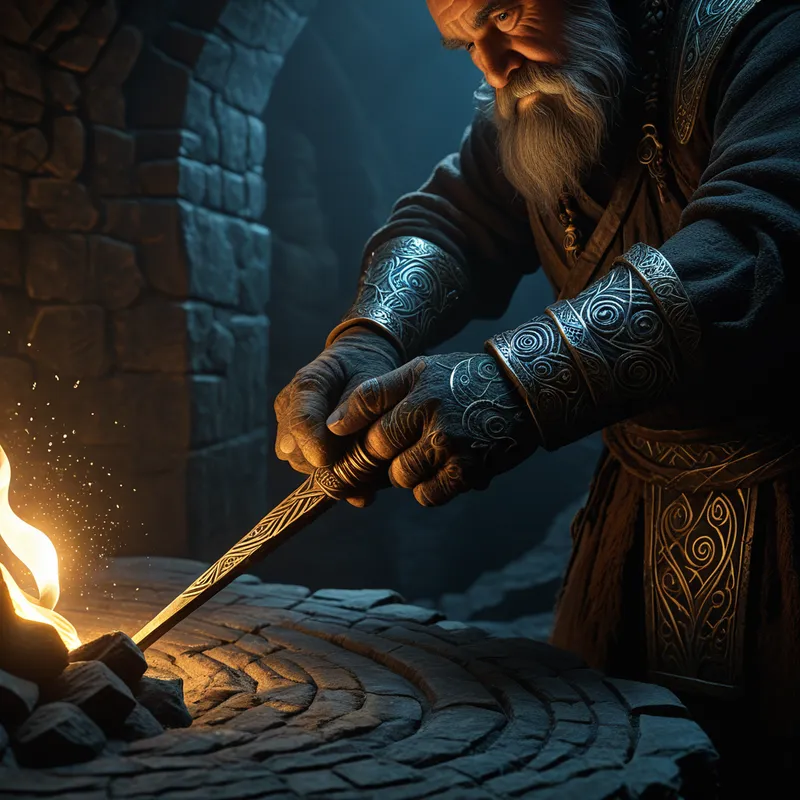
The dwarves, their eyes gleaming in the forge-light, accepted. They gathered iron that had fallen from the stars, and silver mined from the roots of mountains that touched the void. Their hammers sang a song of creation for nine days and nine nights, a rhythm that echoed the heartbeat of the world. They did not merely shape metal; they bound into it the very laws of the cosmos. When they were done, they presented their work.
It was Gungnir. The spear was perfectly balanced, its shaft carved with runes that shimmered like captured starlight, its point so keen it seemed to drink the light around it. But its true power was in its making: the dwarves had enchanted it so that once thrown, it would never miss its mark. It would fly true, a bolt of inevitable fate.
Odin took the spear, and its weight in his hand was the weight of a promise made absolute. He would later stand before the assembled Æsir and Vanir at the founding of their peace. Raising Gungnir high, its point scratching the dome of the sky, he swore a sacred oath upon it. And all who saw knew this: an oath sworn on Gungnir was unbreakable, woven into the fabric of reality itself. The spear became the arbiter of treaties and the herald of war, the instrument through which Odin’s singular will was made manifest in the world. It was the first blow struck in every battle, a streak of certainty hurled into the chaos of clashing armies.
Cultural Origins & Context
The myth of Gungnir is stitched into the fabric of Old Norse literature, primarily found in the Poetic Edda and the later Prose Edda. These texts are not holy books, but repositories of a rich oral tradition, passed down by skalds (poets) and storytellers in the halls of chieftains and around hearth-fires. The story of its forging by the dwarven sons of Ivaldi is part of a larger cycle of tales about the gods acquiring their most famous artifacts, including Mjölnir and Skíðblaðnir.
In the Viking Age society that revered these stories, the spear was not just a weapon of war; it was a profound symbol of authority and legal power. Chieftains and kings would throw a spear over an enemy host to dedicate them to Odin, claiming both the battle and the slain for the god. More peacefully, the ceremonial throwing of a spear over a new territory was an act of claiming sovereignty. Gungnir, as the archetypal spear, embodies this function. It represents the god’s ørlög (primal law) and wyrd (fate) made active. An oath sworn upon it was inviolable, linking the speaker’s word directly to the cosmic order Odin governed. Thus, the myth served to reinforce social structures, the gravity of oaths, and the divine sanction of legitimate rule and warfare.
Symbolic Architecture
Gungnir is far more than a magical weapon; it is a symbolic embodiment of focused consciousness piercing the veil of the unknown.
The spear is the directed will of the ego, but the oath sworn upon it is the covenant of the self with the deeper, often terrifying, truths of the psyche.
Its creation by the dwarves—beings of the earth, of craft, and of the unconscious—signifies that true power and precision are forged in the depths, not in the bright halls of conscious identity. The runes on its shaft are the encoded language of the unconscious, the patterns of meaning that must be understood to wield such power effectively.
The guarantee that it “never misses its mark” symbolizes the inevitable consequence of a fully committed intention. In the psychological realm, this is the moment of insight that cannot be un-seen, the painful truth that, once consciously aimed at, will inevitably strike home. Odin’s use of Gungnir to swear oaths translates this into a moral and existential principle: to swear upon Gungnir is to bind one’s personal identity (ego) to a transpersonal truth (Self), with all the fateful consequences that entails. It is the end of ambivalence.
The Dreamer’s Resonance
When the symbol of Gungnir pierces the modern dreamscape, it often heralds a critical moment of decision or a confrontation with an inescapable truth. To dream of holding such a spear can feel empowering—a somatic sense of clarity, alignment, and potent agency. The dreamer may feel a surge of focused will, ready to “throw” themselves at a life problem.
Conversely, to dream of the spear being thrown at the dreamer, or of being bound by oaths sworn upon it, speaks to a psychological process of being confronted by the consequences of past choices or commitments. The body may register this as a sense of piercing pressure in the chest or gut—the somatic marker of an “oath” or identity structure that has become a prison. The unerring flight of Gungnir in a dream suggests that a period of avoidance or ambiguity is over; a truth is arriving, and it cannot be dodged. The dream is preparing the conscious mind for an impact, for the necessary wounding that precedes integration.

Alchemical Translation
The myth of Gungnir models a crucial phase in the alchemical process of individuation: the fixation of the volatile spirit. Odin’s restless, searching consciousness (his wanderings, his sacrifices for wisdom) is the prima materia—unfocused and diffuse. The forging of Gungnir represents the conscious engagement with the deep, instinctual craftsmen of the psyche (the dwarves/unconscious) to create a tool of precision.
To swear the oath upon the spear is the ultimate act of psychic responsibility, where the individual consciously chooses their fate, binding their scattered energies to a singular, meaningful direction.
The modern individual undergoes this when they move from endless potential and questioning to making a definitive, life-altering choice—choosing a vocation, committing to a relationship, or dedicating oneself to a creative work or spiritual path. This is not a casual decision, but an “oath upon Gungnir.” It feels fateful because it is; it cuts off other possibilities, which is a kind of psychic death. But in that focused commitment, that “never missing its mark,” lies immense power and the ability to truly shape one’s world. The spear’s throw is the point of no return in the individuation journey, where seeking becomes finding, and the question crystallizes into a lived answer. It is the weaponized wisdom of the Sage, used not to dominate others, but to master the chaos within and without, by the sheer force of unwavering, conscious intent.
Associated Symbols
Explore related symbols from the CaleaDream lexicon: