Obatala's White Cloth Myth Meaning & Symbolism
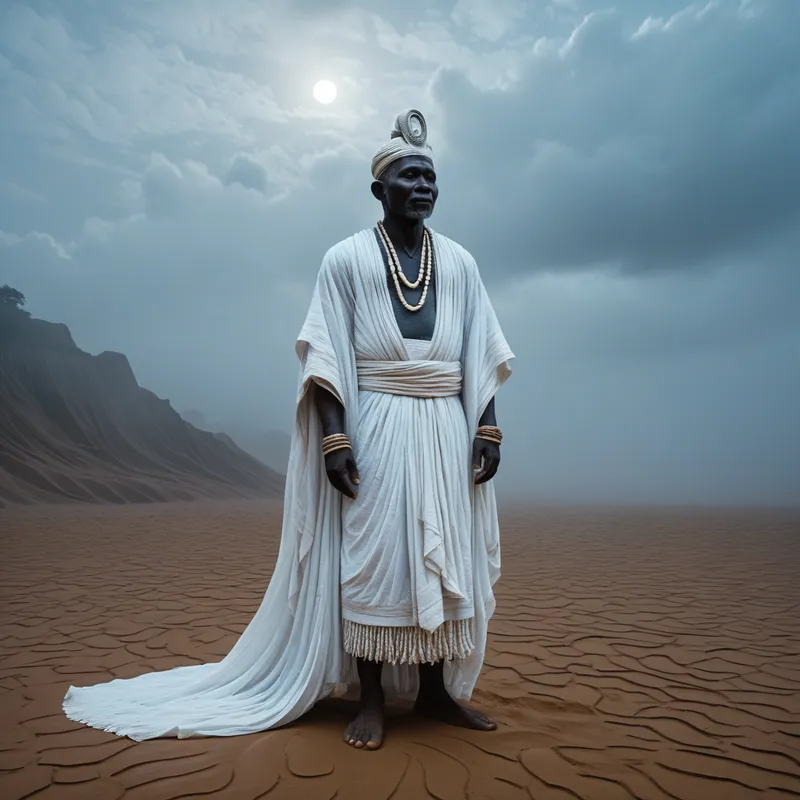
The creator deity Obatala, tasked with shaping humanity, is undone by palm wine. His pristine white cloth is stained, marking a fall from grace and a path to redemption.
The Tale of Obatala’s White Cloth
In the beginning, when the world was a vast marsh of possibility, the Supreme Being, [Olodumare](/myths/olodumare “Myth from Yoruba culture.”/), looked upon the watery chaos and called for order. He summoned [Obatala](/myths/obatala “Myth from Yoruba culture.”/), the eldest of the Orisha, whose essence was clarity, whose thought was precision, and whose form was the color of bleached bone and cloud.
“Go down,” said the voice of creation. “Shape the land from the primeval waters. And from the clay of that earth, fashion the forms of humanity. Pour into them the breath of life I shall grant you.”
Obatala descended on a long chain of gold, carrying a sacred snail shell filled with earth, a five-fingered hen to scatter it, and a palm nut containing the very seed of consciousness. His work was meticulous. With the patience of a mountain, he molded the hills and valleys. Then, from the dark, rich clay, he began to shape figures—each one unique, a vessel awaiting spirit. His hands, the tools of a divine sculptor, moved with grace and solemn purpose. As he worked, he was clothed in a robe of absolute, pristine white, a cloth that reflected his unblemished intent, his cool wisdom, his remove from the messiness of being.
But the world below was not like the clarity above. The sun beat down. The labor was endless. A thirst grew in Obatala—a deep, craving thirst that was both physical and a shadow of the loneliness of creation. He came upon a grove of palm trees, and from their fruit, a clear, inviting liquid had collected. It was palm wine. He drank to quench his thirst. The wine was sweet and cool, but it carried a fire. He drank again, and the fire spread, clouding the pristine lens of his mind, warming the cool certainty in his heart.
His divine focus, once sharp as a star, blurred. The steady hands of the sculptor began to tremble. The figures he now shaped were no longer perfect. Some were bent, some were blind, some bore the marks of his distraction. And as he stumbled in his sacred task, the clay, wet and dark, smeared across his magnificent white cloth. The pure fabric, the symbol of his essence, was now stained with the earthy evidence of his faltering. He fell into a deep, drunken sleep, his work unfinished, his purity compromised.
When he awoke, the clarity returned with the sharp pain of realization. He looked upon his stained robe, upon the imperfect forms around him. Shame, a feeling unknown in the heavens, washed over him like a cold tide. He returned to Orun, not in triumph, but in humility, the stained cloth a testament to his fall. Olodumare saw his remorse. The work of breathing life into the figures, both the perfect and the imperfect, was completed by other hands. But for Obatala, a decree was made: never again would he touch the palm wine. And the white cloth, now eternally associated with him, became not a badge of impossible purity, but a symbol of the aspiration to clarity after the fall, a testament to work that continues despite—and because of—its flaws.
Cultural Origins & Context
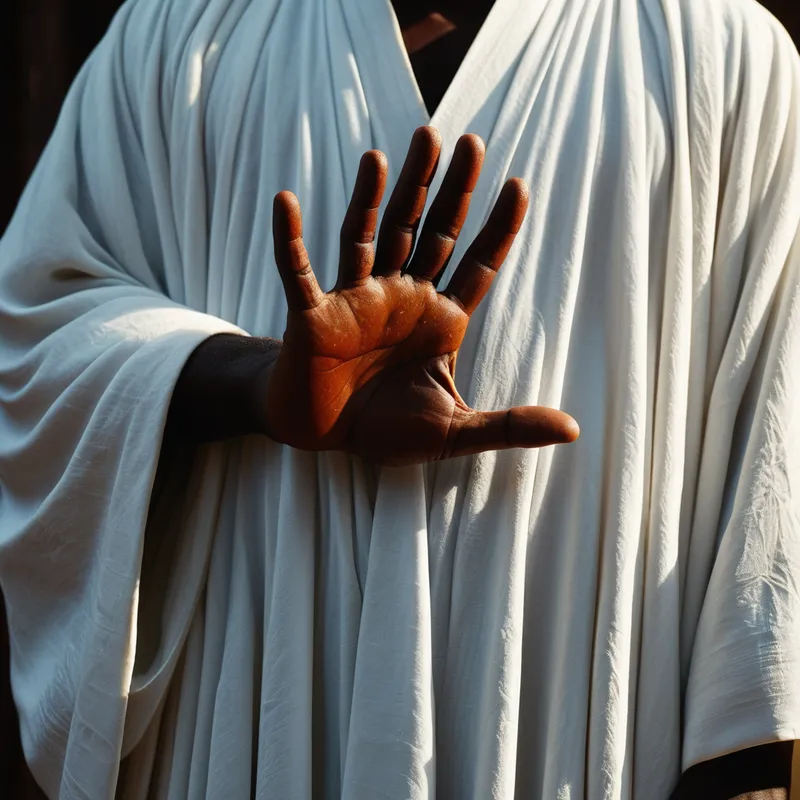
This myth originates from the rich oral tradition of the Yoruba people of West Africa, whose sophisticated cosmology and religious philosophy have influenced diasporic traditions like Santería, Candomblé, and Vodou. The stories of the Orisha were not mere entertainments but the foundational narratives held by priests (Babalawo) and passed down through generations via ritual, ceremony, and the iconic Ifa literary corpus.
The tale of Obatala’s White Cloth served multiple societal functions. It established a theological framework for the diversity and imperfections of the human condition, offering a non-judgmental origin for physical and mental differences. It also functioned as a profound ethical lesson about the responsibilities of creation and leadership, the dangers of indulgence (Eewo), and the paramount importance of intention (Iwa). Furthermore, it sacralized the color white within Yoruba aesthetics, linking it to Obatala, his priests, and rituals of peace, healing, and wisdom, prescribing it as the proper attire for ceremonies seeking clarity and coolness (Itutu).
Symbolic Architecture
The myth is a masterclass in symbolic [density](/symbols/density “Symbol: Represents the concentration of matter, energy, or meaning in a given space, often symbolizing complexity, weight, or substance.”/). Obatala represents the archetypal [Creator](/symbols/creator “Symbol: A figure representing ultimate origin, divine power, or profound authorship. Often embodies the source of existence, innovation, or personal destiny.”/), the [aspect](/symbols/aspect “Symbol: A distinct feature, quality, or perspective of something, often representing a partial view of a larger whole.”/) of [consciousness](/symbols/consciousness “Symbol: Consciousness represents the state of awareness and perception, encompassing thoughts, feelings, and experiences.”/) that seeks to impose order, form, and meaning onto the formless [chaos](/symbols/chaos “Symbol: In Arts & Music, chaos represents raw creative potential, uncontrolled expression, and the breakdown of order to forge new artistic forms.”/) of the unconscious (the primeval waters). His White [Cloth](/symbols/cloth “Symbol: Cloth often symbolizes protection, comfort, and transformation, serving as a barrier and a medium for expression in dreams.”/) is the perfect [symbol](/symbols/symbol “Symbol: A symbol can represent an idea, concept, or belief, serving as a powerful tool for communication and understanding.”/) of this intent: it is the unsullied [canvas](/symbols/canvas “Symbol: A blank surface representing potential, creativity, and the foundation for expression or identity.”/) of the ego, the ideal self, the pure thought before it engages with the messy [reality](/symbols/reality “Symbol: Reality signifies the state of existence and perception, often reflecting one’s understanding of truth and life experiences.”/) of manifestation.
The fall is not into sin, but into experience. The stain is not a mark of evil, but the indelible signature of reality upon the ideal.
The [Palm](/symbols/palm “Symbol: The palm tree symbolizes resilience, victory, and peace, often associated with tropical climates.”/) [Wine](/symbols/wine “Symbol: Wine often symbolizes celebration, indulgence, and the deepening of personal connections, but it can also represent excess and escape.”/) is the intoxicant of embodiment itself—the sensations, passions, and instincts that inevitably cloud pure intellect when one engages fully with [life](/symbols/life “Symbol: The symbol of ‘Life’ represents a journey of growth, interconnectedness, and existential meaning, encompassing both the joys and challenges that define human experience.”/). It is the necessary descent from the [mountain](/symbols/mountain “Symbol: Mountains often symbolize challenges, aspirations, and the journey toward self-discovery and enlightenment.”/) of perfect ideas into the [valley](/symbols/valley “Symbol: A valley often symbolizes a period of transition or a place of respite between two extremes.”/) of flawed [action](/symbols/action “Symbol: Action in dreams represents the drive for agency, motivation, and the ability to take control of situations in waking life.”/). The resulting Stain on the white cloth is therefore the central, transformative symbol. It marks the end of naive perfectionism and the beginning of conscious, compassionate creation. It signifies that true wisdom and creative power are born not from remaining unstained, but from acknowledging, integrating, and working with the stain. Obatala, thereafter, is not the god of perfect creation, but the god of creation that perseveres through imperfection.
The Dreamer’s Resonance
When this myth pattern surfaces in modern dreams, it often signals a critical phase in what psychology might call the “deflation of the ego ideal.” The dreamer may encounter images of pristine white objects (clothing, rooms, surfaces) becoming irrevocably stained, dirtied, or torn. There may be a sense of profound shame or failure associated with the staining.
Somnatically, this can feel like a “falling” sensation or a hot flush of embarrassment upon waking. Psychologically, it indicates the individual is grappling with the gap between their idealized self-image (the perfect white cloth) and the reality of their human limitations, mistakes, or “messy” instincts (the palm wine and clay). The dream is not a condemnation, but a profound initiation. It is the unconscious insisting that the dreamer’s identity must expand to include the flawed, the embodied, the instinctual—the very things that were previously seen as contaminants to their self-concept. The process is one of moving from a brittle purity to a resilient, stained wholeness.

Alchemical Translation
In the alchemy of individuation, Obatala’s journey models the opus contra naturam—the work against one’s own naive nature. The initial state is the albedo, the whitening: the conscious identification with purity, perfection, and cerebral control (the white cloth). The palm wine represents the necessary nigredo, the blackening or descent into the unconscious, where one is “intoxicated” by repressed complexes, passions, and shadow material.
The goal is not to launder the cloth back to its original state, but to discover that the gold of wisdom is woven from the very thread of the stain.
The staining is the crucial coniunctio oppositorum—the conjunction of opposites where the perfect ideal (white) marries the imperfect reality (stain). For the modern individual, this translates to the painful but liberating process of abandoning the narcissistic project of being a “perfect” person—perfect parent, perfect professional, perfectly spiritual being. The triumph is Obatala’s return to work under a new decree. The psychic transmutation is complete when one can don the “stained white cloth” with humility and purpose, creating and acting in the world not from a place of untouchable superiority, but from a grounded, compassionate, and integrated self that has made peace with its own fallibility. The white cloth is no longer an emblem of what one is, but a compass pointing toward what one aspires to amidst the inevitable clay and wine of existence.
Associated Symbols
Explore related symbols from the CaleaDream lexicon:
- Cloth — The fundamental substance of identity and presentation; in this myth, it is the pristine medium of divine intent that becomes the canvas for the record of human error and redemption.
- White — The color of purity, clarity, and unmanifest potential, representing the ideal state of consciousness before it engages with the complexities and compromises of creation.
- Earth — The raw, primal material of form and embodiment, the clay that both obeys and resists the shaper’s hand, symbolizing the physical reality that grounds and tests all ideals.
- Water — The primeval chaos and the unconscious from which form emerges, but also the palm wine as a transformative, intoxicating fluid that dissolves boundaries and precipitates the fall into experience.
- God — The archetype of the supreme creator and lawgiver (Olodumare), and the flawed creator (Obatala), representing the duality of transcendent perfection and immanent, struggling consciousness.
- Shame — The visceral psychological consequence of the fall, the hot recognition of the gap between one’s ideal self and one’s actions, which becomes the crucible for genuine humility.
- Creation — The central act of bringing form from chaos, which is revealed to be an imperfect, iterative process fraught with distraction and requiring integration of failure.
- Sacrifice — Obatala’s sacrifice is his state of perfect purity; he gives up his untouchable ideality to fully engage in the messy, sacred work of making the world and its beings.
- Light — The illuminating principle of consciousness and clarity that Obatala embodies, which must learn to shine through the stained fabric of experience rather than from a detached, sterile height.
- Rebirth — The psychological renewal that follows the fall; not a return to a previous innocent state, but the birth of a new, more complex and compassionate mode of being centered on redemption.
- Ritual — The prescribed avoidance of palm wine becomes a lifelong ritual observance, turning a moment of failure into a structured path of remembrance, discipline, and dedicated service.