Oak King and Holly King Myth Meaning & Symbolism
A myth of two brothers, one of light and one of shadow, locked in an eternal duel that governs the turning of the year and the soul.
The Tale of Oak King and Holly King
Listen. In the deep heart of the world, where the roots of the great trees drink from the well of time, there is a story that breathes with the land itself. It is the story of two brothers, two kings, two faces of the same sovereign spirit.
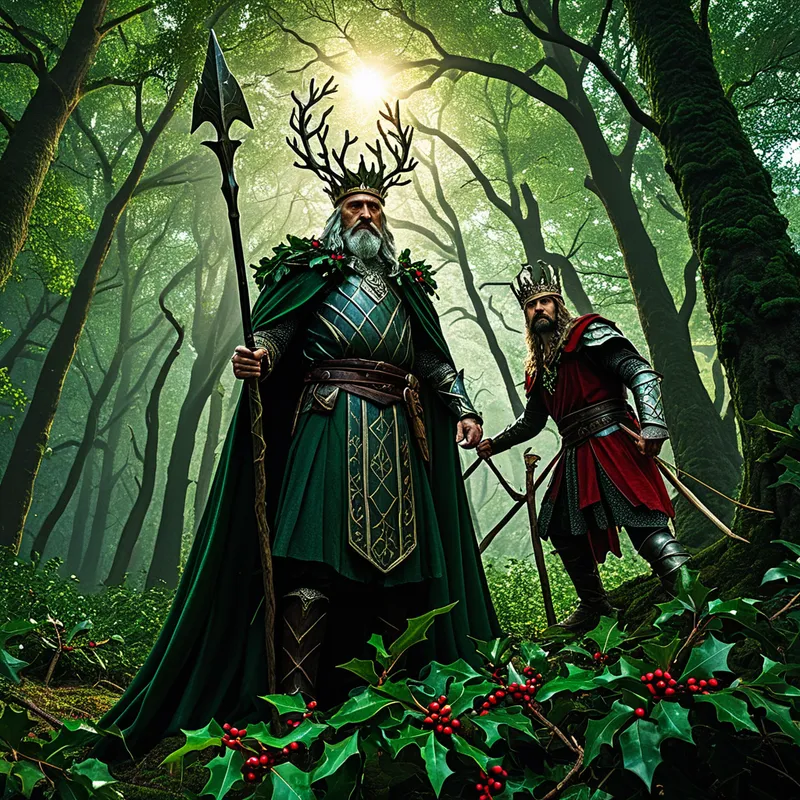
He is the Oak King. In the high, green halls of the forest, he reigns. His crown is a canopy of new leaves, catching the first gold of the dawn. His breath is the warm, damp scent of life pushing through fertile soil; his voice, the rustle of a thousand unfurling buds. He is the strength of the sun at its zenith, the promise of the seed, the generous, outward rush of growth. His rule is the long, bright day.
And he is the Holly King. He dwells in the silent, evergreen groves where the light falls in slivers. His crown is a circlet of dark, prickly leaves and berries like drops of winter blood. His breath is the crisp, clean air of frost; his voice, the creak of ancient boughs in a still night. He is the wisdom of the deep root, the keeper of secrets, the inward pull toward rest and reflection. His rule is the long, contemplative night.
They are not enemies, but counterparts. Yet, twice each year, at the hinges of the world, they must meet. The air grows thick with the scent of honeysuckle and heated earth. It is the summer solstice. On a sun-drenched hill, beneath a sky of endless blue, they face one another. No words are spoken, for their conflict is older than language. The Oak King, radiant in his power, raises his spear of living wood. The Holly King, patient and enduring, draws his sword of dark yew.
The battle is not of clanging metal, but of shifting light. It is the contest of expansion against contraction, of outpouring against gathering. For a timeless moment, the world holds its breath. Then, with a sigh that runs through every root and stone, the Oak King triumphs. The Holly King yields, his form seeming to retreat into the deepening shadows of the forest edge. The Oak King stands supreme, but even in his victory, the first subtle hint of twilight touches his crown.
The wheel turns. The days shorten. The air smells of woodsmoke and decaying leaves. At the winter solstice, in a clearing silvered by moonlight and dusted with frost, they meet again. Now, the Holly King is formidable, his presence a solid, comforting darkness. The Oak King, his vitality drawn inward, fights with the fierce beauty of a final, brilliant sunset. And once more, the balance shifts. The Holly King prevails. The Oak King falls, not to death, but to a necessary sleep, sinking into the dreaming earth to gather his strength. The Holly King rules the silent, star-bright world, guarding the latent spark of life within the frozen ground. And so it has been, and so it will be, forever.
Cultural Origins & Context
The precise, ancient telling of this myth is lost to the oral traditions of the pre-Christian Celtic world. It is a reconstruction, a scholarly and folkloric tapestry woven from fragments: the persistent duality in Celtic thought, the veneration of specific trees encoded in the Ogham alphabet, and the deep ritual importance of the solstices. The oak, particularly the Robur, was the tree of the high god, of lightning, sovereignty, and durability. Holly, evergreen and protective, was associated with the Otherworld, with life persisting in the season of death.
This was not a story written in books, but one enacted in the landscape and the communal mind. It was likely a narrative framework held by the Druids and bards, used to explain and sanctify the relentless, beautiful cycle of the year. Its societal function was profound: to root human life, agriculture, and ritual in a cosmic order that was neither cruel nor random, but a sacred, eternal exchange. It taught that darkness is not evil, but necessary; that light must eventually rest; that kingship—over land or self—is a duty that passes in its season.
Symbolic Architecture
At its core, this myth is a masterful articulation of the principle of enantiodromia—the tendency of any extreme state to eventually transform into its opposite. It is nature’s great metaphor for the dynamic equilibrium that underpins all existence.
The crown is never truly won, only worn in turn. Sovereignty is the recognition that one’s time is both absolute and fleeting.
The Oak King symbolizes the conscious ego in its expansive phase: our outward ambition, generative power, social identity, and the full expression of vitality. He is the hero who builds, conquers, and creates in the light of day. The Holly King symbolizes the necessary counterpart: the unconscious, the introverted self, the period of gestation, shadow-work, and wisdom gleaned from withdrawal. He is the ruler of the interior castle, the keeper of secrets the bright ego cannot yet bear to see.
Their battle is not destruction, but the very mechanism of change. The solstices are the psychological points of crisis and reversal, where one dominant attitude must cede to its opposite for the whole system—the psyche, the community, the ecosystem—to survive and thrive.
The Dreamer’s Resonance
When this myth stirs in the modern dreamer, it often manifests as a profound sense of internal conflict at a life transition. You may dream of two figures fighting, of a changing landscape, or of yourself wearing a crown that transforms from leaves to berries. You may feel caught between a drive to achieve (Oak) and a deep need to rest and reflect (Holly).
Somatically, this can feel like a tug-of-war in the body: restless energy versus heavy fatigue, a desire to speak out battling a urge to stay silent. Psychologically, it marks the process of a dominant complex—perhaps the relentless “achiever” or the withdrawn “hermit”—reaching its zenith and becoming unsustainable. The dream is the psyche’s innate wisdom staging this necessary coup, orchestrating the fall of one inner king so the other may rise and restore balance. It is the unconscious preparing the dreamer for their own personal solstice.
Alchemical Translation
For the individual on the path of individuation, the myth of the kings is a blueprint for psychic transmutation. The goal is not to choose one king and slay the other forever, but to become the sacred grove that contains them both, to become the wheel upon which they turn.
The alchemical work begins with recognizing which “king” has held the throne too long. Has the Oak King’s endless summer led to burnout, a brittle identity all facade? Or has the Holly King’s winter fostered stagnation, a retreat from life’s demands? The conscious ego must learn to perform the sacred surrender at the appropriate time—to willingly lay down its spear when its season is done.
The ultimate triumph is to hold the paradox: to be both the vibrant growth and the deep, enduring root, understanding that each phase secretly nourishes the other.
This is the Mysterium Coniunctionis applied to the rhythms of the soul. We integrate the Holly King not by becoming perpetually dark, but by honoring the value of introspection, boundaries (the prickly leaves), and the wisdom found in stillness. We integrate the Oak King not through constant striving, but through conscious, fertile action when the time is right. In doing so, we move from being subjects of these inner rulers to becoming the sovereign who understands the sacred law of the turning year, within and without. We cease to be torn by the battle and become, instead, the living landscape where it meaningfully unfolds.
Associated Symbols
Explore related symbols from the CaleaDream lexicon: