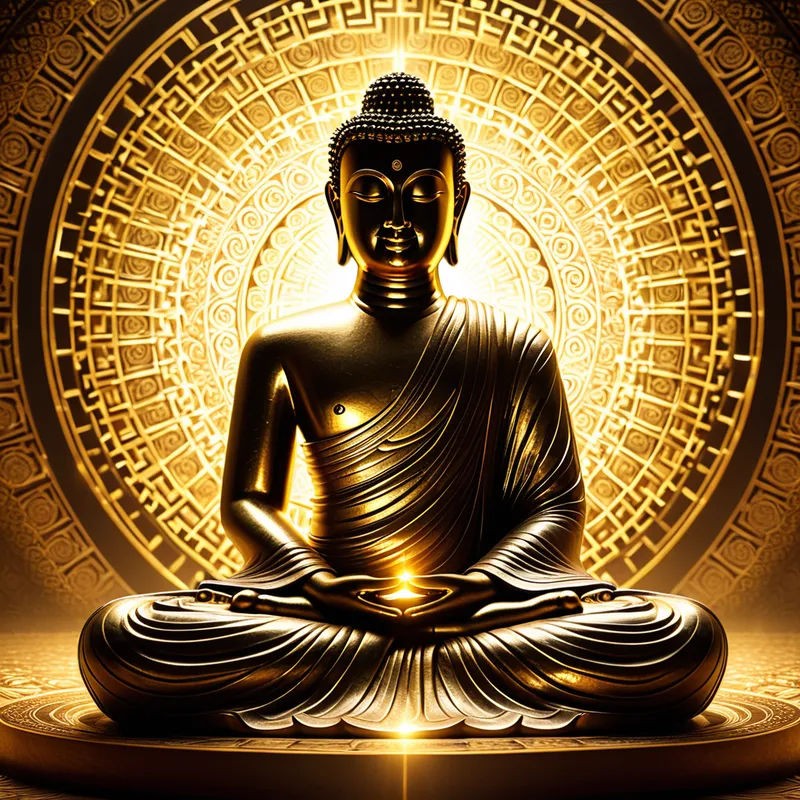
Śūnyatā Myth Meaning & Symbolism
A journey into the heart of reality, where form dissolves into luminous, pregnant emptiness, revealing the interdependent nature of all existence.
The Tale of Śūnyatā
Listen. Before the first thought, before the first name, there is a silence so vast it contains all sound. This is not a story of a god who speaks [the world](/myths/the-world “Myth from Tarot culture.”/) into being, but of a sage who sat down beneath the sheltering arms of the Bodhi tree and vowed not to rise until he had pierced the very heart of reality.
The air was thick with the hum of night insects and the weight of countless lifetimes. The Prince felt [the earth](/myths/the-earth “Myth from Hindu culture.”/) solid beneath him, yet he sought what lay beneath that solidity. He turned his gaze inward, a fearless explorer charting the continents of his own mind. He witnessed the grand procession of his senses—the sight of the stars, the scent of the soil, the memory of palace pleasures and the sight of old age. He saw them not as truths, but as fleeting images cast upon the screen of consciousness.
Then came the assault of Māra. He did not come with swords of fire, but with weapons far more insidious: doubt, whispering that his quest was vanity; fear, painting visions of oblivion; and desire, singing the old, sweet songs of a self to be cherished and protected. Māra’s army was the totality of clinging, the desperate wish for something—anything—to be solid, permanent, and exclusively “me.”
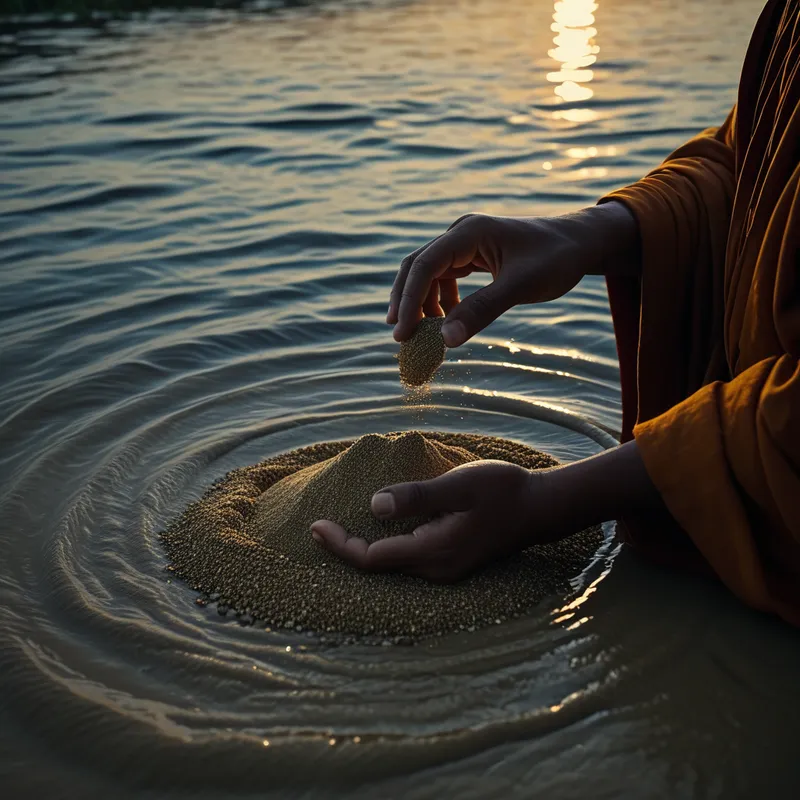
The sage did not fight. He simply touched the earth. His fingers brushed the cool, damp soil, and in that touch, he called the very world as his witness. He saw the earth not as a [thing](/myths/thing “Myth from Norse culture.”/), but as a process—a swirling dance of elements, born from stars, hosting life, returning to dust. He saw his own body in that same dance: [water](/myths/water “Myth from Chinese culture.”/) from ancient rains, minerals from exploded suns, breath shared with every living thing. The boundary between “the one who sits” and “the ground that is sat upon” shimmered, thinned, and vanished like a mirage.
In that moment of supreme, unwavering attention, the great unraveling began. The tapestry of self, woven so tightly from thread of memory, sensation, and thought, began to unpick itself. He saw that every perceived thing—the tree, the feeling, the thought, the “I”—existed only in relation to everything else. Like a net of jewels, each gem holds its place only because of the others; no single jewel is the net. This dependent arising, this radical relativity, left at its heart a profound and luminous absence: the absence of any isolated, independent, permanent essence.
This was not a nihilistic void, but a liberating emptiness—Śūnyatā. It was the still point at the center of the turning world, a silence that was not dead but vibrantly alive with potential. From this emptiness, compassion arose naturally, unbidden, for he saw all beings trapped in the same web of mistaken solidity, fighting phantoms of their own making. At dawn, as [the morning star](/myths/the-morning-star “Myth from Astrological culture.”/) pierced [the sky](/myths/the-sky “Myth from Persian culture.”/), he was awake. The Buddha rose, not as a conqueror who had seized a thing, but as one who had finally put down an unbearable, illusory weight.
Cultural Origins & Context
The mythos of Śūnyatā is not a single tale with a beginning and end, but the deep, flowing undercurrent of the entire Buddhist philosophical and contemplative project. Its primary “storytellers” were the historical Buddha and the later masters of the Prajñāpāramitā tradition. These teachings were transmitted orally for centuries before being committed to palm leaves, not as dogma to be believed, but as a map for a transformative inner journey.
Its societal function was revolutionary. In the context of ancient Indian thought, which ranged from eternalist doctrines of an immortal soul (ātman) to materialist nihilism, the teaching of Śūnyatā presented a “Middle Way.” It deconstructed the metaphysical assumptions that underpinned social stratification, existential anxiety, and the cycle of craving and aversion (saṃsāra). To realize emptiness was to be free, and this freedom was offered as a potential for all, irrespective of birth.
Symbolic Architecture
The myth is a masterclass in the [symbolism](/symbols/symbolism “Symbol: The use of symbols to represent ideas or qualities, often conveying deeper meanings beyond literal interpretation. In dreams, it’s the language of the unconscious.”/) of de-[construction](/symbols/construction “Symbol: Construction symbolizes creation, building, and the process of change, often reflecting personal growth and the need to build a solid foundation.”/). The [Bodhi tree](/symbols/bodhi-tree “Symbol: The sacred fig tree under which Siddhartha Gautama attained enlightenment, symbolizing awakening, wisdom, and the interconnectedness of all life.”/) is not just a [location](/symbols/location “Symbol: The symbol of ‘Location’ signifies a sense of place, context, and the environment in which experiences unfold.”/); it is the [axis](/symbols/axis “Symbol: A central line or principle around which things revolve, representing stability, orientation, and the fundamental structure of reality or consciousness.”/) mundi where the personal [psyche](/myths/psyche “Myth from Greek culture.”/) aligns with the cosmic order. Māra symbolizes the entire psychic apparatus of [the ego](/myths/the-ego “Myth from Jungian culture.”/)—our fears, desires, and identifications—which must be fully confronted and seen through, not defeated in battle.
Śūnyatā is the ultimate symbol: it is the empty center that allows the wheel to turn, the silence between notes that makes the music, the space within the cup that makes it useful.
The “[Earth](/symbols/earth “Symbol: The symbol of Earth often represents grounding, stability, and the physical realm, embodying a connection to nature and the innate support it provides.”/)-Touching” [gesture](/symbols/gesture “Symbol: A non-verbal bodily movement conveying meaning, emotion, or intention, often symbolic in communication and artistic expression.”/) (Bhūmisparśa Mudrā) is profoundly symbolic. It represents grounding ultimate realization in the relative, phenomenal world. [Emptiness](/symbols/emptiness “Symbol: Emptiness signifies a profound sense of void or lack in one’s life, often related to existential fears, loss, or spiritual quest.”/) is not elsewhere; it is the very [nature](/symbols/nature “Symbol: Nature symbolizes growth, connectivity, and the primal forces of existence.”/) of the ground beneath our [feet](/symbols/feet “Symbol: Feet symbolize our foundation, stability, and the way we connect with the world around us, often reflecting our sense of direction and purpose.”/). The [dissolution](/symbols/dissolution “Symbol: The process of breaking down, dispersing, or losing form, often representing transformation, release, or the end of a state of being.”/) of [the self](/myths/the-self “Myth from Jungian culture.”/) is not an annihilation, but the [discovery](/symbols/discovery “Symbol: The act of finding something previously unknown, hidden, or lost, often representing personal growth, new opportunities, or hidden aspects of the self.”/) of a vaster, interconnected [identity](/symbols/identity “Symbol: Identity represents the sense of self, encompassing personal beliefs, cultural background, and social roles.”/). The “awakening” is the [moment](/symbols/moment “Symbol: The symbol of a ‘moment’ embodies the significance of transient experiences that encapsulate emotional depth or pivotal transformations in life.”/) when the dream of separateness ends, and one realizes one was always the entire dreaming field.

The Dreamer’s Resonance
When this myth stirs in the modern unconscious, it often manifests in dreams of dissolution, loss, or profound spatial paradoxes. One may dream of their house having endless, unfamiliar rooms, or of their reflection in a mirror being empty or showing a stranger. These are not nightmares of erasure, but the psyche’s somatic processing of ego-dystonic material—the deep intuition that the solid “I” we present to the world is a construct.
The psychological process is one of dis-identification. The dreamer is undergoing a necessary shedding, where outdated self-concepts (the “I am a victim,” “I am my career,” “I am my past”) are being seen as insubstantial. There is often accompanying anxiety, the psychic equivalent of Māra’s last stand. But if one can stay with the dream-feeling without panic, a profound relief can follow—the relief of no longer having to defend a fiction.

Alchemical Translation
For the modern individual on the path of individuation, the myth of Śūnyatā models the alchemical stage of [solutio](/myths/solutio “Myth from Alchemical culture.”/)—dissolution. Our culture prizes coagulation: building a solid identity, a strong brand, a definitive story. Individuation, however, requires the periodic dissolving of these very structures to prevent psychic rigidity and inflation.
The alchemical gold is not a stronger, shinier ego, but the capacity to rest in the luminous ground of being from which all egoic forms temporarily arise and pass away.
The process begins with “sitting beneath the Bodhi tree”—committing to self-inquiry and meditation. We then must face our personal Māra: [the shadow](/myths/the-shadow “Myth from Jungian culture.”/) aspects, the clinging to narratives of wounding or superiority, the fear of meaninglessness. The “Earth-Touching” moment is the integration, where the insight of emptiness is not a transcendent escape, but a way of being fully, compassionately engaged in the world. We touch the earth by embracing our relationships, our work, and our vulnerabilities, not as solid, independent things, but as fleeting, precious expressions of the same interdependent web. The [triumph](/myths/triumph “Myth from Roman culture.”/) is a transformation from a psyche based on having (an identity) to one grounded in being (an open, compassionate awareness). This is the awakening where one becomes, as the sage is called, a Bodhisattva of the ordinary world.
Associated Symbols
Explore related symbols from the CaleaDream lexicon: