Nyame Creator God Ashanti Myth Meaning & Symbolism
The Sky God Nyame holds all wisdom, sending his children to Earth, creating a world where humanity must seek divine knowledge through sacrifice and story.
The Tale of Nyame Creator God Ashanti
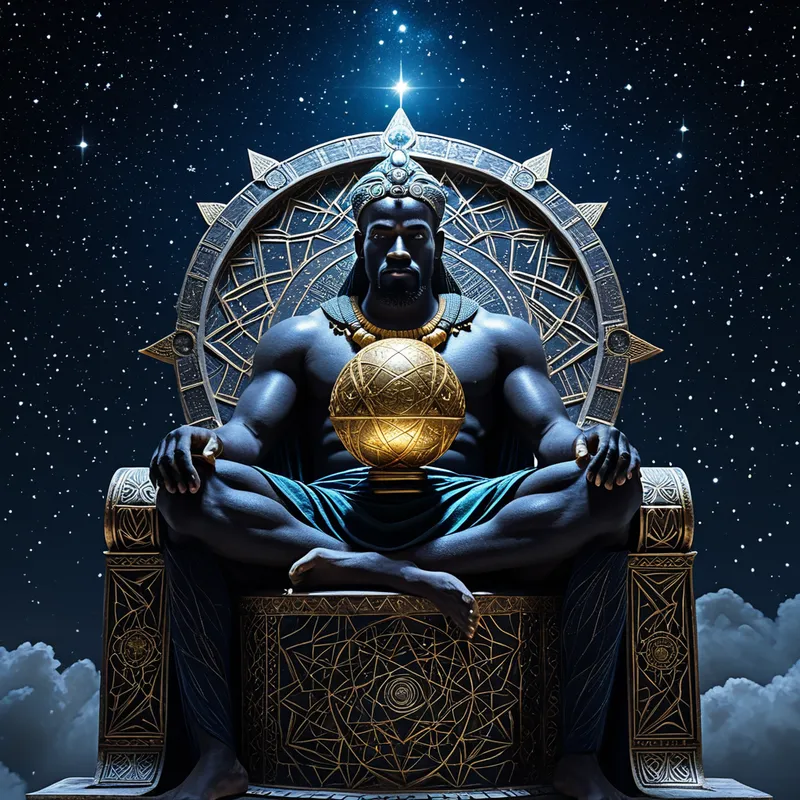
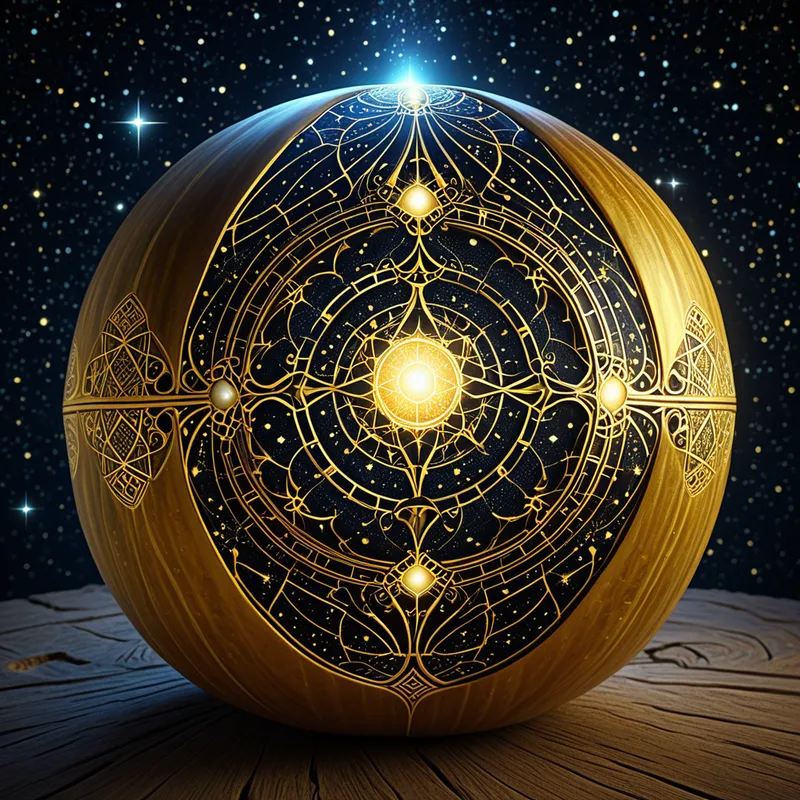
In the time before time, there was only the great, dark, and beautiful expanse of the Sky. And in that Sky dwelt Nyame, the All-Powerful, the One Who Knows All Things. His breath was the wind that stirred the nothingness; his thoughts were the first sparks of light that became the stars. He was complete, holding the Wisdom of the universe in a great, golden orb that shone with the light of a thousand suns.
But completeness, in its perfection, can be a lonely thing. From his own essence, Nyame brought forth his children: Nyame, whose gentle light silvered the void, and Anansi, whose mind was as quick and twisting as a vine. Yet the Sky was vast and empty. So Nyame took the golden orb of Wisdom and from it, he fashioned a new thing: a world of rich, brown Earth, of towering mountains and deep, flowing rivers. He placed this world far below his starry throne, a jewel hanging in the dark.
He sent his daughter, Nyame the Moon, to watch over the night, and his son, Anansi, to roam the new world and fill it with stories. But the world was silent. It had life, but no voice; it had form, but no understanding. Nyame looked upon his creation and felt a new longing—not for company, but for connection. He desired beings who could look up at his stars and wonder, who could feel the rain and know it as a blessing.
So, from the clay of the new Earth and a breath of his own sky-spirit, Nyame fashioned the first humans. He placed them in a garden of immense beauty, where a single, colossal Odum tree reached its branches towards the heavens. But he kept the golden orb of Wisdom with him in the sky. “To live is one thing,” Nyame declared, his voice the rumble of distant thunder. “To know why you live, to understand the laws of the Sun and the Moon, that is another. That wisdom must be earned, not given.”
The humans prospered, but they lived in a state of innocent ignorance. They felt the absence of the wisdom like a hunger in their souls. They would gaze at the night sky, sensing the great mind of Nyame, but could not hear his thoughts. The world was a beautiful Riddle they could not solve.
Seeing their yearning, the trickster Anansi conceived a plan. He wished to possess the stories and wisdom for himself, to be the great connector between sky and earth. He wove a web of cunning so fine it was invisible, and he climbed, on threads of his own making, up the great Odum tree, higher and higher, until he stood before Nyame’s throne.
“Father,” said Anansi, his voice full of false humility. “The humans below are like children in the dark. Let me take the wisdom to them. I will be its keeper and teacher.” Nyame, whose wisdom included knowing the heart of his son, was wary. But he also saw the truth in the longing of his earthly children. He set a price, a test of both human desire and Anansi’s cleverness.
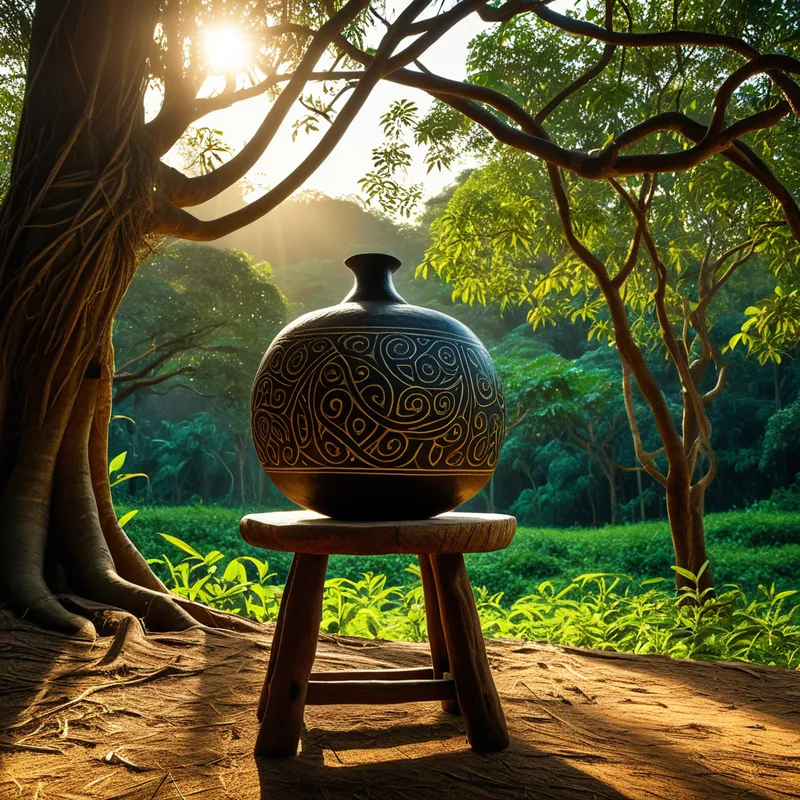
“The wisdom is contained here, in this golden orb,” Nyame said. “I will place it inside a calabash. You may take it to the people, but you must pay my price: you must bring me Osebo the leopard-of-the-sharp-teeth, Mmoboro the hornets-who-sting, and Mmoatia the fairy-whom-never-seen.”
What followed was a Journey of guile and daring, not with a warrior’s sword, but with a trickster’s wit. Anansi used cunning traps, flattery, and deception to capture each impossible creature. He delivered them to Nyame, proving that determination and intelligence could meet the divine challenge. Nyame, bound by his word, placed the shimmering orb of Wisdom into a smooth, hard calabash and gave it to Anansi.
Triumphant, Anansi began his descent. But the calabash was heavy, not with physical weight, but with the gravity of all knowledge. As he climbed down the great tree, the orb shifted, the calabash slipped from his grasp, and it fell. It struck the earth and shattered into countless fragments.
A great flash of golden light erupted, and a wind of knowing swept across the world. The wisdom did not land in one place, in one person’s hands. It scattered. A piece flew into the River, another into the heart of the Forest. A fragment lodged in the Stone, and another was carried by a Bird to a far-off land. From that day, no one person or creature could hold all wisdom. It became the birthright and the lifelong Quest of all humanity—to seek out the scattered pieces, to gather understanding through story, through study, through the hard lessons of life, and through looking up at the sky from which it all came.
Cultural Origins & Context
This myth originates from the Ashanti people of West Africa. It was not written in sacred texts but lived in the oral tradition, passed down through generations by griots and elders around evening fires. The telling was a communal ritual, a way of binding the people to their cosmology and their social order. Nyame was not a distant, abstract concept; he was the ultimate Ruler, and the Ashanti king, the Asantehene, was considered his earthly representative. The myth served to explain the human condition—our innate intelligence coupled with our profound ignorance—and to validate the Ashanti societal values of cleverness (embodied by Anansi), perseverance, and the pursuit of knowledge. It functioned as a foundational philosophy, teaching that divine connection and wisdom are accessible but require effort, respect, and often, navigating the tricky interplay between destiny and cunning.
Symbolic Architecture
The myth presents a profound symbolic map of the psyche’s origins. Nyame represents the unified, transcendent Self—the state of wholeness and omniscience that exists before [consciousness](/symbols/consciousness “Symbol: Consciousness represents the state of awareness and perception, encompassing thoughts, feelings, and experiences.”/) enters the [realm](/symbols/realm “Symbol: The symbol of ‘Realm’ often signifies the boundaries of one’s consciousness, experiences, or emotional states, suggesting aspects of reality that are either explored or ignored.”/) of duality and experience.
The original state is wholeness, but consciousness is born from separation. The cosmos itself is a story of the One becoming the Many to know itself.
The golden orb of Wisdom is the latent totality of the psyche—all potential [knowledge](/symbols/knowledge “Symbol: Knowledge symbolizes learning, understanding, and wisdom, embodying the acquisition of information and enlightenment.”/), archetypes, and laws of being. Its placement in the sky signifies that this wholeness is our [origin](/symbols/origin “Symbol: The starting point of a journey, often representing one’s roots, source, or initial state before transformation.”/) and our ultimate goal, but it is not our starting point in [life](/symbols/life “Symbol: The symbol of ‘Life’ represents a journey of growth, interconnectedness, and existential meaning, encompassing both the joys and challenges that define human experience.”/). The act of creation—forming the [Earth](/symbols/earth “Symbol: The symbol of Earth often represents grounding, stability, and the physical realm, embodying a connection to nature and the innate support it provides.”/) and humans—is the divine ego, the [Creator](/symbols/creator “Symbol: A figure representing ultimate origin, divine power, or profound authorship. Often embodies the source of existence, innovation, or personal destiny.”/) [archetype](/symbols/archetype “Symbol: A universal, primordial pattern or prototype in the collective unconscious that shapes human experience, behavior, and creative expression.”/), projecting itself into manifestation. The resulting [separation](/symbols/separation “Symbol: A spiritual or mythic division between realms, states of being, or consciousness, often marking a transition or loss of connection.”/) between Sky ([spirit](/symbols/spirit “Symbol: Spirit symbolizes the essence of life, vitality, and the spiritual journey of the individual.”/), wholeness) and [Earth](/symbols/earth “Symbol: The symbol of Earth often represents grounding, stability, and the physical realm, embodying a connection to nature and the innate support it provides.”/) (matter, individual consciousness) creates the fundamental [tension](/symbols/tension “Symbol: A state of mental or emotional strain, often manifesting physically as tightness, pressure, or unease, signaling unresolved conflict or anticipation.”/) of existence: the longing of the partial for the complete.
Anansi, the [Trickster](/symbols/trickster “Symbol: A boundary-crossing archetype representing chaos, transformation, and the subversion of norms through cunning and humor.”/), is the necessary agent of this [drama](/symbols/drama “Symbol: Drama signifies narratives, emotional expression, and the exploration of human experiences.”/). He is the clever, amoral, and restless [aspect](/symbols/aspect “Symbol: A distinct feature, quality, or perspective of something, often representing a partial view of a larger whole.”/) of consciousness that instigates change. He represents [human](/symbols/human “Symbol: The symbol of a human represents individuality, complexity of emotions, and social relationships.”/) ingenuity, the drive to acquire, and the [shadow](/symbols/shadow “Symbol: The ‘shadow’ embodies the unconscious, repressed aspects of the self and often represents fears or hidden emotions.”/) side of the [quest](/symbols/quest “Symbol: A quest symbolizes a journey or search for purpose, fulfillment, or knowledge, often representing life’s challenges and adventures.”/) for knowledge—possessiveness and pride. His successful acquisition but ultimate failure to contain the wisdom is the critical symbolic [moment](/symbols/moment “Symbol: The symbol of a ‘moment’ embodies the significance of transient experiences that encapsulate emotional depth or pivotal transformations in life.”/). It represents the impossibility of the ego (Anansi) possessing or controlling the totality of the Self (the orb). The shattering of the calabash is not a tragedy, but a necessary psychic Sacrifice.
Wisdom, when hoarded, becomes a burden. When shattered and shared, it becomes the soil in which collective and individual soul-growth can occur.
The scattered fragments symbolize the [individuation process](/symbols/individuation-process “Symbol: The psychological journey toward self-realization and wholeness, integrating conscious and unconscious aspects of personality.”/) itself. We are not born whole; we are born with a spark of the divine (the [breath](/symbols/breath “Symbol: Breath symbolizes life, vitality, and the connection between the physical and spiritual realms.”/) of Nyame) and must spend our lives gathering the scattered fragments of wisdom through experience, [relationship](/symbols/relationship “Symbol: A representation of connections we have with others in our lives, often reflecting our emotional state.”/), suffering, and [insight](/symbols/insight “Symbol: A sudden, deep understanding of a complex situation or truth, often arriving unexpectedly and illuminating hidden connections.”/). The Odum [Tree](/symbols/tree “Symbol: In dreams, the tree often symbolizes growth, stability, and the interconnectedness of life.”/) is the [axis](/symbols/axis “Symbol: A central line or principle around which things revolve, representing stability, orientation, and the fundamental structure of reality or consciousness.”/) mundi, the connecting [pathway](/symbols/pathway “Symbol: A symbol of life’s journey, direction, and personal progress, representing choices, transitions, and the unfolding of one’s destiny.”/) between the unconscious (Sky) and the conscious (Earth), which the seeking ego must navigate.
The Dreamer’s Resonance
When this myth pattern activates in the modern psyche, it often manifests in dreams of seeking or lost knowledge. One might dream of searching for a precious, glowing object in a vast landscape, of climbing an impossibly tall tree or Tower towards a light, or of holding a container (a Cup, a box) that is either empty or breaks open, spilling its contents.
Somatically, this can feel like a deep, spiritual hunger or a sense of being on the cusp of a major understanding that remains just out of reach. Psychologically, it signals a phase where the dreamer is confronting the gap between their current consciousness and a felt sense of a larger, wiser Self. The dream may present a modern Trickster figure—a charismatic but dubious guide, a sudden “too good to be true” opportunity—representing the ego’s attempt to shortcut the hard work of integration. The breaking of the vessel in the dream is often a moment of profound release, following frustration, indicating the psyche’s move from a desire to possess wisdom (ego inflation) to a willingness to engage with it piece by piece (humility and process).

Alchemical Translation
The alchemical journey mirrored in this myth is the opus of transforming base, unconscious existence into the gold of realized consciousness. The starting prima materia is the innocent but ignorant human in the garden. The first stage, nigredo (blackening), is the painful awareness of separation from Nyame—the feeling of being cut off from source, meaning, and full knowledge. This is the dark night of the soul that fuels the quest.
Anansi’s deal and his cunning trials represent the albedo (whitening) stage—the application of intellect, strategy, and conscious effort to confront and integrate the “impossible” aspects of the psyche (the leopard of fierce passions, the hornets of stinging thoughts, the fairy of elusive intuition). Success here grants the seeker the sealed vessel—the vas hermeticum—containing the potential for wholeness.
The vessel must break for the transformation to be complete. Containment is for gestation; shattering is for birth.
The fall and shattering of the calabash is the crucial citrinitas (yellowing) and the dawn of rubedo (reddening). It is the death of the ego’s fantasy of total control and the birth of the true, humble seeker. The scattered fragments represent the disseminated Self, the realization that wisdom is not a trophy to be won but a world to be lived in and explored. The final stage is not a return to the unbroken orb in the sky, but the lifelong process of gathering the fragments—integrating insights from the Water, the Forest, from Stone and Bird. The goal of this alchemy is not to become Nyame, but to become a conscious, seeking human who maintains a living connection to the Nyame within, understanding that the journey itself, the perpetual gathering, is the gold.
Associated Symbols
Explore related symbols from the CaleaDream lexicon:
- Sky — The realm of Nyame, representing the transcendent Self, cosmic consciousness, and the origin of all wisdom and divine law.
- Creator — The archetype embodied by Nyame, representing the primal urge to bring form from chaos and the source of all manifested existence.
- Wisdom — The central treasure of the myth, symbolizing the integrated knowledge of the Self, which is whole in the divine but fragmented in human experience.
- Earth — The realm of manifestation and human life, created by Nyame as a separate domain where the drama of seeking wisdom unfolds.
- Tree — The sacred Odum tree, an axis mundi that connects the sky and earth, representing the pathway the soul must travel between the divine and the human.
- Trickster — Embodied by Anansi, this symbol represents the cunning, amoral, and creative force that challenges static order and instigates the necessary quest for knowledge.
- Journey — The core narrative structure of Anansi’s quest and humanity’s eternal search, symbolizing the path of individuation and the trials required for growth.
- Sacrifice — Nyame’s price and the ultimate shattering of the calabash, representing the necessary surrender of egoic control to allow for a higher, distributed wisdom to emerge.
- Sun — The golden orb of wisdom shares its symbolism, representing illuminating consciousness, divine law, and the ultimate source of enlightenment.
- Bird — A messenger between realms, symbolizing how fragments of wisdom are carried across the world and into the human soul through inspiration and insight.
- Stone — Represents the foundational, ancestral fragments of wisdom, the enduring truths that form the bedrock of understanding and cultural memory.
- Circle — The shape of the golden orb and the calabash, symbolizing wholeness, containment, and the cyclical nature of seeking and understanding.