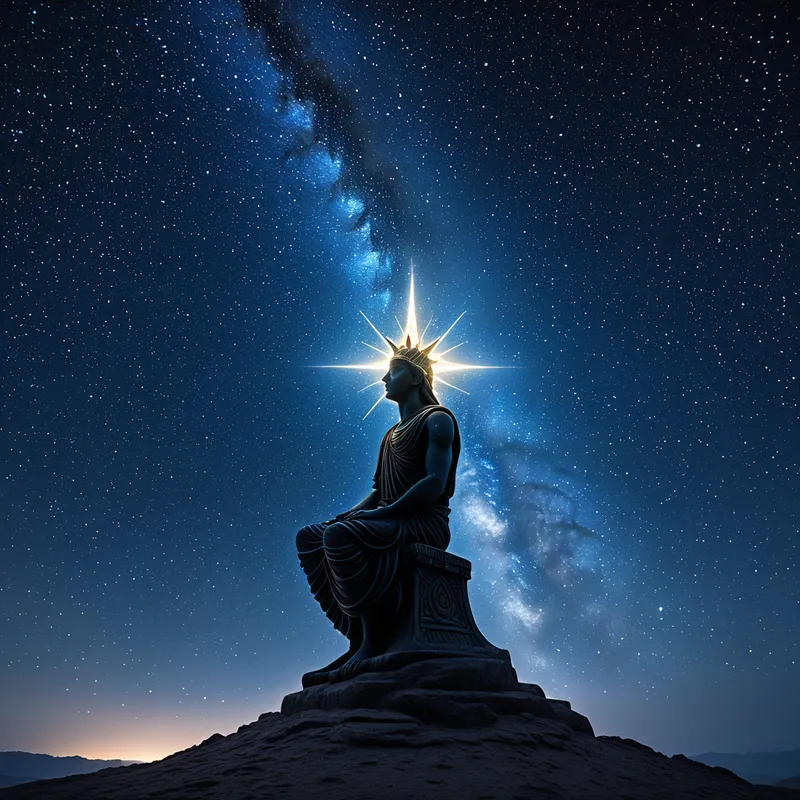
North Star Myth Meaning & Symbolism
Across cultures, the North Star is an eternal, fixed point of guidance, born from sacrifice and cosmic order, offering direction in the deepest darkness.
The Tale of North Star
Before maps, before compasses, there was only the great, swallowing dark. The world was a formless thing, and the sky above it was a chaos of wandering lights, a dizzying whirl that offered no solace to the traveler on the black earth or the sailor on the blacker sea. They were lost children beneath a capricious heaven.
But in the highest vault, where the wheel of the cosmos turns on its silent axle, there lived a spirit of a different nature. While its brethren danced their wild, seasonal reels—rising in the east with boastful fire and sinking in the west with weary sighs—this one spirit felt a different calling. It watched the suffering below, the disoriented hearts, the voyages abandoned in despair. A great stillness settled in its core, a resolve that cooled its fiery heart into something more profound.
A council was called in the starry halls. The Unmoved Mover spoke its intention: “I will step out of the dance. I will forfeit the journey. I will become the hinge upon which the door of heaven turns.” The other lights protested. “You will be alone! You will be a monument, not a musician! You will watch the world age from a fixed and lonely throne.” But the spirit’s light did not waver. It was a vow, not a question.
And so it happened. As the great bear circled its endless hunt and the seasons spun their tapestry of life and death, the spirit drove a stake of pure light into the northern roof of the world. It anchored itself. It felt the terrible strain of cosmic motion, the relentless pull of the turning sky trying to tear it from its post. Its light, once a part of the joyous chorus, now burned with the fierce, concentrated agony of eternal vigilance. It did not move. It became the nail. It became the pivot. It became the still point in the turning world.
And from that moment, a sigh of relief echoed from every corner of the earth. The hunter on the steppe lifted his eyes and saw the faithful guardian. The mother waiting by the shore knew her fisher-folk would return, their prows aimed at that constant friend. The soul in the wilderness of its own despair could finally lift its gaze and whisper, “There. I am not lost. My path begins from there.”

Cultural Origins & Context
The myth of the Fixed One is not the property of a single culture but a human inheritance, arising independently wherever people looked up and navigated the dark. For the Norse, it was Leiðarstjarna, the star bound to the axle of the celestial chariot. For the ancient Greeks, it was the Cynosure, the “dog’s tail” of the Little Bear, a guide for Phoenician sailors. In Mongolian tradition, it is Altan Hadaas, the “Golden Nail” hammered into the sky by the supreme deity to hold the heavens in place. For the Lakota, it is Wičhákhiyuhapi.
This story was not merely told; it was lived. It was passed from elder to child on long winter nights, from master navigator to apprentice under the open ocean sky. Its primary function was profoundly practical: survival. It encoded vital astronomical knowledge into a memorable, sacred narrative. But its secondary function was psychological: it provided a cosmological model for constancy, sacrifice, and spiritual orientation. The star’s fixity was a divine promise of order in a chaotic universe, a symbol of the ethical and spiritual center that must be found and clung to.
Symbolic Architecture
Psychologically, the North Star myth represents the archetypal principle of the Self as the unifying center of the personality. While the other stars symbolize the myriad complexes, passions, and thoughts that swirl through our consciousness—ever-changing, rising, and setting—the North Star is the immutable core.
The true guide is not the one who leads you along the path, but the one who becomes the point from which all paths are measured.
Its “sacrifice” is the key. It gives up its freedom to wander (the ego’s desire for unfettered expression) to serve a higher function: providing orientation for the whole. This symbolizes the difficult, often lonely process of establishing an inner center of gravity. It is the commitment to a principle, a value, or a truth that remains steady amidst the whirl of emotions, societal pressures, and life’s chaos. It is not the light of fleeting inspiration, but the light of enduring purpose, forged in the conscious choice to stand firm.
The Dreamer's Resonance
When the North Star appears in a modern dream, it rarely comes as a simple astronomical object. It manifests as a profound somatic experience of orientation. The dreamer may be in a labyrinth, a trackless forest, or a featureless plain—classic landscapes of psychic confusion or a dark night of the soul. The emotional tone is one of anxiety, lostness, or paralysis.
Then, the dream-ego looks up. There it is: a single, piercing point of light that feels different. It doesn’t sparkle; it hums with a low, resonant frequency. It is often described as “knowable” or “familiar” in a deep, pre-verbal way. The moment of seeing it brings immediate physical relief—a release of tension in the shoulders, a deep breath. The dream doesn’t necessarily provide a map, but it gives the fixed point. The psychological process here is the unconscious affirming the existence of the inner center. It is the Self signaling to the lost ego: “Your coordinates exist. You are not adrift. Remember your axis.”

Alchemical Translation
The alchemical journey of individuation is, at its heart, a navigation from leaden confusion to golden coherence. The North Star myth provides the core model for this transmutation: the establishment of the immovable center.
The initial nigredo, the blackening, is the chaotic, star-drunk sky with no fixed point—the psyche ruled by passing moods, external validations, and unintegrated complexes. The sacrifice of the star is the opus contra naturam, the work against one’s own wandering nature. The individual must consciously “nail down” a part of themselves—a commitment, a moral stance, a creative purpose—and endure the strain of holding it fast while the rest of life swirls around it.
The alchemist does not seek to stop the rotation of the universe, but to become the still hub at the center of its wheel.
This fixed point becomes the lapis philosophorum, the philosopher’s stone of the psyche. From it, all measurement becomes possible. Decisions are weighed against this inner truth. Values are clarified. The once-chaotic elements of the personality begin to orbit this central sun, forming a cohesive solar system of the Self. The final stage is not a cessation of life’s motion, but a profound participation in it from a place of unshakable calm. The individual becomes both the navigator and the navigational aid, guided by the same fixed light they had to become. They have, in the most profound sense, found their true north.
Associated Symbols
Explore related symbols from the CaleaDream lexicon: