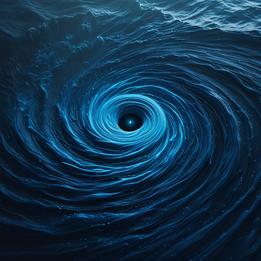
Whirl
A rapid, circular motion representing transition, chaos, or being swept up in forces beyond one's control.
Whirl Dream Meaning
A rapid, circular motion representing transition, chaos, or being swept up in forces beyond one's control.
Interpretive Themes
Mythological Resonance
Charybdis
GreekThe monstrous whirlpool that swallows ships whole, representing the chaotic forces that can consume those caught in life's turbulent currents.
Kalachakra
HinduThe wheel of time whose constant turning represents the cyclical nature of existence and the whirl of cosmic cycles.
Cultural Lenses
Jungian Perspective
View Context →Represents the individuation process - chaotic movement toward wholeness. The whirl symbolizes the psyche's self-organizing principle, often appearing during major life transitions as the unconscious attempts integration.
Freudian Perspective
View Context →Symbolizes repressed sexual energy or birth trauma. The circular motion represents regression to the womb or anxiety about losing control over primal urges and instincts.
Gestalt Perspective
View Context →Represents unfinished business or avoidance. The whirl indicates where energy is stuck in circular patterns rather than moving toward resolution or completion of psychological processes.
Cognitive Perspective
View Context →Manifests cognitive overload or processing difficulties. The whirl represents the brain's attempt to organize overwhelming information, often during sleep when consolidating memories and emotions.
Evolutionary Perspective
View Context →Primordial response to environmental threats like tornadoes or whirlpools. The symbol triggers ancient survival mechanisms warning of disorientation or loss of stable ground in changing circumstances.
Middle Eastern Perspective
View Context →In Sufi tradition, whirling represents mystical union with the divine through ecstatic dance. Historically, the whirling dervish ritual induces trance states for spiritual transcendence beyond earthly concerns.
South Asian Perspective
View Context →In Hindu cosmology, represents the cyclical nature of existence - samsara's endless turning. The whirl symbolizes both creative destruction (Shiva's dance) and the karmic wheel governing rebirth.
East Asian Perspective
View Context →Represents the dynamic balance of yin and yang in Taoist philosophy. The whirl symbolizes the Tai Chi - continuous motion maintaining harmony between opposing forces in nature and life.
African Perspective
View Context →In many traditions, represents ancestral spirits' movement or possession states. The whirl appears in ritual dances as a conduit between worlds, channeling spiritual energy for healing or divination.
Latin American Perspective
View Context →In Mesoamerican cultures, represents cyclical time and celestial movements. The whirl appears in calendar systems and ritual dances symbolizing the universe's eternal rotation and life-death cycles.
Modern Western Perspective
View Context →Often represents information overload, rapid social change, or anxiety about losing control in fast-paced life. The whirl symbolizes both technological acceleration and psychological burnout in contemporary society.
Global/Universal Perspective
View Context →Cross-cultural symbol of transition, chaos, and cosmic forces. Appears in creation myths, weather phenomena, and ritual practices worldwide as representation of powerful, often uncontrollable natural energies.
Historical Authorities
Want a deeper analysis?
Get a personalized interpretation of your entire dream including this symbol.
Interpret My DreamThe Oracle's Prediction
Combine multiple symbolsRapid changes will create both chaos and unexpected opportunities.
Timeframe
Seasonal (~3 Months)
Intensity
Deep
Risk of being swept into situations beyond your control.
Timeframe
Immediate (Next 48h)
Intensity
Deep
Common Appearances & Contexts
| Context | Emotion | Interpretation |
|---|---|---|
| Context Whirling in water | Emotion Panic | Interpretation Emotional overwhelm. |
| Context Whirling leaves | Emotion Nostalgia | Interpretation Seasonal change. |
| Context Whirling dance | Emotion Ecstasy | Interpretation Spiritual transcendence. |
| Context Whirling vortex | Emotion Dread | Interpretation Existential threat. |
| Context Whirling upward | Emotion Hope | Interpretation Ascension possibility. |
| Context Whirling downward | Emotion Despair | Interpretation Spiraling decline. |
| Context Whirling slowly | Emotion Calm | Interpretation Meditative state. |
| Context Whirling violently | Emotion Terror | Interpretation Complete loss. |
| Context Whirling objects | Emotion Confusion | Interpretation Mental clutter. |
| Context Whirling lights | Emotion Wonder | Interpretation Mystical experience. |
| Context Whirling alone | Emotion Isolation | Interpretation Inner turmoil. |
| Context Whirling with others | Emotion Connection | Interpretation Shared experience. |
Interpret Your Full Dream
Beyond this symbol, every dream carries a unique story. Share your dream for a personalized AI-powered interpretation.