Noh Mask Myth Meaning & Symbolism
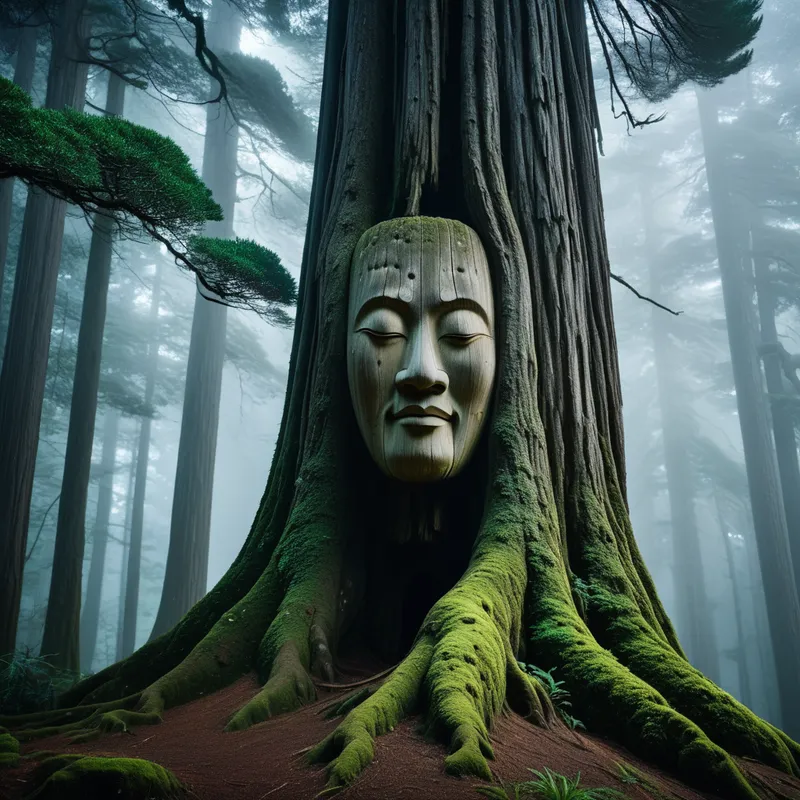
A master carver confronts a living tree-spirit, learning that true art is not creation, but a sacred dialogue with the soul of the material.
The Tale of Noh Mask
Listen. In the deep mountains where the mist clings to the ancient cedars like a second skin, there lived a carver. His name is lost to the wind, but his hands were known to the gods. They could coax the soul of a bird from a block of cypress, the grace of a dancer from a plank of paulownia. Yet, his heart was a hollow vessel. For all the faces he carved—the demons, the warriors, the weeping women—they were but clever shells. They held breath, but not spirit; form, but not kami.
One evening, as the last copper light bled from the sky, a dream came to him. Not a dream of sleep, but a waking vision that filled his workshop. It was the scent of rain on dry earth, the sound of a single leaf turning in still air. A voice, older than the mountains, spoke without sound: “You seek the face that lives. Seek the one who is already waiting. In the heart of the forest that remembers, where the oldest root drinks from the first spring.”
Driven by a longing he could not name, the carver journeyed for seven days and seven nights. He passed forests of chattering bamboo and valleys of silent stone, until he stood before a grove untouched by axe or time. At its center stood a single Cryptomeria, its trunk wider than ten men, its branches holding up the sky. The air hummed. He placed his palm upon the bark, and the tree shivered.
“I have watched your hands,” the tree-spirit whispered, its voice the creak of boughs and the murmur of sap. “You take. You shape. You silence. If you seek a true face, you must first listen to mine.”
The carver fell to his knees. “I will listen.”
And so began the dialogue. He did not raise his chisel. For a full cycle of the moon, he sat. He listened to the tree speak of the sun it had held for centuries, of the storms it had endured, of the fox that slept in its roots and the eagle that nested in its crown. He felt its joy in spring sap, its sorrow in autumn’s shedding. The spirit showed him its essence: not one face, but all faces. The rage of the thunder god, the serene madness of the celestial maiden, the profound, tragic stillness of the wandering ghost.
Finally, the spirit said, “Now, you may carve. But you will not carve me. You will carve the space where your listening meets my song. You will carve the channel for the wind to pass through.”
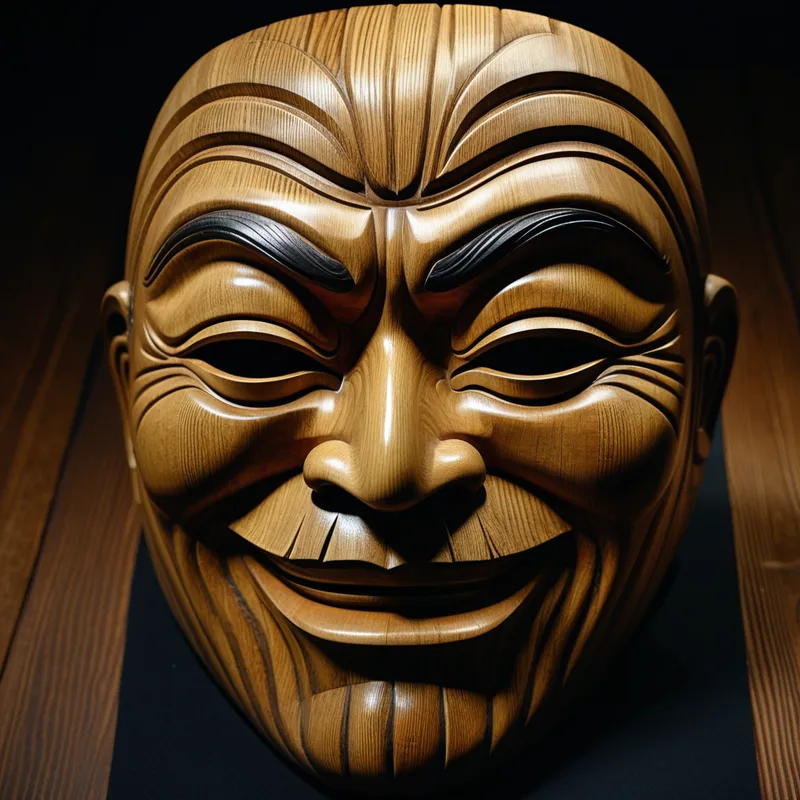
With hands that trembled not from fear but from reverence, the carver began. He did not force the grain; he followed it. The chisel became a prayer, the mallet’s tap a heartbeat. As the mask took form—a Okina, an old god of the earth—the carver felt not that he was creating something, but that he was unveiling something that had always existed. The final stroke was not his. As he polished the brow, a breath that was not his own sighed from the wood. The mask was complete. It was no longer an object. It was a threshold.
Cultural Origins & Context
This tale, woven from the ethos of Noh theatre rather than a single canonical text, emerges from the confluence of Shinto animism, Buddhist philosophy, and the severe aesthetic discipline of the medieval Japanese arts. Noh itself, perfected by masters like Zeami Motokiyo in the 14th and 15th centuries, is less about storytelling and more about the embodiment of essence—yūgen, the profound, mysterious grace that lies beneath the surface of things.
The myth of the mask-carver and the tree-spirit is the foundational parable of this art. It was passed down not in books, but in the kuden—the secret oral transmissions from master to disciple within a ryūha. Its function was ontological: to teach that the actor, donning the mask, does not perform a character but becomes a vessel for a transpersonal presence. The mask is not a disguise; it is an interface with the spirit world, a sacred technology for making the invisible, visible. It served to root the artist in humility, framing creation as an act of collaboration with the living world, a direct challenge to the ego of the craftsman.
Symbolic Architecture
At its core, this myth dismantles the Western heroic model of the Creator as a sovereign will imposing form upon inert matter. Here, the raw material—the tree—is already ensouled. The drama is not one of conquest, but of sacred encounter and reciprocal revelation.
The true mask is not made; it is consented to. It exists in the liminal space between the human ear and the world's whisper.
The Ancient Tree symbolizes the primordial, undifferentiated Self—the totality of the psyche in its raw, natural state. It contains multitudes: all archetypes, all potential emotions, all histories. The Carver represents the conscious ego, the part of us that seeks to shape identity, to craft a persona. His initial hollow success signifies the ego’s lonely project of creating a convincing facade, which lacks the breath of the authentic soul.
The Dialogue is the critical, often neglected, process of deep listening—what in psychology is called attending to the unconscious. It is the ego setting aside its tools and agendas to simply receive. The Final Mask that emerges is the persona in its highest, most authentic sense: not a false front, but a faithful vessel. It is a face that can hold paradox—the rage and the serenity, the god and the ghost—because it has not been fabricated from nothing, but distilled from everything.
The Dreamer's Resonance
When this myth stirs in the modern psyche, it often manifests in dreams of searching for a true face. One might dream of looking in a mirror to see a blurred, generic, or shifting visage. Or of holding a mask that feels disturbingly light and hollow, like plastic. Conversely, one might dream of a tree that speaks, or of wood that feels warm and alive to the touch.
These dreams signal a somatic and psychological process of confronting the inauthentic persona. The hollow mask dream points to the exhaustion of maintaining a constructed identity that no longer fits—the “professional” self, the “social” self, the self built to please others. The somatic sensation is often one of emptiness, fatigue, or facial tension.
The dream of the living tree is the call from the deeper Self. It is an invitation to cease doing and begin listening. The process here is one of re-sacralization: learning to perceive the innate intelligence and spirit within one’s own raw material—one’s emotions, memories, instincts, and body—rather than treating them as problems to be carved into submission.

Alchemical Translation
The myth models the alchemical opus of individuation with exquisite precision. The carver’s journey is the journey of the modern individual from ego-centricity to a psyche-centric existence.
*First, the Nigredo:* The carver’s dissatisfaction, his sense of hollow artistry, is the initial blackening. It is the dark night of the soul where one’s life achievements feel like well-crafted, lifeless masks. The ego confronts its own poverty.
Then, the Albedo: The journey to the forest and the act of listening is the whitening. It is the purification of intention, the washing away of the ego’s will-to-power. The conscious mind (carver) submits to the wisdom of the unconscious (tree-spirit). This is not passivity, but active, receptive humility.
Individuation is not the creation of a unique self, but the patient unveiling of the Self that has always been, through a lifelong dialogue between the one who seeks and the one who knows.
*Finally, the Rubedo:* The carving of the mask is the reddening, the culmination. This is the integration. The ego, now informed by the Self, takes up its tools again—but its purpose has been transfigured. It no longer seeks to create ex nihilo; it seeks to midwife into being what the Self reveals. The resulting “mask”—one’s mature personality, one’s authentic way of being in the world—is now a conduit. It allows the winds of spirit, emotion, and archetypal energy to flow through the individual without possessing them.
For us, the alchemical translation is clear: Our task is not to invent who we are, but to discover it through profound dialogue with all that we are—the ancient, storm-weathered parts of our soul, the deep-rooted instincts, the soaring aspirations. We are both the humble carver and the majestic, waiting tree. The true face we seek is born from their sacred, silent conversation.
Associated Symbols
Explore related symbols from the CaleaDream lexicon: