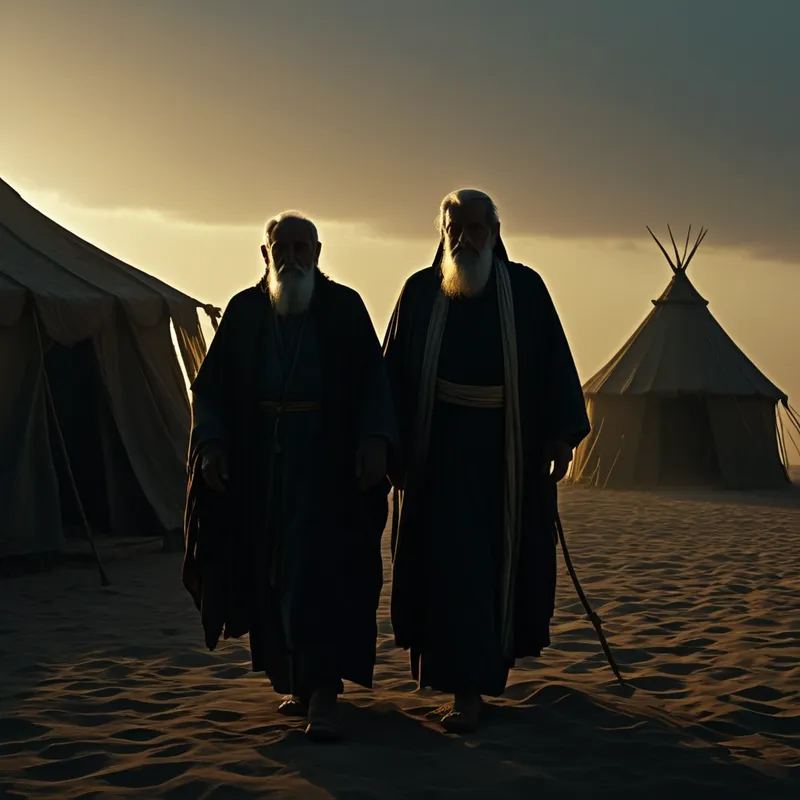
Noah's Drunkenness Myth Meaning & Symbolism
After saving the world, Noah plants a vineyard, drinks its wine, and lies naked in his tent, exposing a primal vulnerability that echoes through his sons' reactions.
The Tale of Noah's Drunkenness
Listen, and hear the tale that comes after the flood.
The great waters had receded, clawing back into the deep. The mountain peaks emerged like the bones of a drowned world. Upon the slopes of Ararat, the ark of gopherwood groaned its last, its timbers settling into the mud of a new, silent earth. From its door emerged Noah, the righteous one, the preserver of all breath. With him came his sons—Shem, Ham, and Japheth—and their wives, blinking at the fierce, clean light of a world washed bare.
They built an altar. The scent of burnt offering pleased the heavens. A covenant was struck, sealed by the bow in the clouds. Life began again.
But what is a hero when the deluge is past? When the great labor is done?
Noah turned to the soil. He took the vine, that ancient climber, and planted it. He tended it under the sun and the rain, seasons turning in their new rhythm. The grapes swelled, dark and heavy with promise. He harvested them, crushed them, and let their blood ferment in skins. He made wine.
Then came the day. In his tent, the patriarch drank. He drank not for thirst, but deeply, from the cup of his own making. The wine was the sun and the rain and the silence after the storm, distilled. It was the memory of forty days of darkness and the terror of the deep, transformed. It flowed into him, and the rigid frame of the righteous man, the shipwright of salvation, began to soften, to unbend.
The cup emptied. The world swam. The weight of all he had carried—the groaning of the animals, the weeping of the lost, the crushing responsibility of being the hinge of creation—slid from his shoulders. He stumbled. His robes, the garments of his authority and his piety, fell away. Naked, he lay down upon the ground within his tent, and a profound, unguarded sleep took him. This was not the sleep of the weary, but the stupor of the soul undone, exposed to the very foundations.
The tent flap stirred. Ham, the father of Canaan, entered. He saw his father’s nakedness. But he did not see a man vulnerable in his rest; he saw a spectacle. A crack in the monument. Instead of covering him, he turned and went out to his brothers in the open field. “Come,” his voice carried a strange tone, part shock, part secret delight. “See what has become of our father.”
But Shem and Japheth took a garment. They laid it upon both their shoulders, and walking backward, their faces turned away so as not to see the nakedness they came to cover, they entered the tent. With a reverent, blind gesture, they draped the cloth over their father’s exposed form.
Noah awoke from his wine. He knew, in the way fathers know, what his youngest son had done. And a curse, cold and lasting, fell from his lips—not upon Ham, but upon Ham’s son, Canaan. A curse of servitude. To Shem and Japheth, he gave a blessing. And then, the scripture tells us, Noah lived for three hundred and fifty years after the flood. But he never again planted a vineyard. The story of his nakedness hangs in the air, the first and deepest secret of the new world.

Cultural Origins & Context
This brief, jarring episode is found in the ninth chapter of Genesis. It is part of the Pentateuch, a collection of texts that underwent centuries of oral transmission and priestly redaction before being codified. Its placement is critical: it follows the cosmic drama of the Flood and the establishment of the Noahic Covenant, and precedes the genealogical Table of Nations. It acts as a narrative hinge.
Societally, this story functioned as an etiological tale for the Israelite audience, explaining and justifying the perceived subordinate status of the Canaanites, whom the Israelites would later encounter in the land of Canaan. But its power lies deeper than political justification. It was a cautionary tale told within families and tribes about honor, shame, and the sacred boundaries of the paternal figure. It explores what happens after the divine mission, in the vulnerable, human space of the household. The storyteller, likely a priest or elder, used it to encode profound lessons about reverence, the proper response to another’s fall from grace, and the long shadow cast by a single act of disrespect.
Symbolic Architecture
The myth is a perfect vessel of shadow material. Noah, the Tzaddik, the universal hero, completes his grand, world-saving task. But the hero’s journey does not end with the boon; it ends with the often-messy return. The vineyard he plants is the symbol of this return to normalcy, to cultivation and civilization. Yet, the fruit of this civilizing act—wine—becomes the agent of his de-civilization, his return to a primal, unadorned state.
The hero’s greatest trial may not be the dragon, but the quiet moment when the armor finally comes off.
His nakedness is not merely physical. It is the nakedness of the psyche stripped of its defining role. It is the exhaustion of the persona, the “righteous man” mask, revealing the vulnerable, flawed, and tired human beneath. The tent is the private sphere, the temenos or sacred enclosure of the self, where such revelations occur.
The reactions of the sons map three fundamental human responses to the shadow of authority:
- Ham (Seeing & Telling): Represents the consciousness that witnesses the shadow but does not relate to it with compassion. It is the voyeuristic, judgmental ego that seeks to amplify the flaw, to gossip, to gain a sense of superiority by exposing the weakness of the great. It is the failure of empathy.
- Shem & Japheth (Covering & Not Seeing): Represent the consciousness that acknowledges the shadow exists but chooses to relate to it with reverence and protection. They “do not see” not out of ignorance, but out of a conscious, ethical decision to honor the whole person by covering the vulnerable part. Their backward approach is a ritual act of respect, preserving dignity.
The curse upon Canaan, rather than Ham, is itself a powerful symbol of the generational transmission of trauma and shadow. The sin of the father (the act of disrespect) is visited upon the son, suggesting that psychological patterns and familial curses are inherited and must be borne by subsequent generations.
The Dreamer's Resonance
When this myth stirs in the modern dreamer, it signals a profound somatic and psychological process: the post-heroic collapse. The dreamer may have recently achieved a great success—finishing a monumental project, surviving a crisis, attaining a long-sought goal. In the aftermath, instead of feeling elated, they feel exposed, hollow, or susceptible to a strange, shameful lapse.
Dreams might manifest as:
- Being found naked or unprepared in a place of honor (e.g., on a stage, in a workplace).
- A revered mentor or parental figure appearing foolish, drunk, or helpless, inciting a mix of pity and contempt in the dreamer.
- The act of hiding or covering something precious that has been shamefully exposed.
- A feeling of being “cursed” after a moment of indiscretion or a failure of respect.
Somatically, this can feel like a draining of vitality after a period of intense adrenaline, a vulnerability to illness, or a deep, unshakable fatigue. Psychologically, it is the ego confronting the fact that the archetypal Hero energy is temporary. The Self is revealing that wholeness includes not just the capacity for great deeds, but also for profound, unguarded humanity and the shadows that come with it.
Alchemical Translation
The alchemical process modeled here is the solve et coagula—dissolve and coagulate—applied to the psyche. Noah’s grand work (the Flood narrative) was a coagula, a bringing together and preserving of all life into a new form. His drunkenness is the necessary, terrifying solve.
The wine is the solvent of the spirit. It dissolves the rigid, saved identity so that a more integrated, human wholeness can eventually re-coagulate.
The individual’s journey parallels this. We identify with an archetype—the Caregiver, the Creator, the Hero. We perform its duties brilliantly. But to individuate, we must allow that identification to be dissolved. We must, like Noah, ingest the intoxicating fruit of our own labors and allow ourselves to fall apart in the privacy of our own “tent.” This is not a failure, but a crucial stage of incubation.
The curse and the blessing that follow represent the psychic consequences of how we handle this dissolved state, both in ourselves and others. The “Ham” within us shames our own vulnerability, gossips about our own failures, and thus curses parts of our future potential (our “Canaan”) to servitude—to being forever dominated by that shame. The “Shem and Japheth” within us approach our own nakedness with reverence. They cover it with compassion, refusing to let the judging eye of the ego define our entire being. This act blesses our future, allowing for integration rather than repression.
The myth, in its brutal simplicity, tells us that salvation is not the end. True wholeness begins when the savior gets drunk on the fruits of his labor, lies naked, and must learn—through the reactions he inspires—how to live with the exposed and human truth of his own soul. The new world is not built by flawless heroes, but by flawed fathers and the sons who must learn how to look upon them.
Associated Symbols
Explore related symbols from the CaleaDream lexicon: