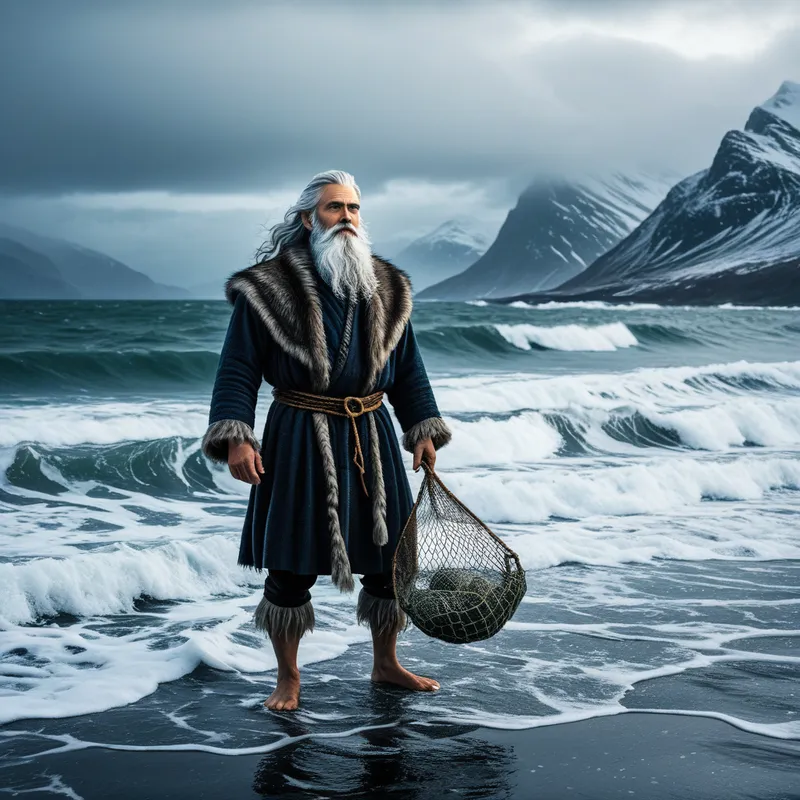
Njörðr Myth Meaning & Symbolism
A god of sea and wealth, bound to a mountain goddess in a marriage of impossible longing, embodying the sacred tension between worlds.
The Tale of Njörðr
Hear now of the lord who is master of two realms, yet a stranger in his own hall. His name is Njörðr. His breath is the salt-tang that fills the sails of daring men; his whispers coax the herring into waiting nets. He dwells in Nóatún, "Ship-Haven," a place of gentle tides and harbors safe from storm. His wealth is not hoarded gold, but the living bounty of the deep—the silver flash of a shoal, the promise of a full catch, the fertile silt washed upon the shore.
But the gods are a restless kindred. In the aftermath of a great war, a treaty was forged between the Vanir and the Æsir. It was sealed not with words alone, but with an exchange of lives. Njörðr, wise and wealthy, was chosen. He left the sighing shores and was led inland, up into the high places of Asgard.
There, he was given a wife: Skaði. She was a daughter of the mountains, her spirit as fierce and cold as the winter wind that screams through the pines. She came clad in snow-weathered leather, a bow in her hand, her eyes the color of a frozen lake. She chose him for his feet, which were clean and fair, believing them to be Baldr's. It was a marriage born of mistake and necessity, a union meant to bind two worlds.
So began the great longing. They agreed to dwell nine nights in her mountain hall, Þrymheimr, and then nine nights in his sea-side Nóatún. But oh, the agony of those cycles! When Njörðr returned from the mountains to his beloved shore, he would sing:
"Hateful for me are the mountains, I was not long there, only nine nights. The howling of the wolves seemed ugly to me after the song of the swans."
And Skaði, when her time came to leave the roar of the surf and climb back to her silent peaks, would weep:
"I could not sleep by the shore for the screeching of the bird. That gull wakes me when from the wide sea he comes each morning."
Their love was a treaty, but their hearts were hostages. He pined for the lap of waves; she sickened for the cry of the wolf. In the end, they parted, though not in bitterness. Skaði returned to her mountains, to her skiing and hunting, visiting the gods but never again dwelling where she could not breathe the thin, sharp air. Njörðr remained by the sea, a generous giver of wealth, a father to Freyr and Freyja. Yet, in the quiet moments, when the wind dies and the water is still, a profound loneliness settles upon the shore—the memory of a love that was as true as it was impossible, bound by sacred law to a home it could not endure.
Cultural Origins & Context
The myths of Njörðr come to us primarily through the Poetic Edda and the Prose Edda, texts compiled in 13th-century Iceland but preserving much older oral traditions. As a Vanir god, Njörðr represents an older stratum of divinity, one deeply connected to fertility, prosperity, and the natural world's generative forces, distinct from the more sovereign and warlike Æsir.
His myth was not mere entertainment. For a culture dependent on fishing, trade, and coastal settlement, Njörðr was a vital psychological and spiritual figure. He governed the liminal space between the known (land) and the unknown, dangerous, yet bountiful (sea). His role in the hostage exchange following the Æsir-Vanir War reflects a deep cultural understanding of peace-making through sacred exchange and the often-painful integration of different worldviews. The story was likely told to explain the origins of certain social and marital customs, the nature of seasonal cycles (as some interpret his time with Skaði), and, most profoundly, to articulate the human experience of belonging and exile.
Symbolic Architecture
Njörðr is the archetype of the liminal. He is not the wild, chaotic ocean of Ægir, but the shoreline itself—the fertile, negotiable boundary where two ecosystems meet and exchange gifts. His wealth is not mined or conquered, but received through relationship with the other. This is the psychology of sustainable abundance.
His marriage to Skaði is one of mythology's most poignant symbols of irreconcilable inner opposites.
The sacred marriage that fails is not a tragedy, but an initiation into the true cost of wholeness. It forces a choice that defines the soul's territory.
He represents the part of the psyche that provides, nurtures, and facilitates exchange (the Caregiver archetype), but his myth reveals the shadow of this role: the sacrifice of one's deepest nature for the sake of peace, treaty, or belonging. His loneliness is the price of his function. Skaði represents the untamed, introverted, self-sufficient spirit of the heights—the part of us that needs solitude, clarity, and a domain of its own. Their inability to cohabit is not a failure of love, but a testament to the integrity of core instincts. The myth validates that some divides within the self cannot be bridged by force of will; they must be honored with separation and respect.
The Dreamer's Resonance
When the pattern of Njörðr stirs in the modern dreamer, it often manifests as a profound somatic tension between two irreconcilable "homes" or states of being. You may dream of being in a beautiful, safe house by the sea, yet feeling an unbearable pull to climb a looming, cold mountain—or vice versa. The dream landscape itself may be impossibly conflated: a forest path that suddenly floods with saltwater, or an office building with the sound of crashing waves in the ventilation shafts.
This is the psyche working through a state of liminal conflict. The somatic feeling is one of being perpetually out of place, a deep homesickness for a place you are currently in. Psychologically, it signals a crisis of belonging. Are you living in Skaði's hall when your soul is of Njörðr's shore? You may be in a relationship, job, or identity that was chosen for good reason (a "treaty" for peace, security, or growth), but which fundamentally violates an environmental need of your spirit. The dream is not necessarily telling you to abandon your post, but to acknowledge the authentic cost of your current life, to sing your lament for the wolves or the gulls, and to consciously re-negotiate the terms of your inner treaty.

Alchemical Translation
The alchemical process modeled here is not union, but sacred separation and precise placement. The prima materia is the conflicted self, trying to force coexistence between elemental opposites. The calcinatio is the burning pain of the nine nights in the wrong home—the feeling that is destroying your vitality. The separatio is the courageous act of discernment: "This is mountain. This is sea. They cannot occupy the same space without mutual poisoning."
Individuation is not always about integration; sometimes it is about conscious, respectful differentiation. Knowing what you are not is as vital as knowing what you are.
The solutio is the tears of both gods—the honest mourning for what must be given up. For the modern individual, this translates to grieving the path not taken, the identity you released for stability, or the part of your nature you subdued for love. Finally, the coagulatio is the re-establishment of each force in its rightful domain. You learn to let the Provider in you operate from its natural shoreline, generating abundance from connection and flow. You allow the Autonomous Self (Skaði) its necessary high ground, its space for solitude and fierce independence. They are not reconciled, but they are in communication. They honor the treaty that binds them (the whole personality) by not forcing cohabitation. In this precise placement, each can thrive, and the entire system gains the wealth of the sea and the integrity of the mountain. You become the sovereign of a richer, more authentic, if sometimes lonely, realm.
Associated Symbols
Explore related symbols from the CaleaDream lexicon: