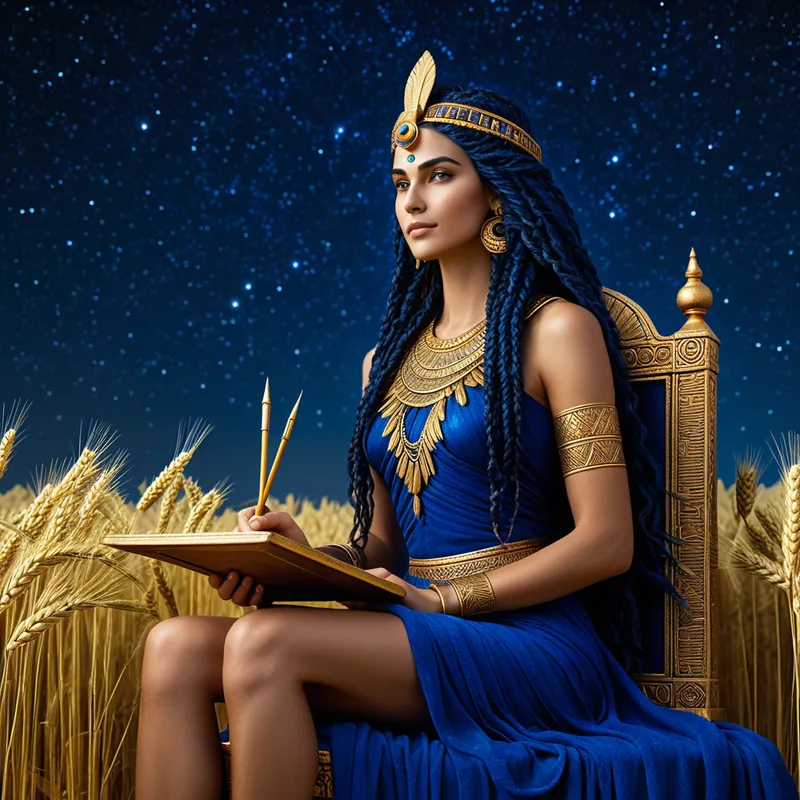
Nisaba Myth Meaning & Symbolism
The story of Nisaba, the Sumerian goddess who transforms from a grain deity into the celestial scribe of the gods, embodying the sacred marriage of earth and intellect.
The Tale of Nisaba
Listen, and hear the rustle in the endless fields where the world began. In the time before time, when the Apsu and the Tiamat were not yet parted, the green force of life pushed through the dark silt. And from this pushing, she emerged. Not with a thunderclap, but with the patient sound of a root seeking water. She was Nisaba, and her body was the field itself, her breath the wind that sways the barley, her heartbeat the slow, sure pulse of growth.
She walked the black earth of Sumer, and where her feet touched, the soil grew heavy with emmer wheat and fat barley. Her laughter was the sound of grain heads nodding together. She taught the people the dance of the seasons—the sowing in terror of drought, the waiting under the cruel sun, the joyous reaping with curved sickles of bronze. She was the mother of the granary, the keeper of the measure, the one who turned desperate hunger into the golden mathematics of surplus. Life was her scripture, written in stalk and seed.
But in the high places, the gods convened. Enlil’s word was law, Enki’s mind was a deep well of cunning, and Inanna’s passions shook the world. Their deeds were mighty, their conflicts epic, but their stories were like wind—heard, then gone. No record held them. No truth was fixed. Decrees were forgotten, destinies blurred, and the divine order itself seemed to shift like desert sands.
Nisaba watched from her fields. She saw the need not in the belly, but in the soul of heaven itself. The gods had power, but they lacked memory. They had will, but they lacked witness. One day, as the heat haze shimmered above the ripe grain, an understanding settled upon her, as quiet and inevitable as a seed germinating. The knowledge of the earth—the precise measure, the counted sheaf, the boundary line—could become the knowledge of the cosmos.
She went to the riverbank, where the mud was fine and pure. She did not take a plough. She took a reed, straight and strong. She pressed its end into the wet clay, not to plant, but to impress. A wedge. A triangle. A line. She began to make marks. The first marks were of what she knew: a stalk of grain, a head of barley, a measuring bowl. But then, the marks began to change. They became the word for “star,” for “god,” for “eternity.” She was translating the body of the world into the mind of the world. The stylus in her hand was no longer a simple tool; it was a bridge.
The gods fell silent when she approached the divine assembly. In her hands, she bore not an offering of bread, but a tablet of clay, covered in the crisp, angular script. She read aloud. She read the decree of Enlil, exactly as spoken. She read the clever plan of Enki, with all its intricate layers. She read the daring exploits of Inanna, preserving their glory. For the first time, the gods heard their own eternal nature reflected back to them, fixed and undeniable. Nisaba, the goddess of the fertile earth, had become the scribe of heaven, the one who gives form to the formless, memory to the timeless. The granary of the people had become the archive of the gods.
Cultural Origins & Context
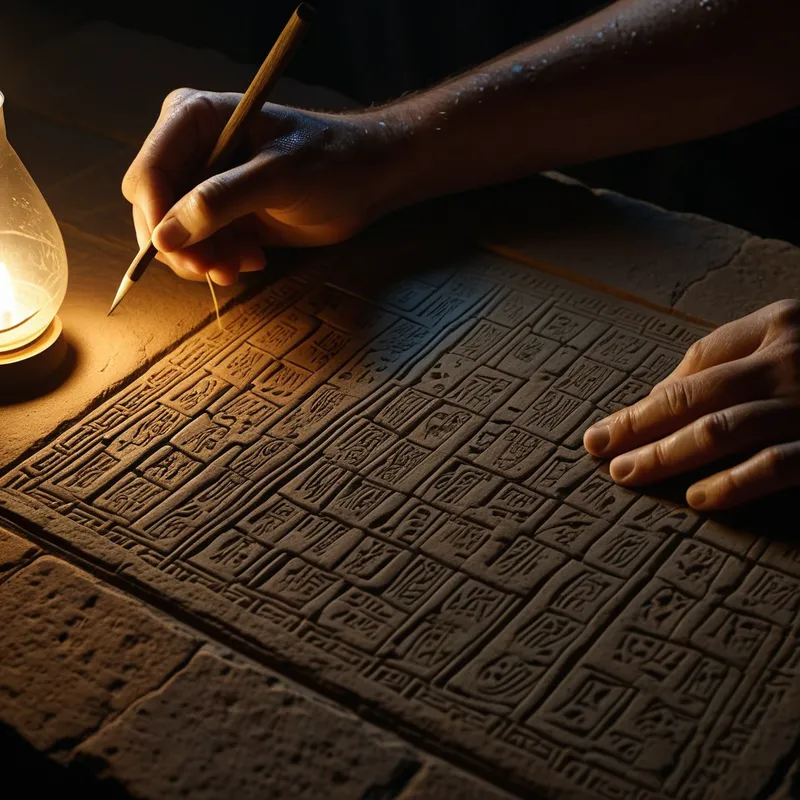
The hymns and tales of Nisaba originate in the very cradle of civilization, the fertile alluvial plains between the Tigris and Euphrates rivers in the 3rd millennium BCE. For the Sumerians, whose survival was a precarious equation of flood, labour, and harvest, the divine was intimately tied to function. Nisaba’s worship was not abstract philosophy; it was the theology of the storehouse and the ledger. She was first and foremost the power within the grain that prevented societal collapse.
Her evolution from grain goddess to patron of scribes mirrors the evolution of Sumerian society itself. As city-states like Lagash and Nippur grew complex, requiring administration, law, and tax records, the scribal class emerged. These were not merely clerks but the high technologists of their age, mastering the arcane and powerful art of cuneiform. It was natural, perhaps inevitable, that they would seek the patronage of the deity who already governed measurement, accounting, and the fruitful outcome of careful effort. Thus, Nisaba’s domain expanded organically from the cyclical wisdom of agriculture to the linear wisdom of recorded knowledge. Her myths were likely recited in scribal schools (edubbas), where students began their lessons with praises to her, understanding that each wedge they impressed into clay was a sacred act, a participation in her synthesizing power.
Symbolic Architecture
At her core, Nisaba represents the profound unity of two fundamental human engagements with reality: nourishment and knowledge. She is the archetype of the Synthesizer.
The first writing was an inventory of grain, and the first wisdom was knowing when to reap. Nisaba reveals that all abstract thought is rooted in the body of the world.
Her primary symbol, the stalk of grain, is a perfect natural cipher for this process. From a seed buried in darkness (unconscious potential), it grows through a stem (the mediating axis mundi), to produce a head bearing countless new seeds (manifested, multipliable knowledge). The scribe’s reed stylus is a direct analogue—a cut reed, shaped by human intellect, which “plants” meaning into the fertile “soil” of the clay tablet to yield a harvest of preserved thought.
Psychologically, Nisaba embodies the movement from participation mystique—a unconscious, instinctual identity with nature’s cycles—towards conscious, differentiated intellect. She does not abandon the earthy, sensual, and nourishing (the Grain Mother). Instead, she informs it, bringing it into the light of consciousness and structure. She is the function that takes raw, life-sustaining experience and translates it into communicable form: story, law, record, and ultimately, self-awareness.

The Dreamer's Resonance
When the pattern of Nisaba stirs in the modern psyche, it often manifests in dreams of synthesis and translation. One might dream of finding ancient, fertile soil in an urban office; of a computer keyboard where the keys are kernels of corn that, when pressed, grow into paragraphs of light; or of being in a library where the books are sheaves of wheat that whisper when touched.
Such dreams signal a critical phase of psychic integration. The somatic feeling is often one of a deep, grounded pressure—not anxiety, but the fertile weight of potential seeking form. It is the process of “bringing to harvest” disparate elements of one’s life or inner world. Perhaps the dreamer is inundated with raw experience, emotion, or data (the overgrown field) and feels a pressing need to “make sense of it all,” to find the pattern, the measure, the record. The psyche is urging the conscious mind to become the scribe of its own depths, to take the nourishing but chaotic material from the inner earth (the unconscious) and translate it into the legible script of self-knowledge.
Alchemical Translation
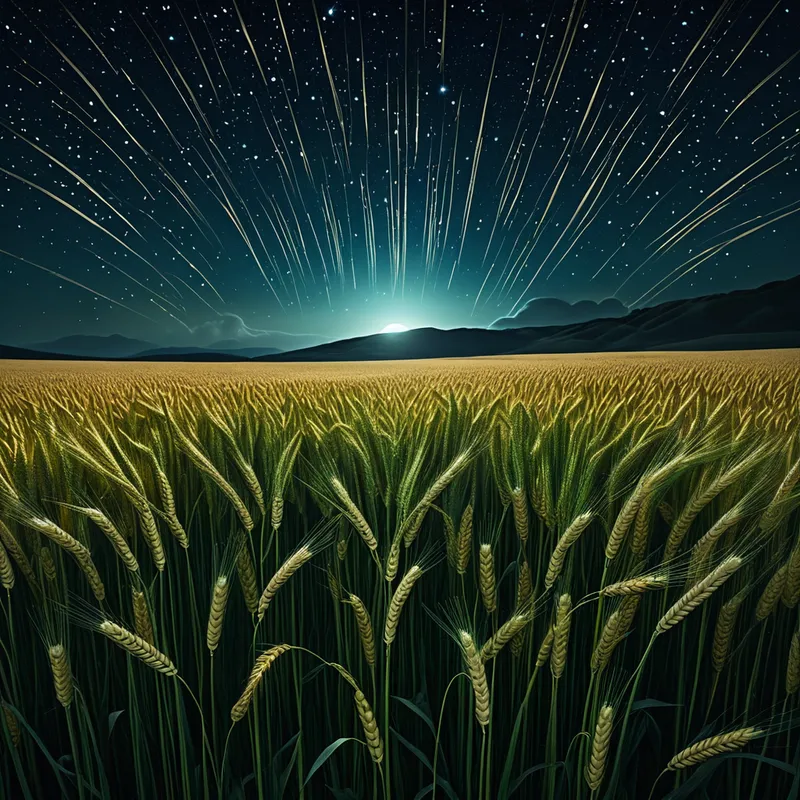
The alchemical journey modelled by Nisaba is the opus of conscious cultivation. It begins with the nigredo, the black earth of the Mesopotamian plain—the fertile but undifferentiated mud of our innate potential, our instincts, and our unprocessed life experiences. This is the primal, nourishing matrix.
The first transmutation is the albedo, the whitening, represented by the growing, green shoot and the ripening golden grain. This is the stage of careful tending, of applying discipline and patience to our natural gifts. It is the development of skill, the practice of attention, the “cultivation” of one’s character or talents.
The final and most sacred transmutation is not from lead to gold, but from grain to text. It is the moment the nourishing becomes the knowing, when what sustains the body begins to illuminate the soul.
The rubedo, the reddening or culmination, is the moment Nisaba takes up the stylus. This is the individuation point: the synthesis of the cultivated self (the grain) with the conscious, formative intellect (the writing). The ego becomes the scribe of the Self. We no longer just live our experiences; we inscribe them, giving them meaningful form in a personal mythology, a creative act, a philosophical understanding, or a coherent life narrative. We become the authors of our own existence, using the disciplined reed of consciousness to record the divine decrees and epic journeys whispered to us from our own inner, fertile darkness. The harvest is no longer just for consumption; it is for revelation.
Associated Symbols
Explore related symbols from the CaleaDream lexicon: