Ninkasi Myth Meaning & Symbolism
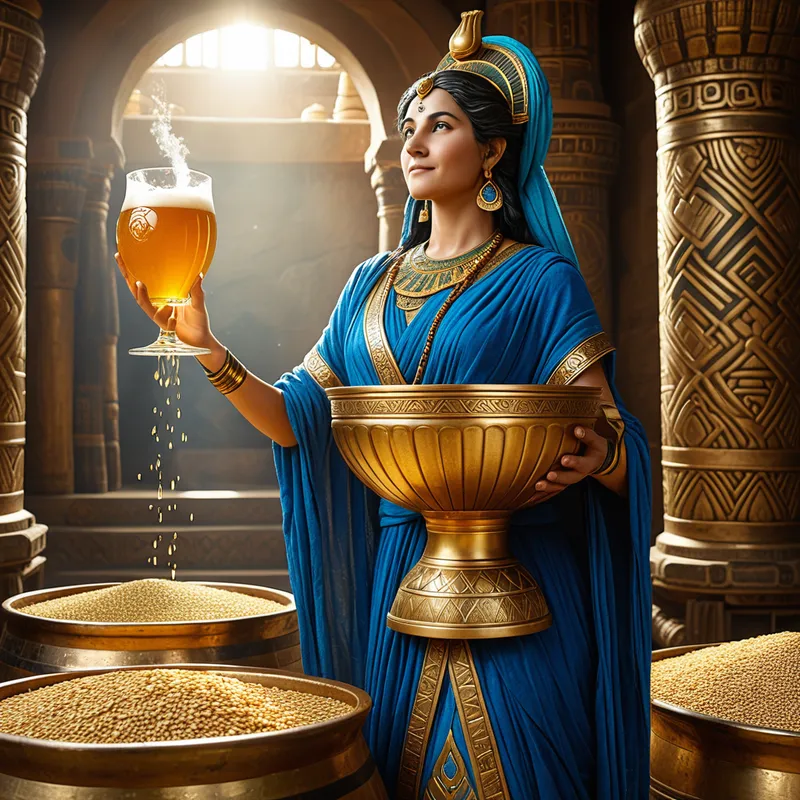
The story of Ninkasi, the Sumerian goddess who brewed beer from the waters of creation, transforming grain into the sacred drink of civilization and divine joy.
The Tale of Ninkasi
In the beginning, before the canals were straight and the cities tall, there was a thirst. Not the thirst of the body for water—for the twin rivers, the Idiglat and Buranun, saw to that. No, this was a deeper thirst, a longing in the soul of the black-headed people for a joy that water could not quench, for a communion that bread alone could not provide. The world was heavy with the labor of creation: the baking of bricks, the carving of clay tablets, the endless turning of the soil. The gods had given life, but they had not yet given the means to truly celebrate it.
Then, from the deep, abyssal waters of Nammu, and through the divine decree of Enlil, she was born. They called her Ninkasi. Her essence was not of war or of the storm, but of the humble, golden field and the patient, bubbling vat. She was the daughter of Enki, the cunning one, and Ninti, the lady of life. In her, the wisdom of the deep waters met the wild vitality of the earth.
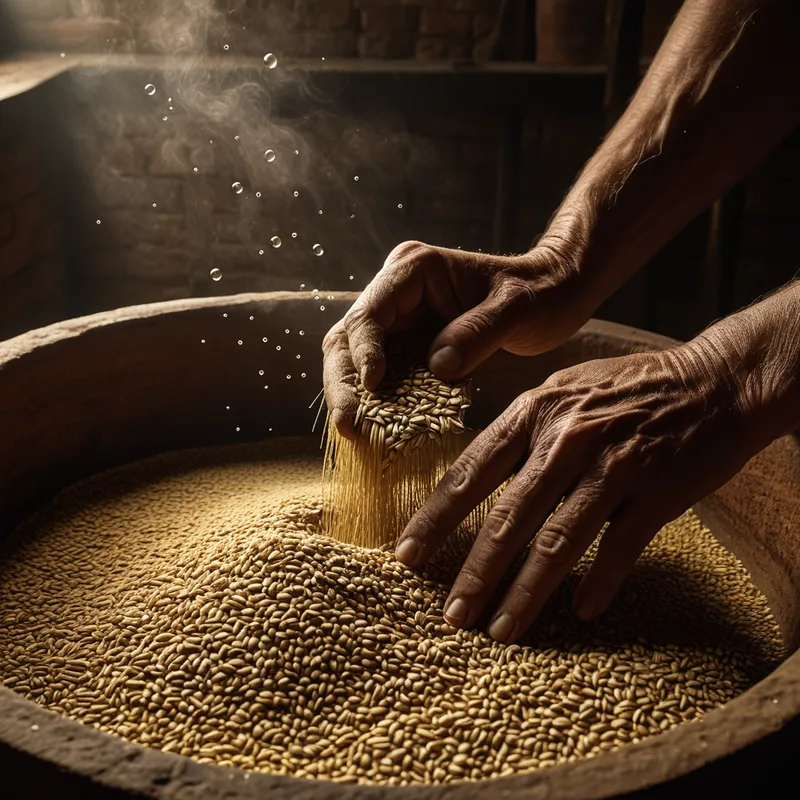
The people watched as Ninkasi walked the sun-baked plains. Where her feet touched, wild barley bent its head in heavy offering. She did not command with thunder, but with a whisper to the grain. She took the barley in her divine hands and showed the first brewers—the priestesses in the temple’s quiet heart—the sacred art. “Watch,” her spirit seemed to say. “See the grain, the gift of the earth. Let it soak in the life-giving water, the gift of the abyss. Let it sprout, a miniature rebirth. Then crush it, release its soul.”
They baked the malted grain into loaves of bappir, fragrant and dark. They crumbled these loaves into great jars, adding water and the secret ferment—a precious, leftover foam from a previous brew, a living chain of divinity. Then, they waited in the temple’s warm gloom. This was the mystery. This was the alchemy.
And then, the sound. A gentle hiss, a soft, collective sigh from the depths of the clay. Bubbles rose, a tiny, effervescent cosmos being born within the jar. The air grew thick with a scent both earthy and ethereal—the smell of transformation. When they dipped their long reed straws into the jar and drank, it was not mere sustenance. It was a golden flood of warmth that loosened the shoulders, lightened the heart, and made the eyes sparkle. Laughter, which had been scarce and hard-won, now flowed as easily as the beer. Songs were sung that had no name before. The worker forgot the weight of his brick for a moment; the scribe saw the cuneiform signs dance. Ninkasi had filled their mouths, and in doing so, had filled the hollow spaces in their civilization with the spirit of collective joy.
Cultural Origins & Context
The Hymn to Ninkasi, inscribed on clay tablets around 1800 BCE, is far more than a poem; it is a technical manual, a liturgical script, and a national treasure rolled into one. It was likely recited or sung during the brewing process itself, a sacred incantation to ensure the success of the batch. Beer (kash) was the staple beverage of Sumer, consumed daily by all ages and classes due to uncertain water purity. It was currency, sacrament, and social lubricant.
The myth and its accompanying hymn were preserved by the temple institution, the economic and spiritual heart of the city-state. Brewing was primarily the domain of priestesses, linking the production of this essential, mood-altering substance directly to the divine feminine and temple authority. To know the story of Ninkasi was to know the recipe for civilization’s comfort. The myth functioned as a divine sanction for a crucial technology, elevating a mundane, microbial process into a theophany—a visible manifestation of the goddess’s grace. It answered the “why” of beer’s power: it was not mere intoxication, but the literal embodiment of a goddess’s gift, a liquid deity meant to be consumed.
Symbolic Architecture
At its core, the myth of Ninkasi is a profound allegory for the civilizing process itself—the transformation of raw, wild nature (edinu) into cultured, communal sustenance. The goddess represents the mediating principle between the untamed earth (the barley) and human society. She is the archetypal transformer.
The sacred is not only in the high temple; it is in the lowly vat. Divinity ferments in the dark, unseen, until it bubbles forth into consciousness as joy.
The ingredients are deeply symbolic: Barley is the concentrated solar energy, the disciplined product of agriculture. Water is the primordial, chaotic source of all life from Nammu and Enki. The ferment is the spark of life itself, the invisible, self-replicating spirit that initiates change. The process—soaking, sprouting, baking, fermenting—mirrors the cycles of death, rebirth, and transformation central to all agricultural and spiritual life. The resulting beer is not an escape, but an ingression: the spirit of the goddess enters the community, dissolving rigid hierarchies and individual burdens, facilitating a state of sacred communion and shared euphoria. It symbolizes the ekstasis (standing outside oneself) necessary to perceive the bonds of community and the grace of the gods.

The Dreamer's Resonance
When the pattern of Ninkasi stirs in the modern unconscious, it often manifests in dreams of fermentation, bubbling liquids, or golden transformations. One might dream of a forgotten basement where jars are mysteriously alive with activity, or of a faucet that pours forth not water, but honeyed, effervescent light. These are not dreams of mere celebration, but dreams of a psychic process underway.
The somatic sensation is one of internal warmth, a gentle pressure building from within the core. Psychologically, this signals a period where raw, perhaps difficult, emotional or experiential material (the “grain” of one’s life) is undergoing a necessary, hidden transformation. The ego must “wait in the temple gloom,” trusting a process it does not control. The bubbling represents emergent insights, feelings, or creative impulses beginning to rise from the depths. To dream of Ninkasi is to dream that one’s struggles, one’s daily “bread,” are being alchemized into something that can nourish the spirit and connect one to a larger, more joyful collective reality. It cautions against interrupting the fermentation—against analyzing the joy away before it has fully formed.

Alchemical Translation
For the individual on the path of individuation, Ninkasi models the alchemical stage of solutio (dissolution) and fermentatio. Our conscious, rigidly held identities and traumas (the hard, baked bappir loaf of the ego) must be broken down and dissolved in the waters of the unconscious. This is a vulnerable, often dark, process where things seem to decompose.
The psyche’s most profound creations are brewed in darkness. We do not invent our joy; we provide the ingredients and consent to the transformative rot.
Then, the ferment is added—the catalytic spark, often encountered as a numinous dream, a synchronicity, or the influence of a therapist or guide (the “priestess”). This begins an autonomous, bubbling process of fermentatio, where the contents of the psyche interact, break down, and recombine into something entirely new. The ego’s role is not to direct this, but to tend the vessel, to maintain the sacred space (the temenos) where this can occur.
The final “beer” is the intoxicating, unifying symbol—a new attitude, a creative work, a deeper capacity for relationship and joy that arises from the integrated self. It is the aqua vitae, the water of life, that makes the burdens of consciousness lighter and connects the individual to the intoxicating, divine flow of life itself. Ninkasi teaches that transformation is not a sterile, intellectual exercise, but a messy, organic, and ultimately celebratory act of creation from the raw materials of our existence. We are all both the brewer and the vessel, waiting for the sacred bubble of insight to rise from the deep.
Associated Symbols
Explore related symbols from the CaleaDream lexicon: