Ninigi and the Descent from Heaven Myth Meaning & Symbolism
The grandson of the Sun Goddess descends from the heavens to rule the fertile land, establishing the divine lineage of Japan's emperors.
The Tale of Ninigi and the Descent from Heaven
Listen, and hear the tale of the descent, when the heavens bent low to kiss the earth.
In the High Plain of Takamagahara, a great unrest stirred. The world below, the Ashihara no Nakatsukuni, writhed in chaos. Its mountains groaned, its rivers ran wild, and the cries of earthly spirits rose like a mist of discord, troubling the celestial order. The great Amaterasu-Ōmikami, she who illuminates all things from her sacred loom, gazed down with a sovereign’s concern. The land needed a ruler, a sovereign of divine blood to bring peace and cultivate its wild beauty.
She summoned her grandson, a prince of peerless grace and virtue. His name was <abbr title=""Ninigi, the August Grandson," the divine grandson of Amaterasu.">Ninigi-no-Mikoto. Before him, she set the Three Sacred Treasures: the Yasakani no Magatama, its curves holding the soft light of compassion; the Yata no Kagami, its polished surface a pool of perfect honesty; and the Ame no Murakumo no Tsurugi, its blade forged from a storm serpent’s tail. “These are the seals of your authority,” her voice echoed like a temple bell. “Go, pacify the Central Land of Reed Plains. Rule it, and let my lineage flourish there forever.”
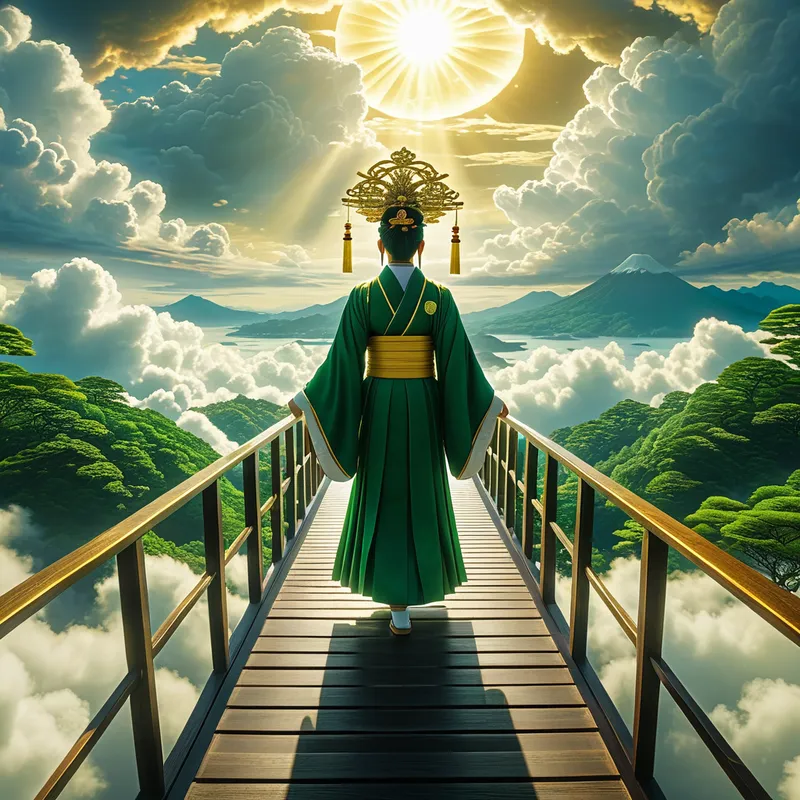
And so the descent began. Not a fall, but a solemn, glorious procession. Ninigi, clad in robes woven from light, stepped from the floating bridge of heaven. A company of eight million kami attended him, their forms shimmering like heat haze. They descended upon the peak of Takachiho-no-mine, a mountain that pierced the sky, its slopes thick with cedar and mist. The very air tasted of ozone and damp soil.
But the earthly spirits were not easily subdued. A great kami named <abbr title=""The Brave One of the Reed Plains," an earthly deity who challenged Ninigi's descent.">Sarutahiko Ōkami stood in their path, a giant whose radiance shone from his eyes and nose, blocking the way. Yet this was not mere opposition; it was a test, a necessary meeting of heaven and earth. The heavenly kami Ame no Uzume approached him, her dance and forthright speech a bridge of understanding. Sarutahiko, recognizing the divine mandate, bowed and became their guide into the land.
Ninigi planted his staff upon the fertile earth. He took a wife from the mountains, Konohana-no-Sakuya-bime, the Princess Who Makes the Trees Blossom, and through their line, the seed of the sun was sown in the soil. The chaos stilled. Order, kotodama, flowed from his presence. The wild rice bent to form golden ears, the rivers learned their courses, and the people of the land looked up to see not a conqueror, but a divine ancestor, whose very being wove the patterns of heaven into the tapestry of earth.

Cultural Origins & Context
This myth, central to the <abbr title=""Chronicles of Ancient Matters," Japan's oldest extant chronicle, compiled in 712 CE.">Kojiki (712 CE) and the <abbr title=""Chronicles of Japan," the second oldest history of Japan, compiled in 720 CE.">Nihon Shoki (720 CE), is not merely a story but the foundational charter of Japanese imperial divinity and national identity. It was preserved and recited by court ritualists (hafuri or kataribe), whose role was to maintain the sacred connection between the ruling dynasty and its celestial origins.
Its societal function was profound: it provided the theological justification for the emperor’s rule (tennō, the “heavenly sovereign”), establishing him as a direct descendant of Amaterasu. This “descent” (tenson kōrin) created a sacred geography, linking specific locations in Kyushu to the divine narrative. The myth served to unify the various clan deities and local spirit cults under a single, solar-derived cosmological order, integrating them into the heavenly lineage as attendant kami. It framed the relationship between the human world and the divine not as one of separation, but of intimate, genealogical connection, where ruling the land was a sacred act of stewardship passed down through blood.
Symbolic Architecture
At its heart, the myth is a grand allegory for the imposition of sacred order (kami no michi, the way of the kami) upon primordial potential. Ninigi is the archetypal principle of consciousness descending into the unconscious, fertile field of matter.
The descent is not an exile, but a sacred marriage; heaven seeks its reflection in the substance of earth.
The Sanshu no Jingi are not just regalia, but the triune psychic faculties required for this task: the Mirror (wisdom, self-reflection, truth), the Jewel (compassion, attraction, the heart), and the Sword (discernment, the will to cut through illusion and chaos). Their reception signifies that legitimate authority must be balanced and whole.
The confrontation with Sarutahiko is critical. He represents the autonomous, untamed spirit of the land—the psychological “shadow” or the raw, instinctual power of a place that must be acknowledged and integrated, not defeated. His transformation from obstacle to guide models the necessary reconciliation between a new, ordering consciousness and the deep, indigenous soul of the territory it seeks to inhabit.
The Dreamer's Resonance
When this myth stirs in the modern dreamer, it often signals a profound process of incarnation—the psyche’s attempt to ground a lofty ideal, identity, or spiritual insight into the practical reality of one’s life. Dreaming of a graceful descent from a high place, of being entrusted with sacred objects, or of meeting a formidable but ultimately guiding earth-figure points to this dynamic.
Somatically, this may feel like a pressure to “land,” a restlessness in the limbs or root chakra as the spirit seeks its place in the world. Psychologically, it is the struggle to become who you are meant to be in the world, to translate inner potential (the heavenly blueprint) into outer action and relationship (the earthly kingdom). Resistance, embodied by a Sarutahiko figure in a dream, is not the enemy, but the crucial test of authenticity. The dream asks: Have you come with true authority (the three treasures), or with empty arrogance? Will you honor the spirit of the place you are entering—be it a new job, relationship, or stage of life—or seek to dominate it?
Alchemical Translation
For the individual on the path of individuation, Ninigi’s journey is the alchemical process of solve et coagula—to dissolve the purely spiritual identity and coagulate it into a functional, embodied self. The “heaven” is the realm of pure potential, the Self in its unmanifest form. The “descent” is the often-wrenching commitment to manifestation, to limiting that infinite potential into a single, mortal life with all its constraints and beauties.
The imperial regalia are the philosopher’s stone of the soul: the mirror for knowing thyself, the jewel for loving thyself, and the sword for willing thyself into being.
The struggle is the nigredo, the darkening, as the shining self meets the shadowy, complex reality of earthly existence (Sarutahiko). The resolution is not victory over the earth, but a sacred pact with it, leading to the albedo and rubedo: the blossoming of one’s unique life (Konohana) and the establishment of a lasting, creative lineage. To undergo this alchemy is to become the sovereign of one’s own inner realm, ruling not through force, but through the divine right of authentic, embodied consciousness, bringing order to inner chaos and cultivating the fertile soil of one’s own soul.
Associated Symbols
Explore related symbols from the CaleaDream lexicon:
- Heaven — The celestial realm of pure order and divine origin, representing the unmanifest Self, spiritual potential, and the source of legitimate authority.
- Earth — The fertile, chaotic realm of manifestation, representing the unconscious, the body, the material world, and the field where spirit must take root.
- Bridge — The Ame-no-ukihashi, symbolizing the perilous yet sacred transition between states of being, consciousness, and worlds.
- Mirror — The Yata no Kagami, representing truth, self-reflection, wisdom, and the capacity to see things—and oneself—as they truly are.
- Mountain — Takachiho-no-mine, the axis mundi where heaven and earth meet, a place of revelation, landing, and the grounding of the divine.
- Journey — The descent itself, modeling the soul's necessary voyage from potential into actualization, from spirit into matter.
- Order — The divine mandate (shintai) brought by Ninigi, representing the imposition of kosmos on chaos, the structuring principle of consciousness.
- Hero — Ninigi as the divine scion who undertakes the foundational task of connecting heaven and earth, establishing a new order.
- Sun — Amaterasu, the ultimate source of the lineage and light, representing consciousness, clarity, life-giving energy, and sovereign power.
- Tree — Symbolized by Princess Konohana, representing blossoming life, fertility, lineage, and the organic growth that follows the establishment of order.
- Goddess — Amaterasu as the supreme source, and Ame no Uzume as the mediator, representing the feminine divine as originator and facilitator of the sacred process.
- Root — The deep, indigenous spirit of the land (Sarutahiko) and the eventual rooting of the heavenly lineage in the soil of Japan, symbolizing connection to the ancestral and the instinctual.