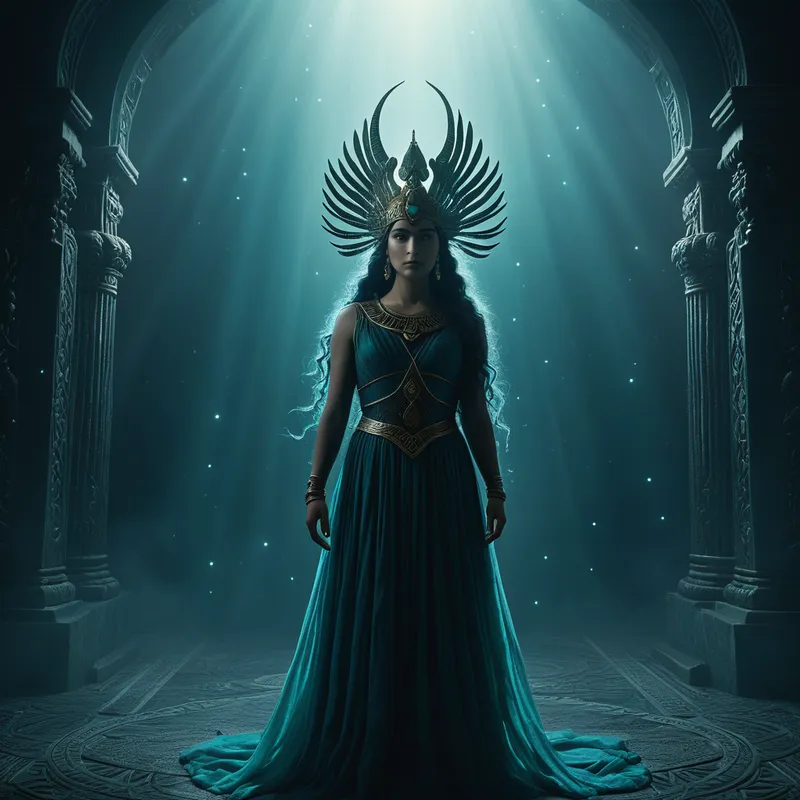
Ninhursag
Ninhursag is the Sumerian mother goddess of fertility, mountains, and wild animals, embodying creation and nurturing life in ancient Mesopotamian mythology.
The Tale of Ninhursag
In the beginning, when the world was still a formless clay, the gods themselves were young and raw. From the primordial waters of Abzu and the solid earth of Ki, life stirred. Among the first generation of deities was Ninhursag, whose name means "Lady of the Mountainhead." She was not a distant sky deity, but one whose essence was the living earth itself—the rugged slopes, the wild pastures, the womb of the mountain from which all life springs.
Her most profound tale is one of creation, wounding, and ultimate healing, a divine drama that establishes the very rhythm of life and decay. It begins with the god Enki, the clever lord of the sweet waters and wisdom. In the sacred land of Dilmun, a pure and pristine place, Ninhursag caused eight delicate plants to sprout from the earth. Enki, seeing these new creations, desired to know their essence, their inner nature. One by one, he consumed them. To Ninhursag, this was not curiosity but a profound violation. Each plant was her child, a unique expression of her fertile power, and Enki had devoured their potential without understanding. Her nurturing aspect turned to a righteous, terrifying wrath.
"You have eaten my children!" she cried, and her voice was the rumble of an avalanche. She cast the curse of death upon Enki, fixing her eye upon him, and would not be appeased. The life-giving god began to wither; eight parts of his body sickened and failed. The other gods watched in despair, for the source of wisdom and fresh water was perishing, and none could soften Ninhursag's heart. The cosmos itself grew ill with him.
But the story does not end in sterile vengeance. From the drama of the curse emerges a deeper magic. The fox, a cunning creature of the wilds Ninhursag oversees, intervened, coaxing the great goddess back to the side of the suffering Enki. Her anger, having flowed like a cleansing flood, now receded to reveal the bedrock of her nature: she is the one who mends. Sitting with the dying god, she brought forth eight healing deities, each born to cure one of Enki's afflicted parts. From the pain in his rib (Ti), she created Ninti, "Lady of the Rib," who is also "Lady of Life." In this act, the wound itself becomes the birthplace of the healer. The curse is not revoked but alchemized; through the confrontation of divine wills, new forms of life and consciousness are birthed. Ninhursag, having asserted the sacredness of her creations, then becomes the agent of restoration, weaving the broken world back into wholeness.
Cultural Origins & Context
Ninhursag's roots are ancient, reaching back to the earliest strata of Sumerian belief. She is one of the four primary deities of the Sumerian pantheon, alongside An (Sky), Enlil (Air), and Enki (Water). Her epithets map her domain: Nintur ("Lady Birth-hut"), Damgalnuna ("Great Wife of the Prince," often linking her to Enki), and Aruru, the fashioner of humanity from clay. She was not a generalized "mother goddess" but a sovereign of specific, vital realms: the fertile foothills of the Zagros mountains, the raw, untamed edge between the cultivated plain and the wild highlands. This positioned her as the patron of wild animals—lions, stags, and gazelles—and the nurturing source of grasses that fed both herds and hunters.
Her worship centered on the life-death-rebirth cycles of the natural and agricultural world. As the "Lady of the Mountainhead," she was the literal body of the earth, from whose stony bones flowed life-giving springs. In the city-states of Kesh and Adab, she was revered as the divine midwife, present at the birth of kings and lambs alike. Her mythology provided a divine template for the human experience of nature: it is bountiful but can be wrathful when its laws are transgressed; it can be wounded, and it alone holds the secret of its own healing. Her conflict and reconciliation with Enki reflect the Sumerian understanding of the necessary, tense partnership between the fertile earth (Ninhursag) and the fertilizing fresh waters (Enki) for civilization to flourish.
Symbolic Architecture
Ninhursag’s myth constructs a profound psychological architecture. She embodies the archetypal principle of the container—the physical womb of the earth, the moral boundary that says "this far, no further," and the healing vessel that holds pain until it transforms. Her narrative challenges a simplistic view of the caregiver as merely gentle; her nurturing is fierce, conditional upon respect for the integrity of what she creates.
Her curse upon Enki is not chaos, but an enactment of sacred law. It is the earth itself declaring that exploitation without communion leads to sterility. The subsequent healing is not a forgiveness of the violation, but a demonstration that wholeness must be re-earned through the painful, creative process of addressing the wound directly.
Her story presents a non-linear model of creation. Life is not a single act, but a continuous cycle of emergence (the plants), violation (their consumption), crisis (the curse), and regeneration (the birth of the healers). The caregiver, in this deepest sense, is not one who prevents pain, but one who midwifes the new consciousness that pain can reveal. Ninhursag’s journey from creator to avenger to healer maps the full spectrum of the maternal: the power to give life, the power to withdraw vitality, and the ultimate power to restore it on a new, more conscious level.
The Dreamer's Resonance
To encounter Ninhursag in the inner landscape is to meet the part of the psyche that is fundamentally generative and fiercely protective of its creations. She may appear in dreams as a mountainous landscape, a protective but stern animal, or an ancient, potent female figure associated with caves or springs. She resonates when one is in a phase of nurturing a new project, idea, or aspect of the self. Her energy demands respect for the fragile, emerging thing—to not "devour" it with premature analysis, criticism, or public exposure before it has rooted.
Her myth also speaks directly to the experience of violation and healing. When a personal boundary is crossed, when something sacred within is consumed by another's carelessness or greed, Ninhursag’s righteous rage provides a template. It legitimizes the curse—the withdrawal of life-force, the setting of a firm, implacable limit. The healing that follows, however, is not automatic. It requires the "fox" of cunning insight to bridge the isolation of wrath, and it demands sitting with the wounded one (whether in oneself or another) to birth the specific "deity"—the specific insight, skill, or quality—needed for repair. She teaches that healing is not a return to the old state, but the creation of something new from the site of the wound.

Alchemical Translation
In the alchemy of the soul, Ninhursag represents the prima materia itself: the raw, fecund earth of potential. The process she oversees is the solve et coagula—dissolve and coagulate—of natural cycles. The plants are coagulated forms; Enki’s consumption dissolves them; the curse dissolves Enki; and from his dissolved state, new, more conscious forms (the healing deities) are coagulated.
The alchemical secret in her myth is that the lapis philosophorum, the philosopher's stone of wholeness, is not found in purity but in the reconciliation of opposites through the crucible of conflict. The fertile earth and the clever waters must engage in a dangerous dance of violation and repair to produce the elixir of true life, which is always life that has known death.
Her process transforms blind, instinctual fertility into conscious, responsible creation. The first plants are innocent growth; the final healing deities are born with purpose and name. This is the evolution from nature as mere process to nature as sacred, knowing participant. To integrate Ninhursag is to accept that one's own creative and healing powers are forged in the difficult encounters between will and boundary, love and rage, wounding and mending.
Associated Symbols
Explore related symbols from the CaleaDream lexicon:
- Mountain — The enduring, foundational body of the goddess, representing solidity, refuge, and the source of life that emerges from stony heights.
- Earth — The primal substance of her being, the dark, fertile ground from which all life is born and to which it returns.
- Wound — The necessary rupture that precedes deep healing, as Enki’s afflictions become the sites for the birth of restorative deities.
- Healing — The active, creative force of restoration that Ninhursag embodies, moving beyond cure to the generation of new life from pain.
- Fertility Ritual — The ceremonial enactment of her power, connecting human community to the cyclical, sacred processes of birth, growth, and renewal.
- Mother — The archetypal source of nurture and life, manifested here with the full spectrum of protective fierceness and regenerative compassion.
- Tree — A symbol of her organic, rooted creativity, standing as an axis between the underworld, earth, and sky, perpetually cycling life.
- Stone — The unyielding aspect of her nature, the bedrock of law and boundary, which is also the tablet upon which the story of life is written.
- Seed — The latent potential buried within her earthy body, containing the entire pattern of future life awaiting the right conditions to sprout.
- Cyclic Nature — The fundamental law she governs, where creation, violation, crisis, and regeneration form an endless, sacred wheel.
- Cave — The womb of the mountain, a sacred enclosure representing the dark, fertile interior where transformation and new beginnings are nurtured.
- River — The flowing, fertilizing principle (often associated with Enki) that engages with her static earth, their union making all cultivated life possible.