Nine Night Death Ritual Myth Meaning & Symbolism
A mythic journey where the soul, guided by ritual, navigates nine nights of dissolution and remembrance to be reborn into the ancestral realm.
The Tale of Nine Night Death Ritual
Listen. The breath has left the body, but the journey has only just begun.
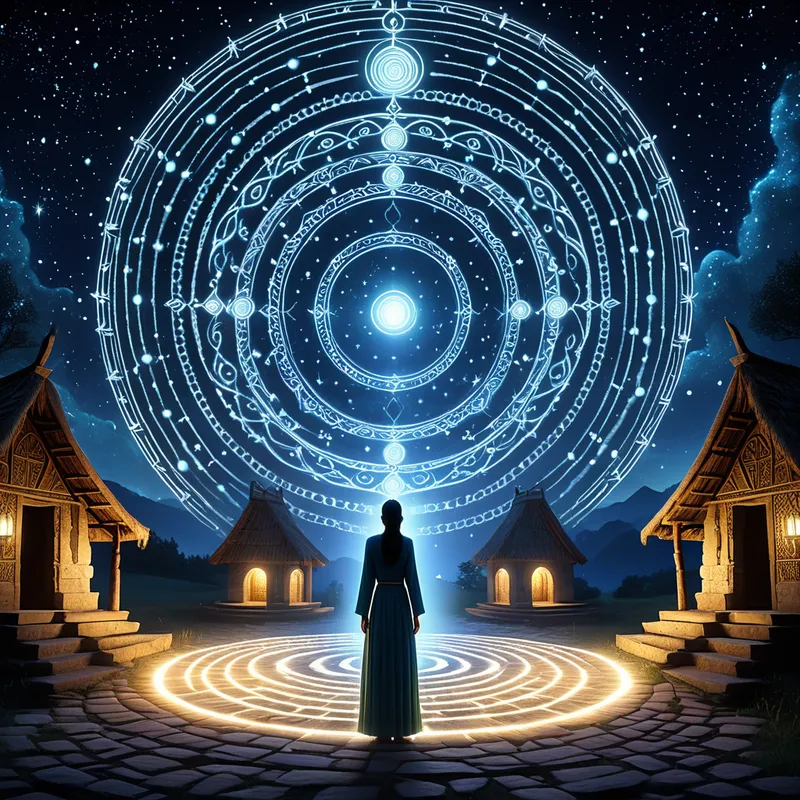
In the village where the drums speak a language older than words, a great quiet falls. Not the quiet of absence, but the thick, potent quiet of a threshold crossed. The one who was among us has stepped into the river of shadows. Their body lies still, a husk, but their ntoro is untethered, adrift in the bewildering fog that lies between the world of the living and the land of the mighty ancestors.
For the sisa, this is a time of terrible danger. It is a child lost in a storm. It can be snatched by malevolent winds, tempted by false lights, or worse—it might simply turn around, forgetting it is dead, and try to claw its way back into the familiar warmth of the family hut, bringing confusion and sickness in its wake.
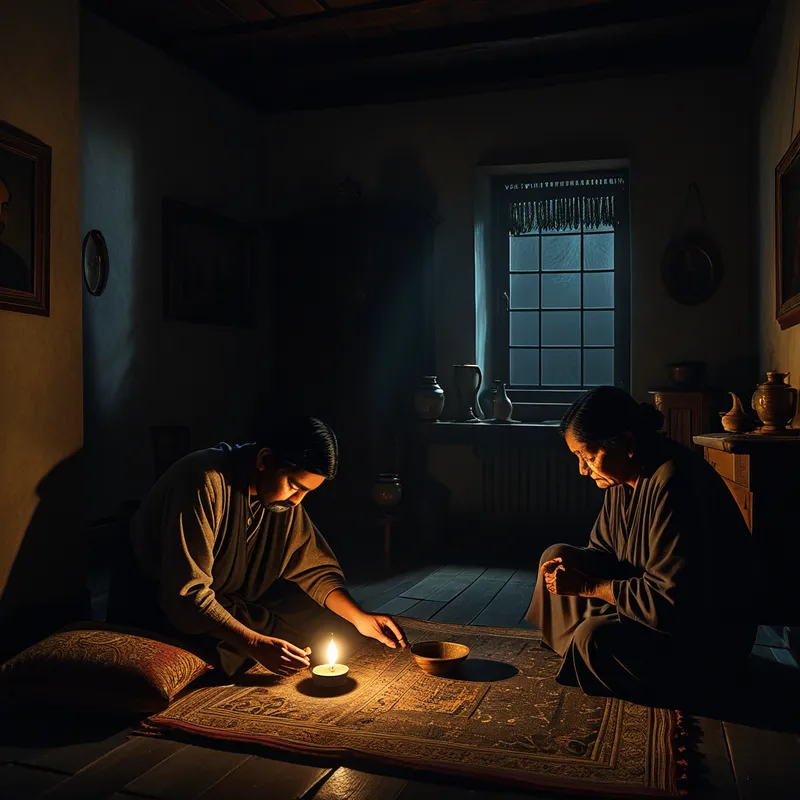
So the people begin. They light a lamp, a single, unwavering eye of fire that must not go out. This is the first thread, a lifeline cast into the dark. For nine nights, the village holds its breath. The compound becomes a sacred vessel, a womb of memory. Each night, they gather. They do not mourn in silence; they summon the departed with sound. The drums beat, not the complex rhythms of celebration, but the steady, heartbeat-thump of the earth itself. They sing the old songs, the ones the departed knew as a child. They speak their name, tell stories of their life—their laughter, their stubbornness, their kindness.
The sisa hears. Drawn by the scent of familiar food left at the nsamanpow, by the sound of its own name sung with love, it begins to find its way. But the path is not straight. Each night is a trial, a stripping away. On one night, the spirit wanders the places of its old joys, tasting the ghost of laughter. On another, it is forced to gaze upon the wounds it left unhealed, the words left unsaid. It is washed in the waters of memory, scorched by the fires of regret, and cooled by the balm of forgiveness offered from the living side of the veil.
The ninth night arrives, the great turning. The drumming reaches a crescendo that is also a profound silence. The family prepares a final feast, a lavish offering. Every dish the loved one cherished is prepared. This is not a meal for the living; it is a passport, a last taste of the world being left behind. As the food is shared in the spirit, a final, sacred ritual is performed—often a libation, the pouring of drink onto the earth, a bridge of liquid connecting the realms.
And then, a release. The clinging tendrils of earthly life are severed by love and ceremony. The fog clears. Before the sisa now shines the true path, the radiant road to the village of the ancestors. It is welcomed home, examined by the ancient ones, and given its rightful place in the eternal community. The lamp is extinguished. The ritual is complete. The one who was lost is now found, not as a ghost to be feared, but as an ancestor to be honored. The living can breathe again, their grief alchemized into connection. The circle, though changed, remains unbroken.
Cultural Origins & Context
This mythic narrative is not a single story from one book, but a living, breathing ritual complex carried in the collective soul of the African Diaspora. Its deepest roots are in West and Central African spiritual systems, particularly among the Akan, Kongo, Yoruba, and Igbo peoples. The transatlantic slave trade did not destroy this worldview; it forced it underground, where it mutated with incredible resilience, weaving itself into new forms in the Caribbean, the American South, and South America.
It became the <abbr title="A Jamaican funerary tradition of nine nights of community gathering">Nine Night</abbr> in Jamaica, the <abbr title="A wake or vigil lasting several nights">Set-up</abbr> or Dead Yard. In Haitian Vodou, it resonates with the journey of the <abbr title="The soul or spirit">gwo bon anj</abbr> after death. In the Brazilian Candomblé and Umbanda, similar concepts of guiding the spirit (egun) exist. It was passed down not by bards in courts, but by grandmothers washing bodies, by deacons leading hymns, by community elders ensuring the proper respect was paid. Its societal function was paramount: it was a technology of psychic hygiene. It protected the living from spiritual unrest (hauntings, madness, misfortune) and secured the dead a safe passage, thereby maintaining the cosmic balance between the visible and invisible worlds. It transformed paralyzing grief into active, communal love, reaffirming that death is a transition managed by the community, not an abrupt, solitary end.
Symbolic Architecture
The myth is a profound map of the psyche's journey through a catastrophic change. The nine nights are not arbitrary; they represent the complete gestational cycle for a new state of being. The <abbr title="The recently deceased's spirit">sisa</abbr> is the psyche itself in a state of traumatic shock—after the "death" of a identity, a relationship, a life phase.
The ritual is the psyche’s own healing intelligence, a sequence of operations performed by the inner community (our memories, our loves, our regrets) to process what has been lost.
The <abbr title="A ritual altar or sacred space for offerings">nsamanpow</abbr> is the altar of the heart, where we make offerings of memory to the departed part of ourselves. The unceasing lamp is the flame of consciousness that must be maintained through the dark night of the soul, lest we dissolve entirely into the unconscious. The final feast is the act of fully savoring and then consciously relinquishing our attachment to what was. The entire process symbolizes the dissolution of the ego’s temporary identification (the personal life) and its reintegration into a larger, transpersonal order (the ancestral [realm](/symbols/realm "Symbol: The symbol of 'Realm' often signifies the boundaries of one's consciousness, experiences, or emotional states, suggesting aspects of reality that are either explored or ignored."), the Self).
The Dreamer's Resonance
When this mythic pattern stirs in modern dreams, it signals a profound somatic and psychological process of integration after a "death"—be it divorce, job loss, illness, or a deep betrayal. The dreamer may find themselves in a long, empty house, cleaning room after room (the nine nights of preparation). They may hear faint, familiar music or voices calling their name from another part of the dream (the living calling the spirit). They might be trying to pack a suitcase but can never finish, or be waiting at a terminal for a train that is always delayed (the suspended state of the <abbr title="The untethered soul or spirit">sisa</abbr>).
The somatic feeling is one of liminal weight—a heavy, foggy, in-between state. Psychologically, the dreamer is navigating the bardo of their own life change. The ritual sequence in the myth shows that this is not a pathology, but a necessary, structured descent. The dreams are the psyche’s own drumming and singing, gathering the scattered pieces of the self after an explosion, performing the nightly work of recollection and release so that a new orientation can be born.
Alchemical Translation
For the modern individual striving toward wholeness (individuation), the Nine Night Ritual is a masterful model of psychic transmutation. Its core teaching is that grief is alchemical labor. The "death" is any content—a complex, a persona, a cherished ideal—that must be consciously sacrificed for growth to occur.
The ritual insists we do not skip the nights. We must stew in the memory, face the regret, and offer the feast of farewell. This is the slow, sacred work of turning leaden grief into the gold of wisdom.
The first nights (recognition and anchoring) correspond to acknowledging the loss fully, without spiritual bypass. The middle nights (review and cleansing) are the shadow work, where we honestly assess our part in the story. The final nights (feast and release) are the active, often painful, choice to bless and let go. The culmination is not a return to the old self, but a rebirth into a broader identity. The integrated complex or lost relationship no longer haunts as a ghost (a neurotic symptom), but is honored as an ancestor (a source of depth and perspective), a permanent, peaceful part of the inner community. The ritual transforms a possession by the past into a dialogue with it, achieving the ultimate alchemical goal: making the volatile fixed, and the fixed, volatile.
Associated Symbols
Explore related symbols from the CaleaDream lexicon:
- Ritual — The structured, loving container that transforms chaotic grief into sacred transition, modeling the psyche’s innate need for ceremony to process profound change.
- Night — The ninefold realm of dissolution, incubation, and unseen guidance, where the work of the soul is done away from the harsh light of day-consciousness.
- Door — Each of the nine nights represents a threshold the spirit must pass through, a successive shedding of earthly attachments to move closer to the ancestral realm.
- Water — Symbolizes the cleansing of the spirit’s memory and the fluid, emotional medium through which it travels between worlds, often seen in libations.
- Fire — The unwavering lamp of consciousness and communal love that guides and protects the wandering spirit, preventing its loss in the darkness.
- Ancestors — The ultimate destination and welcoming committee, representing the integrated, transpersonal Self into which the individual psyche is reborn.
- Journey — The core narrative of the myth; a purposeful, perilous passage from a state of fragmented attachment to one of wholeness and belonging.
- Circle — The unbroken cycle of life, death, and rebirth that the ritual affirms, and the communal circle formed by the living to enact the ceremony.
- Feast — The final, lavish offering of attachment and love, a sacred act of savoring and then relinquishing the past to secure safe passage forward.
- Drum — The heartbeat of the ritual and of the earth itself, the rhythmic call that tethers the wandering spirit to the world of love and memory.
- Bridge — The entire nine-night ceremony functions as a psychic bridge, carefully constructed by the living, for the soul to cross the dangerous abyss between states of being.
- Rebirth — The triumphant resolution of the ritual; not a return to old life, but the achievement of a new, elevated state of existence as an integrated ancestor.