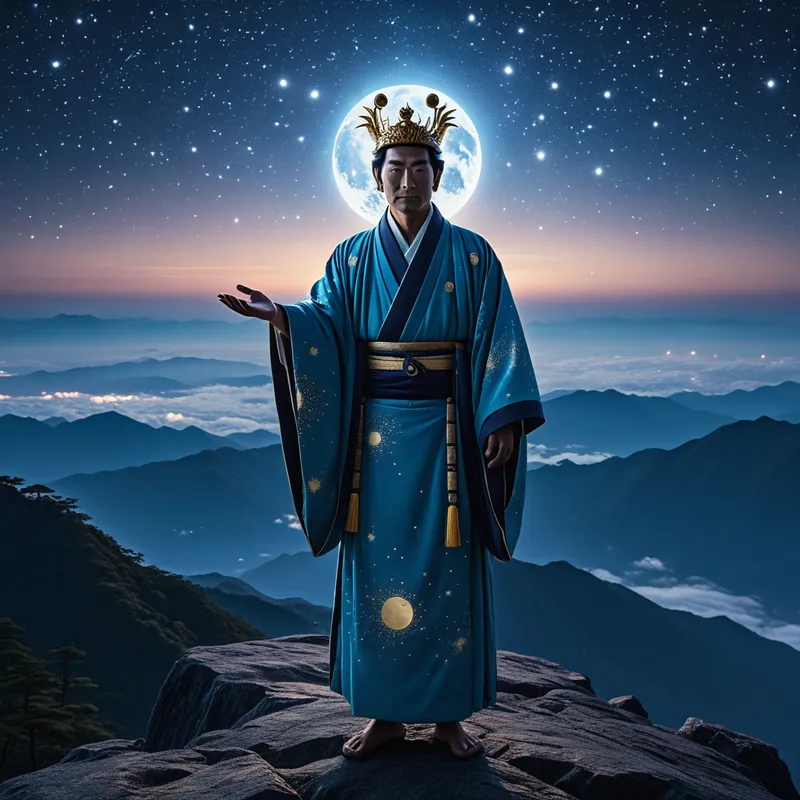
Nigihayahi Star God Myth Meaning & Symbolism
A celestial deity descends from the starry heavens to become the earthly sovereign, bridging the divine and mortal realms in a sacred union.
The Tale of Nigihayahi Star God
Listen, and hear the tale of the one who came from the star-road, the divine ancestor who descended not in wrath, but in peace.
In the Age of the Gods, when the world was still soft and new, the heavens were a tapestry of divine lights. Among them shone the Pleiades, the Subaru. From this glittering council of stars, a decision was woven in light. The earthly realm, Ashihara no Nakatsukuni, was beautiful but turbulent. The earthly spirits, the Kunitsukami, were mighty but unruly. A sovereign was needed, not to conquer, but to unite; not to rule from afar, but to walk the soil.
And so, the Star God was chosen. His name was Nigihayahi-no-mikoto. He did not descend on a bolt of Ikazuchi, but in a vessel of celestial intent—a heavenly rock-boat or a ship woven from star-wind, depending on the teller. His descent was a silent streak of purpose across the vault of night, a falling star with a destination. He landed not on a battlefield, but on the sacred, cloud-wreathed peak of Mount Miwa. The mountain, already a dwelling of powerful spirits, received him. The earth did not tremble in fear, but in recognition.
He came bearing the three sacred treasures: the mirror that reflects truth, the jewel that commands the tides of affinity, the sword that cuts through illusion. But his greatest offering was his presence. He did not declare war on the earthly deities. Instead, he presented himself. He spoke of harmony, of the divine mandate from the Plain of High Heaven, Takamagahara. He spoke of a lineage that would bridge star and stone, heaven and reed plain.
The conflict was not of clashing swords, but of clashing sovereignties. Could a celestial being truly understand the mud and the root, the river's flow and the mountain's stubbornness? The resolution was not submission, but marriage—a sacred union. Through ritual and pact, the celestial lineage of Nigihayahi intertwined with the earthly lineage of the Ōmononushi, the great spirit of the mountain itself. From this union was born a line of kings, the early sovereigns of Yamato. The Star God became the peaceful, foundational pillar upon which the earthly realm was ordered. He did not return to the stars; he became the star within the land, his spirit enshrined within the very mountain of his descent, a quiet, enduring pulse of celestial order within the heart of the world.

Cultural Origins & Context
The myth of Nigihayahi is preserved primarily in the Kojiki and the Nihon Shoki, the great mytho-historical records commissioned by the early Yamato court in the 8th century. Its telling is not a folktale of the village, but a charter myth of the state. It functioned as a critical piece of political theology, legitimizing the ruling lineage by connecting it directly to a peaceful celestial descent that predated and paralleled the more famous descent of the Sun Goddess's grandson, Ninigi-no-Mikoto.
This narrative served a specific purpose: to integrate and pacify powerful regional cults, particularly the worship centered on Mount Miwa. By claiming Nigihayahi as a direct ancestor, the Yamato sovereigns were not erasing local gods but marrying into their legitimacy. The myth asserts that sovereignty arises from a sacred covenant between the heavenly and the earthly, the new and the ancient. It was a story told by court scribes and ritualists to weave disparate threads of belief into a single, coherent tapestry of divine kingship, where the emperor rules not by force alone, but as the living node where heaven and earth meet.
Symbolic Architecture
At its core, the myth of Nigihayahi is a profound allegory for the descent of consciousness into the unconscious, and the subsequent establishment of a ruling principle that integrates both realms.
The true sovereign is not the one who conquers the wilderness, but the one who recognizes the wilderness within as a sacred territory to be married, not subdued.
The Star represents transcendent consciousness, pure pattern, and divine order from "above." The Earth (and the Kunitsukami) symbolizes the chthonic unconscious, the raw, instinctual, and ancestral powers of the land and the psyche. Nigihayahi’s journey is the archetypal Descent. He does not fall; he chooses to come down, embodying the necessity for spirit to incarnate, for idea to take form. His landing on Mount Miwa—a specific, localized Mountain—signifies that this integration happens at a central, axial point within the personal or collective psyche, a temenos or sacred precinct.
The sacred treasures he brings are tools of integration: the Mirror for self-reflection and truth, the Jewel for attracting and harmonizing relationships (the tides of emotion), the Sword for discernment and cutting through psychic knots. The union with Ōmononushi is the critical alchemical coniunctio: the marriage of the celestial animus (spirit, order) with the chthonic anima (soul, substance). This creates the Child—the nascent, integrated Self, capable of ruling the inner kingdom with legitimacy and peace.

The Dreamer's Resonance
When this mythic pattern stirs in the modern dreamer, it often signals a profound process of psychic integration, a call to sacred sovereignty. One might dream of a Star descending into a Forest or landing softly in a backyard garden—a sense of a "higher" calling or insight seeking grounding. The dreamer may find themselves at a Bridge between a dazzling, abstract city of light and a dark, fertile, wild landscape, feeling a duty to cross.
Somatically, this can feel like a deep, centering pressure—a grounding, rather than an uplifting. There may be a sense of the crown of the head (Crown) connecting to the soles of the feet (Earth). Psychologically, it is the process of bringing one’s highest ideals, spiritual insights, or intellectual frameworks (the starry blueprint) into difficult, messy, embodied reality—one’s career, relationships, or creative work. The conflict in the dream may not be with monsters, but with stubborn, earthy "facts" or ingrained emotional patterns (the Kunitsukami) that resist the new order. The resolution is felt as a quiet, firm alliance, a pact with one’s own depths, leading to a newfound sense of authentic authority and calm power.

Alchemical Translation
The individuation journey modeled by Nigihayahi is not one of heroic conquest, but of sacred diplomacy and marital union. The modern seeker often attempts to "ascend"—to transcend the body, the past, the shadow. This myth inverts the paradigm: the goal is a deliberate, respectful Descent.
The alchemical gold is not found by fleeing the lead of our earthly nature, but by marrying our celestial vision to it, creating a new substance that is both.
The first stage is recognizing the "star" within—the core ideal, the spiritual insight, the visionary calling. The second is the courageous decision to launch it into the gravitational pull of real life, to land it on your personal Mount Miwa (the central issue, the core complex). The third, and most crucial, is the negotiation. You cannot simply impose your celestial blueprint. You must present your treasures (your skills, your truth) and parley with the indigenous "gods" of your psyche: your inherited traumas, your instinctual drives, your ancestral stories (Root). This is the Ritual.
The union is the Sacrifice of pure, detached spirit for the sake of embodied soul. The Child born is the integrated personality, the conscious ego that now rules not as a tyrannical usurper, but as a legitimate heir to both heaven and earth. You become the Temple where both are worshipped. The final stage is enshrinement: the process is complete not when you return to the stars, but when the stellar consciousness becomes the still, guiding presence at the heart of your daily, earthly life. The Journey ends in a state of abiding, sovereign peace.
Associated Symbols
Explore related symbols from the CaleaDream lexicon:
- Star — The celestial origin, divine consciousness, and transcendent blueprint that chooses to incarnate within the earthly realm of form and matter.
- Mountain — The sacred, axial meeting point between heaven and earth, the inner temenos where descent occurs and sovereignty is established.
- Mirror — The tool of self-reflection and truth brought from the heavens, essential for seeing and integrating the realities of the earthly self.
- Descent — The core narrative action of the myth, representing the voluntary journey of spirit into incarnation and the unconscious.
- Journey — The sacred passage from one state of being to another, which in this myth is not a quest outward but a purposeful voyage downward.
- Ritual — The sacred pact and ceremonial union between the celestial and the chthonic, which transforms conflict into legitimate sovereignty.
- Child — The new, integrated consciousness born from the marriage of star and earth, the legitimate ruler of the inner kingdom.
- Temple — The psyche itself, once integrated, becomes a sacred space where both divine order and earthly substance are honored.
- Earth — The realm of the unconscious, the body, ancestral memory, and instinct, which must be engaged with respectfully, not conquered.
- Crown — The symbol of the sovereignty achieved not through domination, but through the sacred covenant of integration.
- Root — The deep, chthonic, and ancestral powers of the psyche (the Kunitsukami) that must be acknowledged and allied with for true grounding.
- Sacrifice — The offering of pure, detached celestial identity for the sake of achieving a embodied, unified wholeness.