Ngatoroirangi and the Fires of Tongariro
A Maori legend of the navigator Ngatoroirangi, who called upon volcanic fire to survive the freezing cold, creating the Tongariro mountains and establishing sacred connections.
The Tale of Ngatoroirangi and the Fires of Tongariro
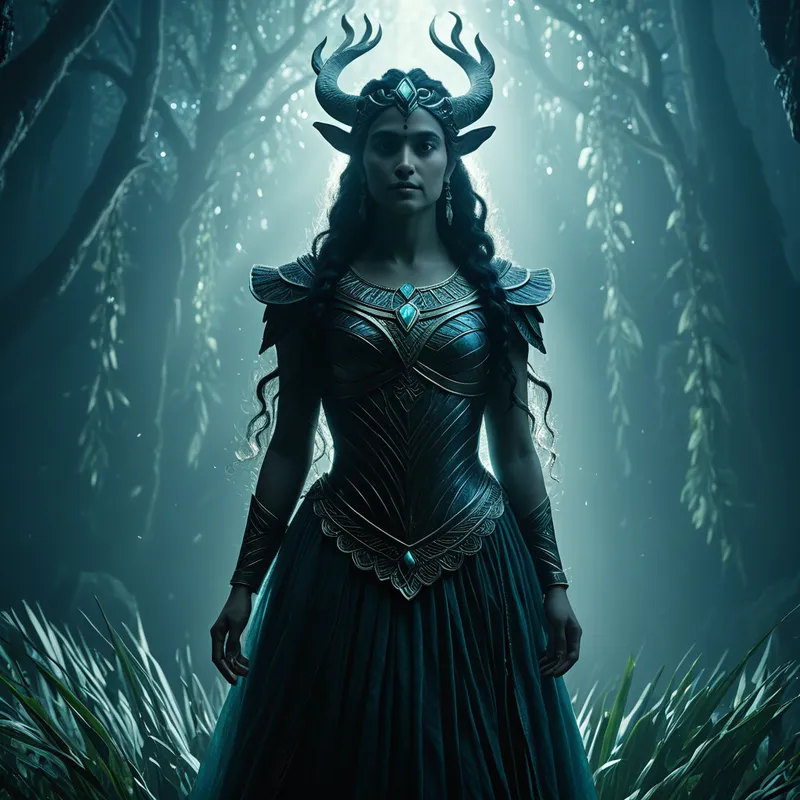
The great navigator and tohunga, Ngatoroirangi, stood upon the deck of the waka Te Arawa as it made landfall on these new, wild shores of Aotearoa. He was a man of the warm, sun-drenched islands of Hawaiki, his blood thrumming with tropical heat, his spirit a conduit for the gods. Driven by a sacred imperative, he left the safety of the coastal settlement and journeyed inland, climbing ever higher into the vast, brooding heart of the North Island. His mission was to claim this land, to imbue it with mana and make it a home for his people.
But the land resisted. As he ascended the colossal, silent peaks of the central plateau, the warm breath of the Pacific fell away. A cold of a kind he had never known seized him—a deep, marrow-freezing cold that seemed to emanate from the stone itself. The lush green gave way to grey scree and barren rock. The sky, a vast and pitiless dome, offered no warmth. This was Te Ika-a-Māui, the fish of Māui, but here in its mountainous spine, it was a land still in the primal sleep of ice.
Ngatoroirangi, the hero who had navigated by stars across the trackless ocean, now found himself lost in a desert of frost. His breath plumed white, his limbs grew stiff and leaden. He called upon his own mana, but the cold was a physical and spiritual void, sucking the life and warmth from him. He realized with a shudder of dread that this was no ordinary chill; it was the cold of the underworld, the breath of Hine-nui-te-pō, the Great Lady of Night. He was being claimed by the land, not as a conqueror, but as a frozen sacrifice.
At the precipice of death, his spirit cried out across impossible distances. His plea was not to local deities, for there were none here, but back to the ancestral hearth, to the fiery goddesses of his homeland: his sisters, Te Pupu and Te Hoata. In Hawaiki, they heard. They felt the dying ember of their brother’s life-force, a spark guttering in a vast, cold darkness.
Without hesitation, they plunged into the earth. Their journey was a mythic race beneath the ocean floor, a torrent of molten urgency. They travelled south, a subterranean river of fire, seeking the source of their brother’s fading call. Where their fiery heads broke the surface in their haste, the land burst aflame: at White Island, at Rotorua, at Taupō. Each was a fiery footfall, a beacon of their passage.
Finally, they reached the frozen peaks where Ngatoroirangi lay, his body almost one with the stone. With a cataclysmic surge of love and elemental power, they erupted at his feet. The earth split open. Fire, liquid and glorious, vomited forth. Scalding steam melted the hoarfrost; rivers of incandescent rock flowed, driving back the deathly cold. The heat thawed Ngatoroirangi’s frozen veins, filling his lungs with searing, life-giving air.
But the goddesses did not retreat. They remained. The fire that had saved him cooled and hardened, becoming the very bones of the land. The peaks—Tongariro, Ngauruhoe, Ruapehu—were born that day, not as mere mountains, but as eternal tapu hearths, permanent conduits of the earth’s inner fire. Ngatoroirangi had not just survived; he had, through his extremity and his sacred connection, translated the ancestral fire of Hawaiki into the landscape of Aotearoa, transforming a place of death into a sacred, living heart.
Cultural Origins & Context
This pūrākau is central to the identity of the Ngāti Tūwharetoa iwi, the people of the central volcanic plateau. It is an origin story of the most profound kind: an origin of sacred geography. The narrative exists at the intersection of several key Māori cultural frameworks. It is a whakapapa narrative, linking the people directly to a founding ancestor and, through him, to the elemental gods of their homeland. It is also a tauparapara, a spiritual claim stamped upon the landscape.
The journey inland from the coast mirrors the historical and spiritual journey of the Māori people after arrival—moving from exploration and settlement to the profound task of knowing and becoming part of the new land’s spirit. The myth explains not just volcanic activity, but the very mauri (life force) of that region. The mountains are not passive scenery; they are the petrified, yet still breathing, body of the ancestor’s salvation and the goddesses’ enduring presence. This establishes an unbreakable kinship and kaitiakitanga (guardianship) relationship between the people and the mountains, making Tongariro not just a landmark, but a revered ancestor.
Symbolic Architecture
The myth is built upon a powerful triad: the freezing Mountain, the dying Hero, and the subterranean Fire. The mountain represents the ultimate challenge of the new land—its indifferent, potentially lethal reality. Ngatoroirangi’s near-fatal freezing is the ultimate vulnerability, the stripping away of all cultural artifice and power, reducing the great navigator to a primal state of need. This creates a sacred vacuum, a need so absolute it can only be filled by a divine response.
The fire that answers is not a weapon of conquest, but a gift of kinship. It is the warmth of the ancestral hearth transmitted across the abyss, transforming the land not by destroying it, but by marrying its form with a new spirit. The volcano becomes a symbol of this union: the hard, enduring earth cradling a heart of transformative, living flame.
The journey of Te Pupu and Te Hoata is equally critical. Their path creates a psychic and geothermal network, connecting the new homeland to the old. Each thermal area they create is a node in this network, a reminder that the sacred fire is a connective tissue beneath the apparent separateness of islands and tribes. The myth thus architecturally constructs a world that is spiritually continuous and alive with pathways of power and memory.
The Dreamer's Resonance
To the psyche, this is a foundational myth of the survival of consciousness itself. Ngatoroirangi’s journey inland is the ego’s venture into the unknown territories of the unconscious—the high, cold, inner landscapes that are initially barren and lifeless. The freezing cold is the numbing terror of encountering the Self in its raw, unintegrated state, a realm that feels devoid of the familiar warmth of identity and personal history.
His cry for help is the critical moment when the conscious mind, faced with annihilation or psychic paralysis, must surrender its solo project and call upon deeper, instinctual resources. The fiery sisters represent the chthonic, instinctual energies of the psyche—the libidinal and life-preserving forces that reside in the unconscious "below." Their eruption is the moment of profound psychological integration, where these raw, primal energies surge up to save and revitalize the conscious personality. The resulting "mountain" is a new, stable structure in the psyche: a complex where the fire of instinct and the stone of enduring form coexist. It symbolizes an achieved state of being where one’s deepest, most passionate nature is not a threat, but the sacred, central hearth of one’s identity.
Alchemical Translation
In alchemical terms, Ngatoroirangi’s ordeal is the stage of mortificatio or nigredo—the blackening, the freezing, the dissolution of the old form. The proud navigator-ego is reduced to a state of absolute prima materia, the frozen, worthless starting matter. His plea is the first spark of the opus, the recognition that transformation must come from beyond the ego’s resources.
The subterranean race of the fire goddesses is the solutio and calcinatio happening simultaneously and invisibly. The journey through the watery underworld (solutio) dissolves boundaries, while their fiery nature (calcinatio) purifies and energizes the medium itself. Their eruption at the peak is the sublime coniunctio oppositorum—the marriage of the deepest earth with the most ardent fire, of freezing death with liquid life.
The volcanic mountains that remain are the lapis philosophorum, the Philosopher’s Stone. They are the permanent, tangible result of the alchemical process: a body (the stone of the mountain) that contains and radiates a divine, transformative spirit (the eternal fire). This Stone does not turn lead to gold, but transforms a lethal, frozen wasteland into a sacred, life-sustaining center. The myth is thus a perfect allegory for the alchemical goal: the creation of a durable, sacred vessel capable of containing and transmitting the transformative spirit.
Associated Symbols
Explore related symbols from the CaleaDream lexicon:
- Mountain — The ultimate challenge and the frozen, enduring form of the unconscious, which becomes the sacred vessel for transformative fire.
- Fire — Primal life-force, ancestral spirit, and the transformative energy that saves, purifies, and permanently alters the nature of a place or psyche.
- Hero — The one who ventures into the unknown, faces dissolution, and through their extremity calls forth a divine transformation that benefits the whole world.
- Journey — The perilous passage from the known to the unknown, both across oceans and into the interior self, which is necessary for creation.
- Death — The freezing, paralyzing encounter with non-being that is the essential precursor to a more profound rebirth and integration.
- Rebirth — The eruption of new life and sacred identity from a state of frozen stasis, fundamentally changing the landscape of being.
- Heart — The inner hearth, the central source of vital warmth and spirit, which must be ignited in a cold and barren place to create life.
- Fires of Creation — The divine, elemental force that shapes and animates the world, often summoned through sacrifice or extreme need.
- Survival Instinct — The deep, chthonic, automatic force that races to preserve life and consciousness when all conscious resources are exhausted.
- Earth — The receptive, solid body that receives and is shaped by inner fire, representing the physical and psychological ground of being.
- Spirit — The immaterial, connecting essence that travels vast distances to answer a call, binding separate realms into a living whole.
- Sacrifice — The offering of one’s current state—comfort, pride, even life-force—to a greater power to elicit a world-changing response.