Nāgarāja Myth Meaning & Symbolism
A mythic serpent king who guards profound treasures and wisdom, embodying the transformation of primal instinct into enlightened power.
The Tale of Nāgarāja
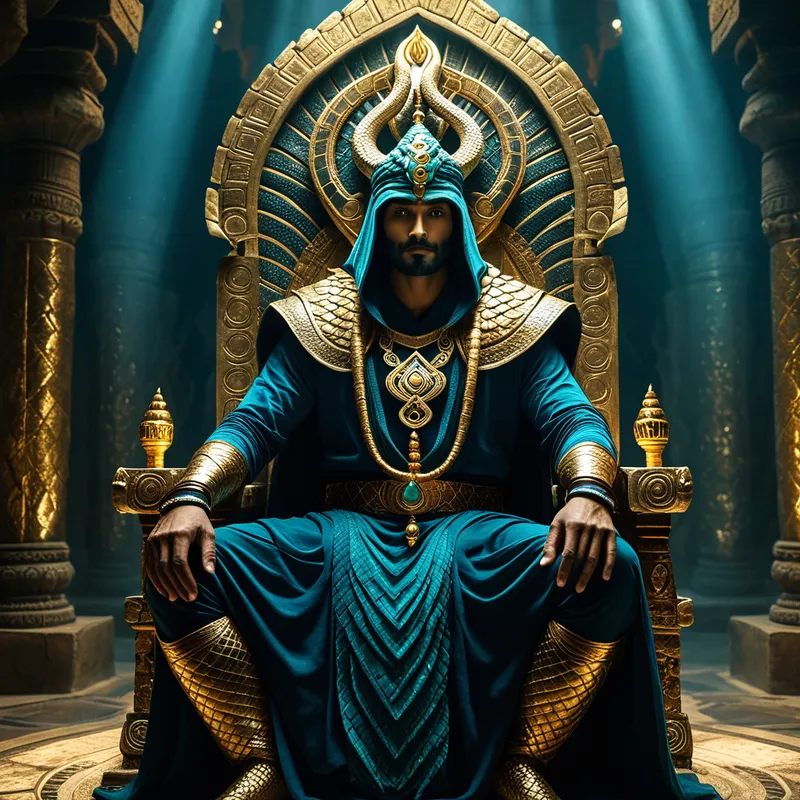
Beneath the roots of the world, where the soil turns to stone and the stone to darkness, lies a kingdom untouched by sun or moon. Here, in the fathomless deep, the earth’s own pulse is a slow, resonant drum. This is the realm of the Nāgas, and at its heart sits their sovereign: the Nāgarāja.
His form is a paradox of power: a human torso, broad and regal, rising from the immense, coiled body of a great serpent. His brow is crowned not with gold, but with the flared hood of a cobra, a living canopy of scales that shimmer with the colors of deep water and polished jade. His eyes hold the patience of mountains and the ancient memory of rivers. He is the guardian of all that is hidden—the subterranean waters that feed the world, the veins of precious gems, and treasures of a different kind: the profound, secret teachings of the Dharma.
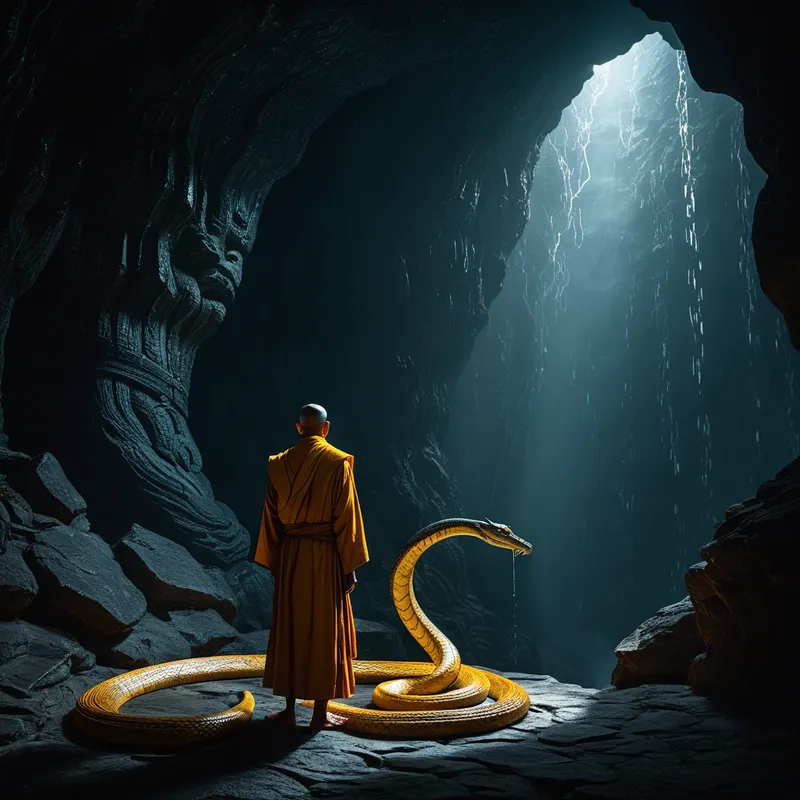
The story whispers of a time when the great sage, Mañjuśrī, sought to awaken the world. He descended from his celestial abode, his sword of prajñā—wisdom that cuts through illusion—gleaming. But wisdom, in its raw, untempered form, is a fire that can scorch the earth. As Mañjuśrī taught, his radiant, penetrating insight threatened to dry up the very waters of life, to wither the roots of compassion.
The Nāgarāja felt this disturbance in the deep currents of his realm. The life-giving waters, his sacred charge, began to recede. Rising from his jeweled palace, he confronted the bodhisattva not with venomous fury, but with the immense, grounded power of the earth itself. “Your wisdom is brilliant,” the serpent king’s voice echoed like stone shifting deep underground, “but it lacks the moisture of mercy. It sees truth but forgets the mud from which the lotus grows.”
A great tension filled the space between them—the dazzling, vertical light of insight meeting the dark, horizontal pull of the chthonic world. It was not a battle of destruction, but a confrontation of essences. Mañjuśrī, in his infinite adaptability, understood. He did not slay the serpent; he sheathed his sword. In that moment of recognition, a sublime alchemy occurred. The Nāgarāja, in turn, offered not resistance, but reception. He opened his realm to protect the most potent, secret aspects of the Dharma—the Tantras—until beings were ready to receive them without harm. The serpent became the guardian of the treasure, its coiled form now a vessel for the very wisdom it had tempered.
Cultural Origins & Context
The myth of the Nāgarāja flows into Buddhist tradition from the ancient, pre-Buddhist river systems of South and Southeast Asia. Nāgas were primal deities of water, fertility, and the earth’s bounty, worshipped for their power to bring rain or cause drought. As Buddhism spread, it did not erase these deep-rooted spirits; it engaged them in a profound dialogue. The myths served a vital sociological function: they narrated the conversion and integration of local nature spirits and indigenous cults into the Buddhist cosmological order, transforming potential adversaries into revered protectors of the Sangha and the Dharma.
These stories were passed down not merely as scripture, but as living narratives in Jātaka tales and the lore surrounding great stupas. The Nāgarāja Muchalinda, who sheltered the Buddha from a storm after his enlightenment, is a prime example. This narrative layer softened the ascetic, world-renouncing edge of early Buddhism, reconnecting it to the vital, animating forces of the natural world. The serpent king became a bridge between the transcendent truth of enlightenment and the immanent, pulsing life of the world.
Symbolic Architecture
The Nāgarāja is a master symbol of ambivalent, transformative power. He is the archetypal guardian of the threshold, ruling the liminal space between the conscious and unconscious, the cultivated world and the wild underworld.
The serpent does not hoard treasure to possess it, but to preserve it until the seeker has grown strong enough to bear its weight and wise enough to understand its price.
His serpentine body represents the raw, coiling energy of the libido or psychic energy—instinctual, potent, and often feared. His human torso signifies the potential for this energy to be raised, organized, and directed by consciousness and wisdom. The jewel he often holds or guards is the Cintāmaṇi, the wish-fulfilling gem of the awakened mind, born from the alchemical pressure of confronting and integrating one’s deepest nature.
The confrontation with Mañjuśrī is the central psychic drama. It symbolizes the necessary conflict between penetrating, discriminative insight (the sword) and the deep, emotional, instinctual base of the personality (the serpent). Enlightenment that ignores the unconscious is arid and destructive. The myth insists that true wisdom must “descend,” must be hydrated by the waters of the unconscious, embodied and protected by the very forces it seeks to transcend.
The Dreamer's Resonance
When the Nāgarāja glides into the modern dreamscape, he announces a profound encounter with the foundational layers of the Self. To dream of this serpent king is to feel the psyche engaging its own instinctual bedrock.
You may dream of a vast, coiled presence in a basement, a cave, or deep water—a sense of awe mixed with primal fear. This is not a nightmare to be fled, but a summons to audience. The somatic experience is key: a feeling of pressure at the base of the spine, a visceral sense of a powerful, sleeping energy awakening. Psychologically, this marks a critical phase where repressed vitality, creative force, or long-buried trauma (the “treasure” in the dark) is demanding recognition. The dreamer is being confronted by their own latent power, which initially appears as a threat because its integration requires the death of an old, rigid identity. The Nāgarāja guards the passage to your own inner wealth.

Alchemical Translation
The myth of the Nāgarāja provides a precise map for the alchemical process of individuation. The journey begins with the “descent”—the conscious ego (the seeker, the monk) must venture into the underworld of the unconscious, leaving the sunlit world of known identity behind.
The confrontation with the serpent king is the stage of nigredo. The ego’s bright, logical understanding meets its shadowy, emotional counterpart. This is often experienced in life as a crisis, a depression, or a feeling of being “dried up” by over-intellectualization—precisely the condition the Nāgarāja addressed with Mañjuśrī. The key is not to fight or slay this inner serpent, but to recognize its sovereignty and its legitimate claim.
Individuation is not the victory of spirit over nature, but the sacred marriage where the serpent’s coil becomes the throne for the jewel of consciousness.
The resolution is the alchemical albedo and rubedo. The serpent energy is not eliminated; it is transmuted. The coiled, instinctual force (kundalinī, in another tradition) is raised and harnessed. It becomes the vigilant protector of your deepest values (the Dharma), the energized foundation of your conscious life. The treasure is retrieved, not by theft, but by treaty. You become both the monk receiving the teaching and the Nāgarāja who guards it—a conscious individual grounded in the immense, ancient power of your own fully integrated nature.
Associated Symbols
Explore related symbols from the CaleaDream lexicon: