Ngai Creator God Kikuyu Myth Meaning & Symbolism
The myth of Ngai, who gave the Kikuyu people the sacred land of Mũkũrwe wa Gathanga and the nine founding mothers, establishing a covenant with humanity.
The Tale of Ngai Creator God Kikuyu
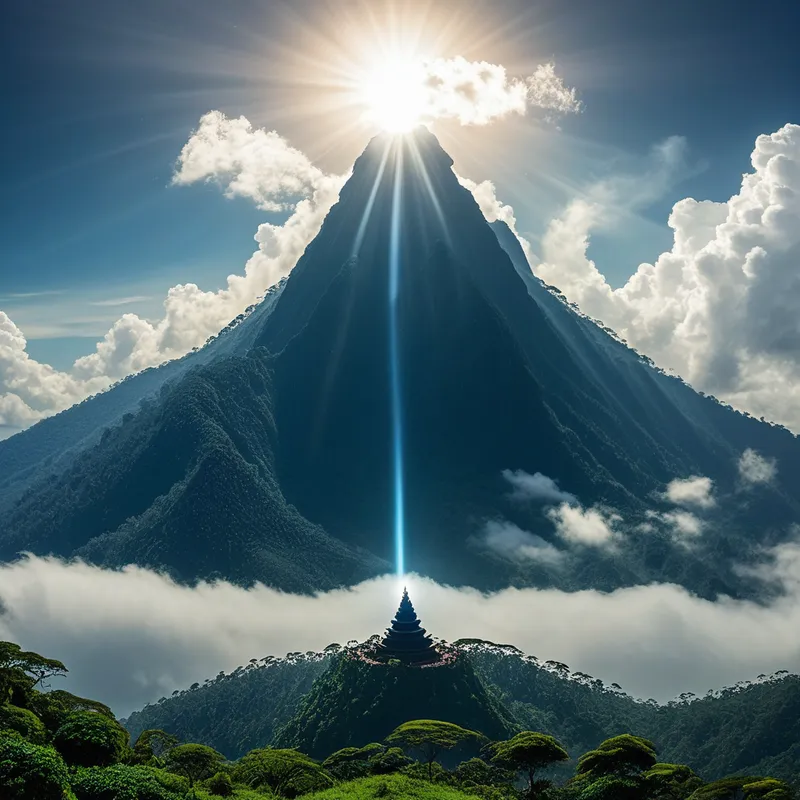
In the time before time, when the earth was soft and the sky was close, there was only the Great Presence, Ngai. He was not a man, but the breath in the wind, the warmth in the sun, the rumble in the belly of the clouds. His throne was the highest peak, the mountain of brightness, which men would later call Kirinyaga. From this icy, mist-shrouded summit, he looked upon the vast, silent land below—a canvas of forest, plain, and river awaiting a story.
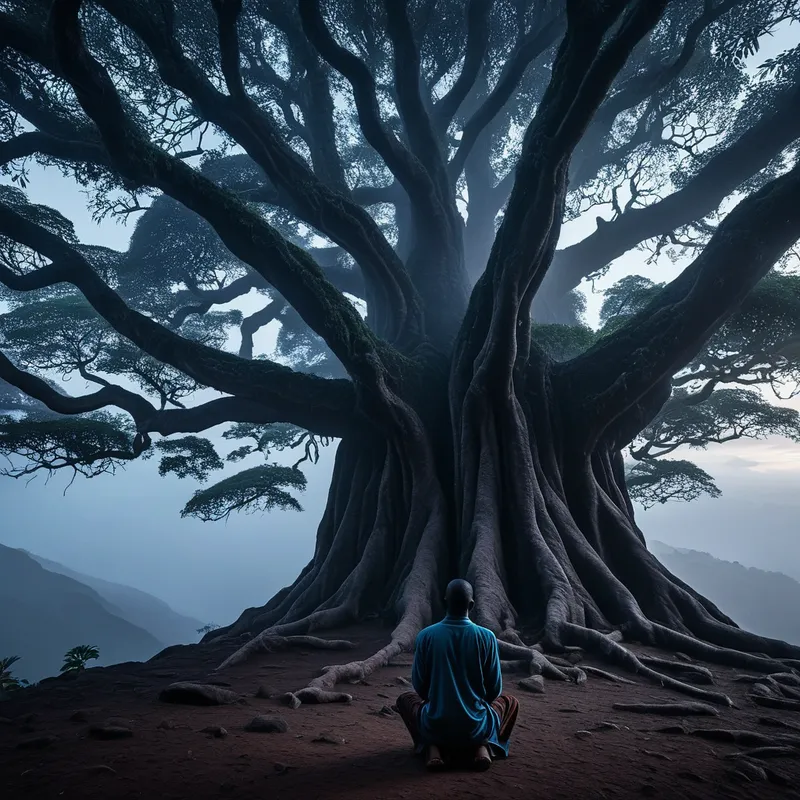
And so, Ngai descended. He did not walk, but his will became manifest. He took the red earth, rich and fragrant, and from it, he fashioned the first man. He named him Gikuyu, and breathed into him the spirit of life. Gikuyu awoke not to emptiness, but to a paradise. Before him stood a magnificent, sprawling Mũkũrwe wa Gathanga, its roots deep in the heart of the world, its branches offering shelter and fruit.
Ngai spoke, and his voice was the sound of distant thunder and flowing water. "This land I give to you, Gikuyu. From this Mũkũrwe wa Gathanga, your people will spread. But you shall not be alone." And from the same sacred earth, Ngai brought forth a companion for Gikuyu—a woman of grace and strength named Mumbi. Their meeting was not one of surprise, but of recognition, as if two halves of a single seed had finally sprouted together.
Ngai bestowed upon them a covenant, a sacred pact. "This land is yours to tend. When you have need, or when you wish to give thanks, come to the foot of my mountain, Kirinyaga. Raise your hands and your voice to me. Make your sacrifices there, and I will hear you." Then, he returned to his luminous abode, leaving Gikuyu and Mumbi beneath the generous shade of the fig tree.
And from their union, life multiplied. Mumbi bore nine daughters—Wanjirũ, Wambũi, Wanjikũ, Wangũi, Wangeci, Wanjeeri, Wanjirũ, Nyambura, and Wairimũ. These nine were the founding mothers, the very roots of the clans. But a question hung in the air: how would the people continue? The daughters needed husbands. In his wisdom, Gikuyu returned to the sacred Mũkũrwe wa Gathanga and prayed to Ngai. In answer, nine strong, youthful men emerged from the nine points of the land, drawn by the same divine will that had created Gikuyu. Each daughter took a husband, and from these nine houses, the great family of the Kikuyu people grew, spreading out from the blessed shade of the fig tree, forever children of the land given by Ngai.
Cultural Origins & Context
This is the foundational narrative of the Kikuyu people, one of the largest ethnic groups in Kenya. It is not a story locked in a book, but a living breath passed orally from generation to generation, from athamaki (elders and leaders) to the young around evening fires. Its primary function was and is ontological—it answers the deepest questions of a people: Where do we come from? Why are we here? To whom do we belong?
The myth establishes a sacred geography. Kirinyaga (Mount Kenya) is not just a mountain; it is the axis mundi, the literal and spiritual connection between the realm of Ngai and the world of humanity. The Mũkũrwe wa Gathanga is the navel of the world, the precise point of origin. This narrative served as the ultimate title deed, a divine charter that legitimized the Kikuyu's stewardship of their homeland. It also codified social structure—the nine clans stemming from the nine daughters—and prescribed ritual practice, detailing how and where to communicate with the divine through prayer and sacrifice at the sacred sites.
Symbolic Architecture
The myth presents a profound symbolic system centered on relationship, not conquest. Ngai is not a distant clockmaker but a involved, gift-giving presence who establishes a covenant. The relationship is reciprocal: humanity tends the land and offers sacrifice; Ngai provides sustenance and presence.
The sacred Mũkũrwe wa Gathanga is the archetypal World Tree, its roots in the underworld of ancestors, its trunk in the present world of the living, and its branches reaching toward the heavenly realm of Ngai. It symbolizes the interconnectedness of all existence.
Gikuyu represents the archetypal human—created from the Earth, placed in a specific, blessed context, and given a task of stewardship and relationship. His prayer for husbands for his daughters is not a plea for magic, but an act of engaging the covenant, trusting the generative principle of life itself to provide. The nine daughters symbolize the multiplicity and diversity of life emerging from a unified source, a model for clan and community that is matrilineal at its symbolic core.
The Dreamer's Resonance
When this myth stirs in the modern psyche, it often manifests in dreams of profound placement or acute displacement. One might dream of finding a specific, majestic tree in an unknown landscape and feeling an overwhelming sense of "This is my place; I am home." Conversely, one might dream of searching desperately for a mountain that is always on the horizon but never reached, or of being in a crowded city yet feeling a crushing loneliness for a "land" one has never physically known.
These dreams point to a somatic process of seeking one's inner Mũkũrwe wa Gathanga—the psychic center from which one's authentic life can grow. The longing for the mountain is the soul's yearning for a direct connection with the transpersonal, the Ngai-principle within, often experienced as a call to one's true purpose or vocation. The dream may surface during life transitions, when old identities fall away, and the fundamental questions of "Who am I?" and "Where do I belong?" re-emerge with urgent force.
Alchemical Translation
The individuation process modeled here is not one of slaying dragons, but of remembering and honoring the covenant. The modern individual's "hero's journey" is often framed as leaving home to find oneself. The Kikuyu myth suggests the journey is about returning to the sacred center, the inner homeland given by the Self.
The alchemical work is to differentiate oneself from the collective not through rebellion alone, but through taking conscious, responsible stewardship of one's own "given land"—one's unique talents, wounds, and destiny.
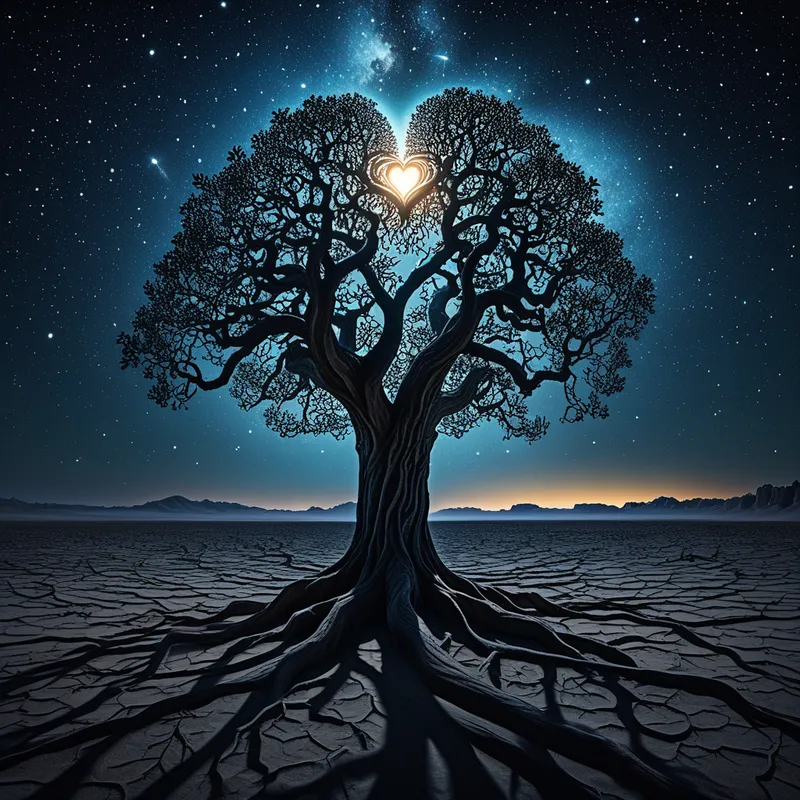
First, one must acknowledge the "Ngai" within—the inner creative, ordering principle that summoned one into being. This is the stage of recognizing the gift. Then comes the labor of tending the land: cultivating one's skills, facing one's shadows (the barren patches of the inner landscape), and building a life structure (Mumbi and the nine houses). The final, ongoing stage is maintaining the covenant—the ritual dialogue between the conscious ego and the greater Self. This is the prayer at the mountain, the act of sacrifice (surrendering lesser attachments for greater wholeness), and listening for the guidance that comes not as a booming voice, but as the sure, slow growth of the sacred fig tree from the center of one's being.
Associated Symbols
Explore related symbols from the CaleaDream lexicon:
- Mountain — Represents Kirinyaga, the axis mundi and direct connection to the divine, symbolizing aspiration, spiritual ascent, and the fixed point of orientation in one's psyche.
- Tree — The Mũkũrwe wa Gathanga, the World Tree of life, ancestry, and sustenance, representing rootedness, growth, and the interconnection of all realms of existence.
- Earth — The red earth from which Gikuyu was formed, symbolizing the physical body, fertility, belonging, and the foundational, grounding substance of reality and identity.
- Creator — Ngai as the ultimate source, the transpersonal Self that initiates the individuation process and establishes the covenant of becoming.
- Covenant — The sacred pact between humanity and the divine, symbolizing the reciprocal relationship and mutual responsibility between the individual ego and the greater Self.
- Goddess — Embodied in Mumbi and the nine daughters, representing the generative, life-bearing, and clan-founding feminine principle essential to creation and community.
- Root — The deep, anchoring origins of the people from the sacred tree and the land, symbolizing ancestry, tradition, and the unconscious foundations of the psyche.
- Seed — The primordial potential within the land and the union of Gikuyu and Mumbi, representing the initial spark of life, destiny, and the latent possibilities within the individual.
- Journey — The spreading of the people from the single sacred center, symbolizing the necessary expansion of consciousness from its core identity into the world.
- Ritual — The prescribed acts of prayer and sacrifice at the mountain, symbolizing the conscious, repeated practices that maintain the connection between the personal and the transpersonal.
- Sky — The domain of Ngai, representing the vast, ordering, spiritual dimension of consciousness that oversees and blesses the earthly realm.