
Nereids Myth Meaning & Symbolism
Fifty daughters of the Old Man of the Sea, the Nereids are benevolent spirits of the Mediterranean, embodying its shifting moods and profound depths.
The Tale of Nereids
Listen. The wine-dark sea does not sleep. It breathes, a vast, salt-lunged beast beneath the hulls of men. And in its deepest, sun-starved trenches, where the pressure would crush a mountain, dwells Nereus, the Old Man of the Sea. He is prophecy made flesh, a shape-shifter who knows all that was and is to come. But his true power, his legacy, is not in his own form. It is in his daughters.
They are born from the marriage of the deep salt and the memory of rain. Fifty of them. Fifty faces of the same dreaming ocean. They do not dwell in the crushing dark with their father, but in the sun-pierced middle depths of the Aegean. Their palace is not of stone, but of living coral and shifting light. Their voices are the hiss of retreating waves on pebbled shores, the sigh of wind over open water, the song that lulls sailors into a trance not of death, but of profound, watery belonging.
They are the Nereids. Thetis, whose beauty rivaled the dawn on the waves, whose fate was woven with the destiny of gods and the sorrow of a mortal son. Galatea, whose ivory-white skin captivated a monstrous cyclops, a tale of impossible love and tragic violence. Psamathe, the goddess of sandy beaches, whose wrath could summon seals to drag the unwary to their doom.
They are not vengeful like the Sirens, nor tempestuous like their storm-born sisters, the Harpies. When Poseidon stirs the waters in rage, it is the Nereids who rise. They do not cause the storm; they ride it. They circle his chariot, a chorus of fluid grace, their bodies cutting through the towering waves, their hands calming the cresting foam. They are the benevolent spirit of the sea itself. When the hero Theseus descended to the palace of Amphitrite, another Nereid, it was they who welcomed him, crowning him with a golden crown to prove his divine lineage.
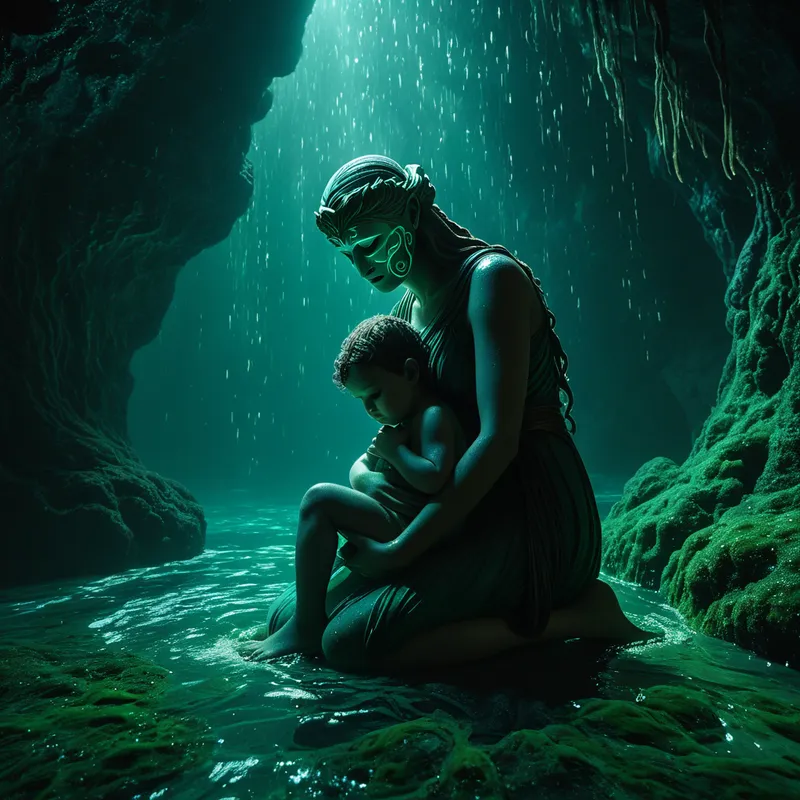
Their greatest story is one of maternal grief and foresight. Thetis, knowing her son Achilles was fated for a short, glorious life, sought to make him immortal. She dipped him in the sacred river Styx, holding him by the heel. That tiny patch of vulnerability, untouched by the magical waters, became the locus of his doom. Later, when his friend Patroclus was slain, it was Thetis and her sister Nereids who rose from the deep, wailing a dirge so haunting it stilled the very waves in sympathy, before she brought her son new armor forged by Hephaestus himself. They are the sea’s compassion, its memory, and its inescapable, fluid truth.
Cultural Origins & Context
The Nereids were not the abstract deities of Olympus, distant and thunderous. They were local, intimate, and immediate. Their myth emerged from the daily reality of a people whose world was bounded by the coastline. For the ancient Greeks, the Mediterranean was not a barrier but a connective tissue—a road, a source of food, and a realm of immense, unpredictable power. The Nereids personified that power in its most benevolent, navigable form.
They were spirits of place, or numina. Fishermen and sailors would offer small libations of wine or oil to them before setting out, not to the remote Poseidon. They were the protectors of sailors and the nurturers of marine life. Their stories were passed down not in grand epic poems alone, but in the hymns of sailors, the tales told in harborside taverns, and the local cults of coastal villages. Votive offerings—small clay figurines of women riding dolphins—have been found in harbors across the Greek world.
Artistically, they were ubiquitous. They adorned temple pediments, vase paintings, and mosaics, almost always depicted in motion, dancing in a chain or riding sea creatures. This reflected their societal function: they represented the ordered movement of the sea, its rhythms of tide and current, in contrast to the chaotic fury of a storm. They mediated between the human world and the alien, fluid world of the deep, making it comprehensible and, at times, compassionate.
Symbolic Architecture
Psychologically, the Nereids represent the anima in its most fluid, collective, and nurturing aspect. They are not the singular, transformative anima that leads a man to his soul, but the myriad faces of the unconscious itself—the fifty moods, possibilities, and depths of the inner life.
The sea is the classic symbol of the unconscious, and its nymphs are the personified, intelligible forces within that vastness.
They symbolize the realm of emotion, intuition, and psychic fluidity. Where the Olympian gods represent clear, differentiated psychic functions (thinking, feeling, sensation, intuition), the Nereids represent the medium in which these functions swim—the foundational, salt-water consciousness that precedes and supports all differentiation. They are the "water of life," the emotional and instinctual substrate of the psyche.
Thetis’s attempt to immortalize Achilles by dipping him in the Styx is a profound symbolic act. It represents the attempt by the deep, nurturing unconscious (the mother, the sea) to protect consciousness (the hero) from the mortal wound of fate, of reality. The inevitable failure—the vulnerable heel—signifies that total invulnerability, or complete immersion in the unconscious, is death to the ego. A connection to the mortal, human world must remain. The Nereids, therefore, do not offer escape from fate, but the strength to bear it with grace. They provide the armor forged in the depths (self-knowledge, compassion) after the inevitable wounding has occurred.
The Dreamer's Resonance
When figures like the Nereids appear in modern dreams, they seldom arrive with classical clarity. One does not dream of a labeled "Nereid." Instead, one dreams of presences in water. A group of serene, luminous women seen beneath the surface of a lake or swimming alongside a boat. A feeling of being guided or comforted by a feminine, non-human intelligence associated with the ocean. The dream water is usually calm, clear, and deep—not the terrifying abyss, but a inviting, mysterious depth.
Somatically, this dream points to a process of emotional integration and deep self-nurturing. The dreamer may be in a period of healing, where old wounds are being "washed" by the waters of the unconscious. The collective aspect (the fifty sisters) suggests the dreamer is accessing not a single insight, but a whole spectrum of emotional intelligence and empathetic connection that was previously submerged.
Psychologically, it indicates the ego is in a receptive, rather than assertive, mode. It is allowing itself to be supported by the autonomic, fluid processes of the psyche—intuition, dream logic, and body wisdom. The dream is a sign that the dreamer’s psyche is providing its own care, its own chorus of nurturing voices from the deep, to help them navigate a current life passage. It is the opposite of a heroic, conquering dream; it is a dream of being held, guided, and accompanied by the innate wisdom of life itself.

Alchemical Translation
The alchemical process mirrored in the Nereid myth is solutio—dissolution. Not dissolution as destruction, but as return to the primal, fluid state. In the work of individuation, there are times when the hardened, crystalline structures of the ego and its fixed identities must be softened and returned to solution. We must, like Achilles dipped in the Styx, be re-immersed in the waters of our own origins to be remade.
The alchemical solutio is not drowning; it is the necessary return to the womb of the unconscious to be born anew with a more resilient form.
The Nereids are the agents of this benevolent dissolution. They represent the part of the psyche that knows how to navigate this fluid state without panic. Their dance around Poseidon’s chariot is the key: they do not stop the storm (the chaotic, disruptive emotions), but they move with it, finding grace and order within the tumult. For the modern individual, the "alchemical translation" is learning to call upon this inner chorus.
When faced with a crisis that dissolves our old certainties—a grief, a loss, a profound change—the Nereid process invites us not to fight the flood, but to summon our own inner Thetis. To allow ourselves to be held by the deep, nurturing wisdom of the body and the unconscious. To be anointed, not for invulnerability, but for authenticity, accepting our mortal heel—our vulnerability—as the very price of our humanity. The armor the Nereids bring from the deep, like Thetis’s gift to Achilles, is not a shield against feeling, but a forging of compassion and understanding in the very fires of the deep-sea forge. We emerge not dry and untouched, but fluid-connected, able to move with the rhythms of life and death, guided by the fifty voices of our own profound, inner sea.
Associated Symbols
Explore related symbols from the CaleaDream lexicon: