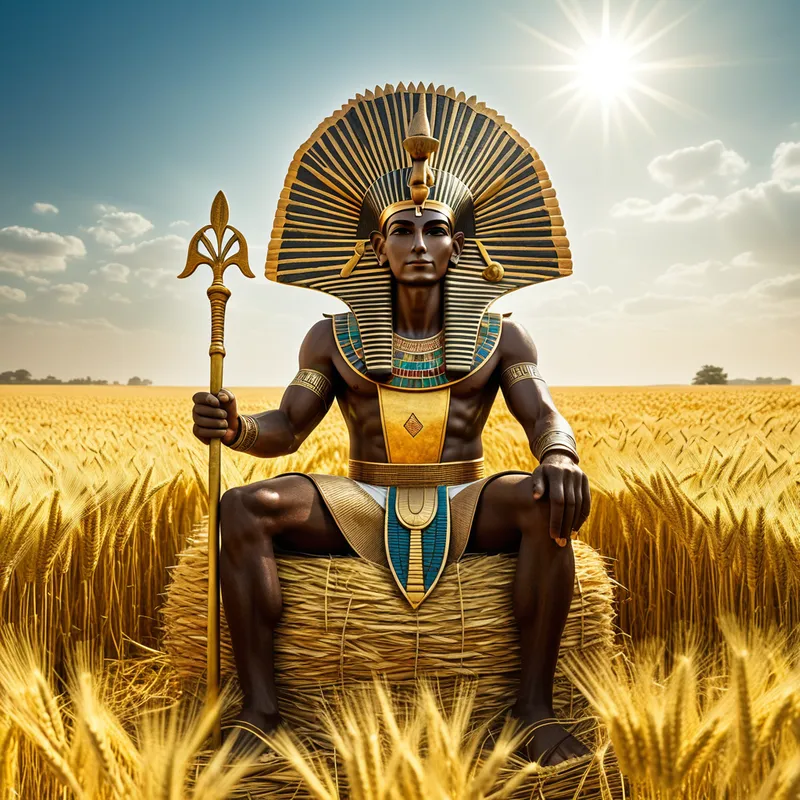
Neper Myth Meaning & Symbolism
The myth of Neper, god of grain, embodies the sacred cycle of death and rebirth, where harvest is a divine sacrifice for the world's renewal.
The Tale of Neper
Listen, and hear the whisper of the black earth. It is the hour when the sun, Ra, retreats below the horizon, and the world holds its breath. The air is thick with the scent of damp soil and the promise of decay. In this twilight, he stirs.
He is not born of a mother’s cry, but of a sigh from the land itself. He is Neper, and his body is the body of the field. His flesh is not flesh, but the firm, golden kernel of emmer wheat. His hair is not hair, but a cascade of ripe barley, catching the last copper light. His bones are the sturdy stalks that have held up the sky all season. He walks, and where his feet touch the mud of the Nile, green shoots tremble with potential.
For a time, he is abundance incarnate. He dances in the wind, a rustling, golden giant whose laughter is the sound of a full granary. The people sing to him as they watch their fields grow fat under his gaze. He is life, he is fullness, he is the promise of no hunger.
But the dance must end. The sun’s gaze grows fierce, and a dryness enters the wind. Neper feels it first in his golden hair, which begins to bleach and stiffen. He feels it in his kernel-flesh, hardening, preparing. He does not fight it. This is his sacred knowing. The reapers come, their sickles not weapons of war, but tools of a solemn covenant. They do not see a god to slay, but a god offering himself.
The first cut is not pain, but release. As the sickle passes through his stalk-bones, Neper does not cry out. He lets out a long, whispering sigh that carries across the entire delta. With each swing, his body falls, not in death, but in profound sacrifice. He is threshed, his divine body broken apart. He is ground, his golden form crushed between millstones into coarse, life-giving flour. He is consumed, baked into the bread that becomes the flesh of children, the strength of farmers, the offering to the gods.
He vanishes from the field. All that remains is stubble and dust. The world is silent, barren. It seems a tragedy, an end. But deep in the silos, in the bellies of the people, in the dark, secret heart of the earth where his last seed was buried, Neper waits. He is not gone. He is transformed. He is the potential in the seed, the life in the loaf, the memory in the soil. And when the Inundation comes again, bringing its gift of black, fertile silt, that memory will stir. A green tip will break the surface, reaching for Ra’s light, and the whisper will return: Neper is here.
Cultural Origins & Context
The story of Neper is not a epic narrative of battles and quests, but a rhythmic, agricultural truth woven into the very fabric of Egyptian life. His presence is felt more in ritual and practical symbiosis than in grand temple tales. He is a neter, a divine principle, of the most fundamental kind.
This myth was passed down not by bards in courts, but by the cyclical labor of the farming communities along the Nile. It was told in the action of planting, in the song of harvest, in the daily grinding of grain. His name was invoked during the sowing, a prayer for his return. His "death" at harvest was a sacred, necessary act, understood not as murder but as a willing offering for communal survival. In this, Neper’s myth served a critical societal function: it sacralized the entire food cycle. It transformed the brutal necessity of the harvest—the cutting down of life—into a participatory divine drama. The farmer was not a destroyer, but a priest in the temple of the field, assisting in the god’s transformation. This provided a profound psychological and spiritual framework for enduring the harsh realities of an agricultural existence, where life was utterly dependent on a cycle of death.
Symbolic Architecture
Neper is the archetypal symbol of the substance that must be sacrificed to become sustenance. He represents the stage in a cycle where form must be deconstructed so that essence can be redistributed.
The god who is eaten is the god who endures. To be consumed is to become the building block of all future life.
Psychologically, Neper embodies the principle of necessary dissolution. He is not a hero who overcomes an enemy, but a entity who consciously undergoes his own disintegration for a greater purpose. His "body" of grain symbolizes a matured, complete structure—a developed ego, a finished project, a peak state of being. The harvest represents the inevitable point where that structure must be broken down. The threshing floor and millstone are the agents of this psychic processing, separating the useful "kernel" of experience and insight from the protective "chaff" of outdated identities or rigid forms.
Neper’s journey is one of radical humility. He surrenders his glorious, golden, autonomous form to become anonymous nourishment. This symbolizes the death of the personal for the benefit of the transpersonal, the individual ego yielding its separate glory to feed the larger psyche or community.
The Dreamer's Resonance
When the pattern of Neper stirs in the modern dreamer, it often manifests not as a figure of grain, but as a profound somatic and psychological process of being processed. One might dream of being ground by immense, impersonal gears, of being winnowed by a great wind that scatters their components, or of willingly walking into a mill. The emotional tone is rarely one of terror, but of solemn inevitability and deep fatigue.
This dream state signals that a period of life—a career, a relationship, a long-held self-concept—has reached its full maturity and is now entering a necessary phase of deconstruction. The psyche is initiating its own harvest. The somatic feeling is often one of heaviness, brittleness, or a sense of being "ripe for the fall." The dreamer is going through the psychological "threshing," where life’s experiences are being separated into what is essential nutrient (core wisdom, true values) and what is chaff (outgrown attachments, egoic pride). It is a deeply vulnerable, passive phase where one feels subject to forces larger than oneself, being broken down to be remade.

Alchemical Translation
In the alchemy of individuation, Neper’s myth models the stage known as mortificatio or nigredo—the blackening, the dissolution. This is not a failure, but the crucial operation without which no transformation is possible.
The granary of the soul must be emptied, its contents ground to dust, before the new bread of being can be baked.
For the modern individual, the "grain" is any achieved identity, accumulated knowledge, or hard-won status. We spend years building this golden harvest of the self. Neper’s path asks: Are you willing to let it be cut down? Are you willing to be threshed by life’s disappointments, ground by its crises, and consumed by demands beyond your own? This is the alchemical sacrifice. The ego, like the stalk, must be severed from its solitary standing. The persona, like the husk, must be beaten away.
The triumph in Neper’s story is not in avoiding the millstone, but in the miraculous fact that the flour—the distilled essence—retains the god’s life-force. Psychic transmutation occurs when we stop identifying solely with the glorious, golden stalk (our specific achievements, our static self-image) and begin to identify with the transformative process itself—with the seed, the stalk, the harvest, the flour, and the new life it feeds. We become the cycle, not just a point within it. Individuation, in this light, is the continual willingness to be harvested by life, trusting that our essential substance will be reborn in a new, more nourishing form, having fed the deeper, unknown soul in its journey toward wholeness.
Associated Symbols
Explore related symbols from the CaleaDream lexicon: