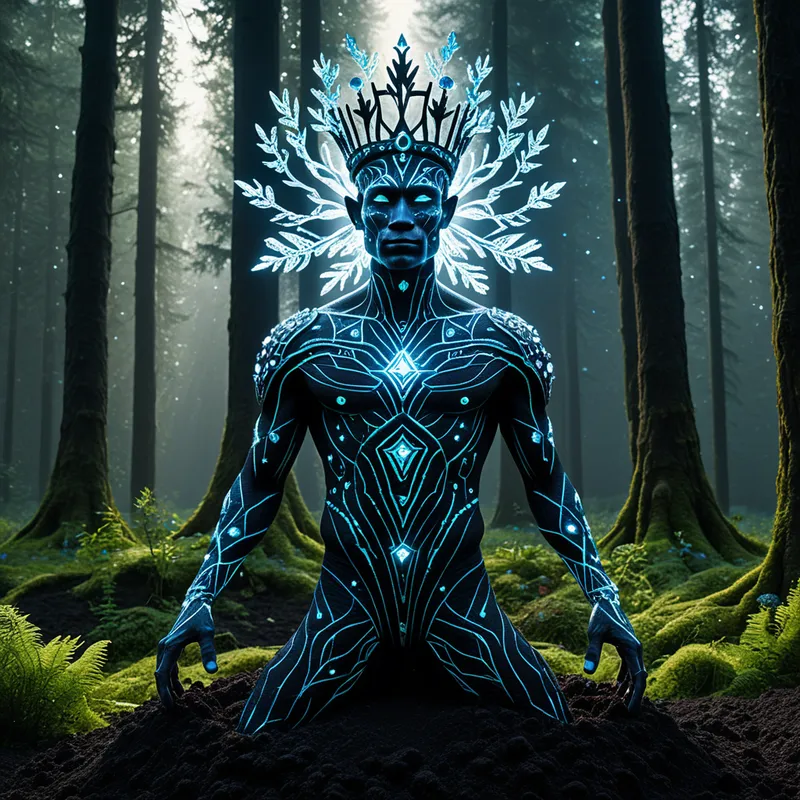
Nav, Prav, and Yav Myth Meaning & Symbolism
A Slavic cosmological myth of three interwoven worlds: manifest reality, divine order, and the ancestral underworld, modeling the psyche's structure.
The Tale of Nav, Prav, and Yav
Listen, child of the clay and the star, to the whisper that rides the wind between the worlds. This is not a story of a single hero, but of the very breath of existence, a tale told in the groaning of the ancient oak and the silent turning of the seasons.
In the time before time was measured, there was only the great, dreaming Chaos. From its swirling depths, a rhythm emerged—a heartbeat. And with that heartbeat, three brothers were born, not of flesh, but of essence. They were the first thought, the first word, the first silence.
The eldest was Yav. His voice was the crackle of fire, the rustle of leaves, the cry of a newborn. He built the world you can touch: the mountains that scrape the sky, the rivers that sing their journeys, the forests thick with mystery and life. Yav was the great Weaver, spinning the tapestry of the tangible from the threads of light and matter. His realm was the day, the summer, the fierce and beautiful struggle of life in all its forms. But Yav knew he was not the source of his own patterns. His weaving followed a design he could feel but not see.
For the design belonged to Prav, the middle brother. Prav spoke not in sounds, but in perfect geometries, in the unwavering paths of the stars, in the laws that bind seed to soil and cause to effect. His realm was not a place you could walk, but a truth you could know. It was the eternal blueprint, the divine justice, the cosmic balance that holds Yav’s vibrant chaos in a sacred order. Prav was the silent Judge and the celestial Architect, his light a cool, clear radiance that illuminated the right path. Yet, Prav’s perfect laws were sterile without a vessel, without a consequence.
And the consequence was the domain of the youngest brother, Nav. Nav held no light of his own. His voice was the echo in the deep cave, the memory in the blood, the soft sigh of decay that makes way for new growth. His realm was the underworld, the place of roots and ancestors, of finished things and forgotten things. It was the dark, fertile soil from which Yav’s forests sprang and to which they returned. Nav was the Keeper of Endings, the guardian of all that has passed from Yav’s bright stage. He was feared, for he was the unknown, the night, the winter. But he was not evil; he was necessary.
The world breathed because of their eternal dance. Yav would grow wild and proud, and Prav would send a storm or a hard frost—a law of balance—to trim his excess. The fallen leaves and fallen creatures would sink into Nav’s embrace, where they were dissolved, remembered, and transformed. From Nav’s dark womb, new potential would rise, following Prav’s design to be born again into Yav’s light. They were forever linked, a trinity of existence: the Manifest, the Law, and the Source. To live in ignorance of one was to live a half-life. To honor all three was to walk in wisdom. This is the truth sung by the rivers and carved into the bark of the world-tree: nothing stands alone. All is three, and three is all.

Cultural Origins & Context
The cosmological concept of Yav-Prav-Nav is not found in a single, canonical text like myths from literate traditions. It is a reconstruction, a deep pattern gleaned from the fragments of Slavic folk belief, folklore, ritual practices, and linguistic traces that survived centuries of Christianization. This trinity represents a pre-Christian, likely Indo-European, worldview that organized the cosmos into interconnected layers.
This myth was not "told" in a linear narrative but was enacted and implied. It was present in the very structure of the Slavic homestead: the Yav of the field and house; the Prav of ancestral customs and taboos governing planting, marriage, and justice; and the Nav, represented by the household shrine for ancestors (chur) or the forest beyond the fence, a place of both danger and sacred power. Storytellers and wise women (veduny) would weave understanding of these realms into tales of heroes journeying to the underworld, into rituals for the dead during Navsky days, and into the profound acceptance of cyclical time—where death in Yav was not an end, but a return to Nav and a potential rebirth under Prav’s laws.
Symbolic Architecture
Psychologically, this triad forms a complete map of the human psyche and its relationship with reality. Yav is the conscious ego—the "I" that experiences the sensory world, engages in action, and navigates daily life. It is our identity, our body, our present-moment awareness.
Prav represents the superego or the higher Self—the internalized principles, morals, and archetypal blueprints that guide us. It is the inner sense of justice, the longing for meaning, the recognition of natural laws (both physical and ethical). It is the compass, often felt as a "calling" or a sense of destiny.
Nav is the personal and collective unconscious—the vast, dark reservoir of memories, instincts, repressed emotions, ancestral patterns, and creative potentials. It is the realm of dreams, of trauma, of forgotten talents, and of the primal self that exists before socialization.
The journey of the soul is not a straight line from birth to death, but a spiral dance through Yav, guided by Prav, and forever nourished by Nav.
The myth’s core teaching is that health, or individuation, requires communication and balance between all three. An ego (Yav) that ignores the moral law (Prav) becomes chaotic and selfish. A person who tries to live only by rigid law (Prav) and denies the unconscious (Nav) becomes brittle and disconnected from their instinctual life. And one who is swallowed by the unconscious (Nav) without the structuring principle of consciousness (Yav) or order (Prav) risks dissolution.
The Dreamer's Resonance
When this mythic pattern activates in the modern psyche, it often manifests in dreams of tripartite structures or liminal journeys. You may dream of a house with three distinct levels: a cluttered, lived-in ground floor (Yav); a pristine, orderly attic full of old books or blueprints (Prav); and a dark, forgotten basement or root cellar holding family heirlooms or unsettling memories (Nav). The dreamer’s task is often to move between these levels, perhaps bringing an item from the basement to the attic, or cleaning the ground floor.
Somatically, this process can feel like a deep re-ordering. There may be a period of chaotic feeling or life disruption (Yav in imbalance), followed by a strong, almost compulsive need for structure, routine, or ethical clarity (Prav asserting itself). Underlying this is often a somatic sense of "digestion"—aches, fatigue, or vivid dreaming as the body-mind processes unresolved material from the personal "Nav." The dreamer is undergoing the myth’s core process: allowing the unconscious contents (Nav) to be brought into the light of consciousness (Yav) and integrated according to a deeper, more authentic personal order (Prav).

Alchemical Translation
The alchemical work modeled by Yav-Prav-Nav is the opus contra naturam—the work against one’s own fragmented nature—to achieve wholeness. It is a process of psychic transmutation where the lead of our unconscious shadow (Nav) is turned into the gold of integrated consciousness.
The first stage is Nigredo, a voluntary descent into Nav. This is the shadow work: confronting repressed grief, shame, rage, or ancestral trauma. It is dark, disorienting, and feels like a "death" of the old ego (Yav). The second stage is Albedo, the application of Prav. Here, the raw material brought up from Nav is examined in the clear, discerning light of consciousness. Patterns are understood, truths are acknowledged, and a new, more authentic personal law is forged from the chaos. The final stage is Rubedo, the rebirth of a renewed Yav. The integrated self returns to the world of action, but now that action is informed by both deep instinct (Nav) and higher principle (Prav). The individual no longer just lives in Yav; they embody the trinity, becoming a living bridge between the worlds.
Individuation is the moment the tree realizes it is not just trunk, but also root and crown. It is the conscious enactment of the eternal myth within.
This is the ultimate triumph: not conquering a dragon, but achieving a dynamic, conscious equilibrium. The modern individual learns to respect their daily reality (Yav), heed their inner truth and ethics (Prav), and courageously dialogue with their depths (Nav). In doing so, they stop being a passive inhabitant of a fragmented cosmos and become an active, conscious participant in the sacred, threefold dance of existence.
Associated Symbols
Explore related symbols from the CaleaDream lexicon:
- Tree — The ultimate symbol of the tripartite world: roots in Nav, trunk in Yav, and branches reaching toward the order of Prav in the heavens.
- River — Represents the flow of time and consciousness from the source in Nav, through the manifest landscape of Yav, following the ordained course of Prav.
- Circle — Embodies the eternal, cyclical relationship between the three worlds, where endings in Nav feed beginnings in Yav, all within the lawful wheel of Prav.
- Door — The liminal threshold between Yav and Nav, and the point of access where the laws of Prav permit or forbid passage between the realms.
- Mirror — Often linked to Nav, it reflects the surface world of Yav but can reveal deeper, shadowy truths or serve as a portal to the other side.
- Root — The hidden, anchoring connection to Nav, the ancestral past, and the unconscious foundation from which all visible life in Yav draws sustenance.
- Star — A pure manifestation of Prav, representing cosmic order, navigation by higher principles, and the unchanging laws that govern the chaos below.
- Cave — An entrance to Nav, a place of descent, incubation, and confrontation with the contents of the deep unconscious before returning to Yav.
- Bone — The lasting remnant from Yav that returns to Nav, symbolizing ancestral memory, structure, and the essential truth that persists beyond decay.
- Dream — The primary mode of travel and communication between Yav and Nav, where the laws of Prav are suspended and the soul navigates by different rules.
- Order — The essential quality of Prav, the principle that structures chaos into cosmos and provides the template for a meaningful life in Yav.
- Shadow — The personal Nav, the repressed or unseen aspects of the self that reside in the underworld of the psyche, awaiting integration.