Namazu Myth Meaning & Symbolism
A myth of a giant catfish bound beneath the earth, whose struggles cause earthquakes, overseen by a god who must keep it still.
The Tale of Namazu
Beneath the world you know, there is another world. It is not a world of light and air, but of endless, pressing dark and the slow, cold weight of stone. Here, in the fundament of the islands, the earth is not solid. It is a vast, soft mud, a primordial ooze that shifts and sighs. And in this deep, dreaming mud, a giant stirs.
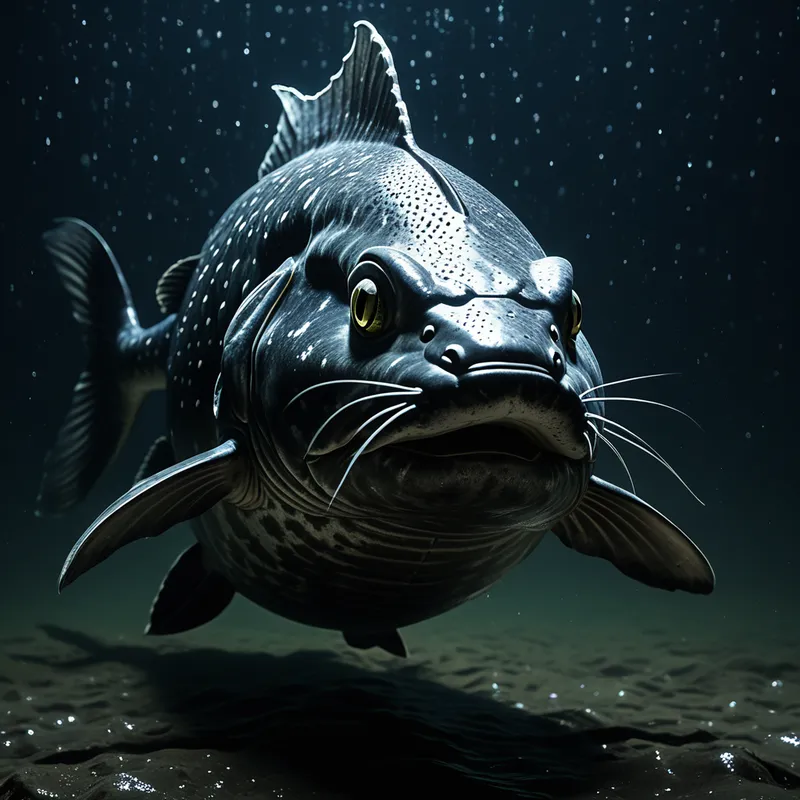
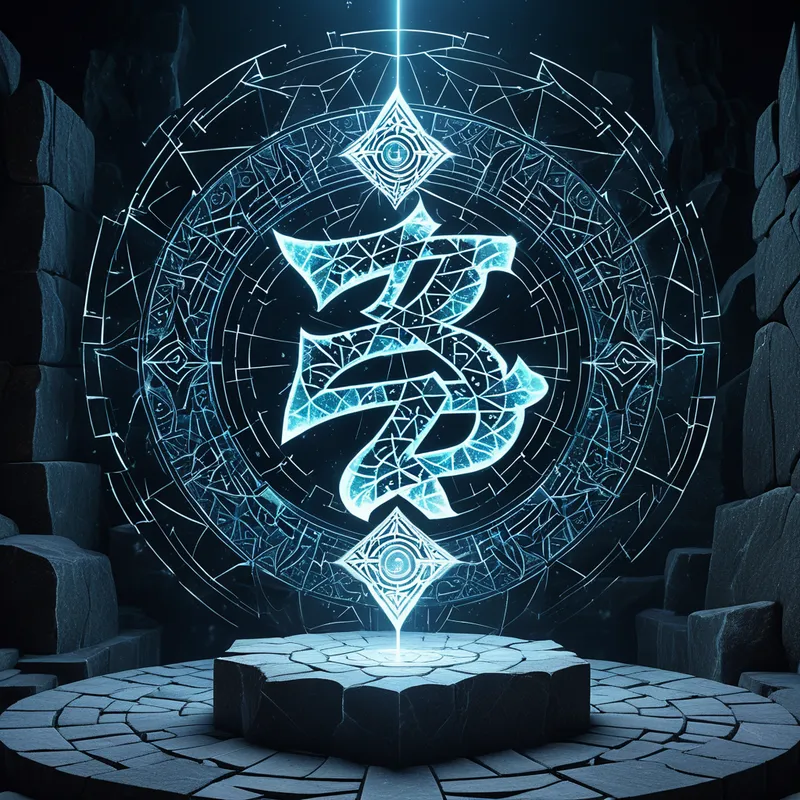
His name is Namazu. He is a leviathan of the underworld, a catfish of such scale that his fins could brush the roots of mountains. His skin is not skin, but plates of tarnished silver and polished jet, and in the abyssal gloom, his single eye holds a sullen, restless light. He is bound, but he is not tame. For upon his broad forehead is inscribed a sacred kanji, a word of power that is both his prison and his nature: jishin. Earthquake.
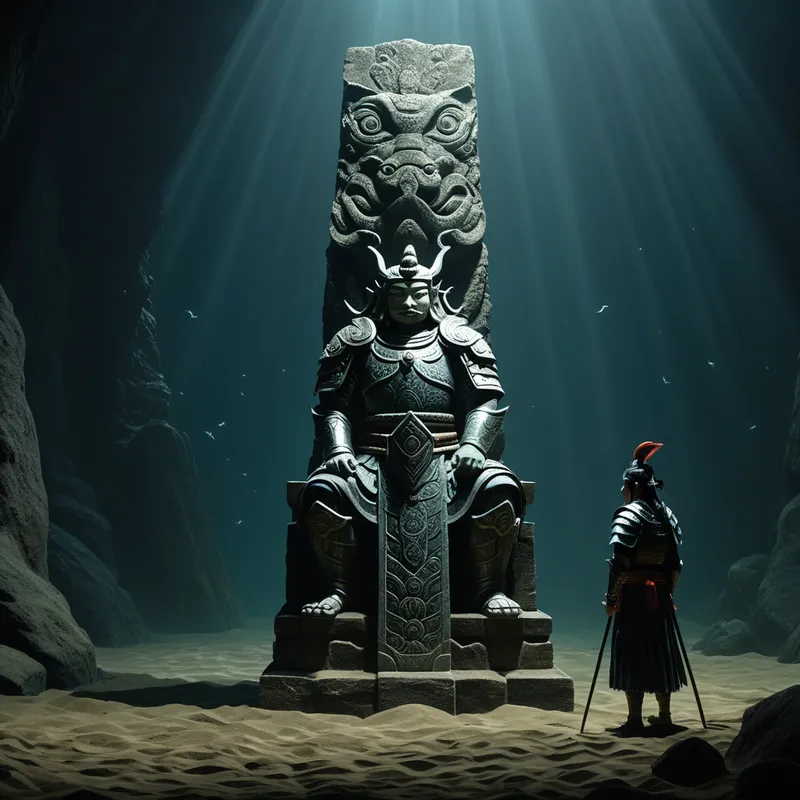
His jailer is Kashima, a god of thunder and steadfast strength. Kashima’s duty is eternal vigilance. At the sacred stone of Kaname-ishi, he stands guard. This stone is no ordinary rock; it is the keystone of the world, driven like a divine nail into the mud of the deep, pinning the great fish’s head. When Kashima’s attention is absolute, when his will is an unbreakable pillar, Namazu lies still. The world above knows peace. The rice grows, the cities stand, and the people sleep untroubled.
But gods, like men, are not infallible. There are moments—during the great festivals in the heavens, during a lapse of divine focus—when Kashima’s guard wavers. The pressure on the Kaname-ishi lessens by a hair. And in that instant, Namazu feels it. A tremor of possibility runs through his immense body. The ancient, coiled energy of his rebellion, stored for eons in the dark, uncoils.
He thrashes.
It begins as a shudder in the deep mud, a ripple that becomes a wave. The great tail lashes. Silver scales scrape against the continent’s roots. The Kaname-ishi groans. Above, in the world of light, the sensation arrives not as sound, but as movement. The ground, once trusted and firm, betrays itself. It bucks like a living thing. Tiles shiver from roofs. Trees whip the air. The very bones of the earth crack and sing a terrible, grinding song. This is Namazu’s moment of freedom, a catastrophic dance that reshapes the land and scatters the works of humankind like toys.
Then, the reckoning. Kashima, his duty recalled in a thunderclap of purpose, returns. His divine might focuses once more upon the stone. With a force that echoes through the strata, he drives the Kaname-ishi down, down, pinning the giant’s head anew. The thrashing slows to a twitch, then to a sullen stillness. The mud settles. The world holds its breath, and then exhales into a fragile, trembling quiet. The giant is bound again, but his eye still glows in the dark, waiting for the next moment of inattention, the next chance to stir.
Cultural Origins & Context
The myth of Namazu emerged not from ancient, canonical texts like the Kojiki or Nihon Shoki, but from the fertile ground of folk belief and the urgent need to explain the incomprehensible. Japan, situated on the volatile Pacific Ring of Fire, has always lived with the tremors of the earth. The Namazu legend provided a tangible, narrative cause for a terrifyingly abstract geological force.
By the Edo period, the myth had crystallized into a vibrant part of popular culture. It was disseminated through ukiyo-e prints, known as namazu-e (catfish pictures). These prints, often produced in the wake of major earthquakes like the catastrophic 1855 Ansei Edo quake, served multiple purposes. They were talismanic, attempts to visualize and thus control the chaos. They were satirical, sometimes depicting Namazu as a necessary evil who, by shaking down the wealthy, redistributed wealth (a concept called yonaoshi, or "world rectification"). And they were psychological, giving a face and a story to the trauma, allowing a shaken populace to process the event through narrative and art, transforming sheer terror into a drama with a villain, a divine guardian, and a resolution.
Symbolic Architecture
At its core, the Namazu myth is a profound allegory for the relationship between chaos and order, the unconscious and the conscious, the foundational and the destabilizing.
The earth’s stability is not a given, but a continuous act of will exerted upon a restless, primal force.
Namazu is the embodiment of the chthonic, the subterranean power that underpins reality. He is the seismic unconscious—the repository of instincts, traumas, repressed energies, and creative potentials that lie beneath the surface of our ordered personalities and societies. He is not evil, but amoral and elemental; his nature is to move. The kanji on his forehead signifies his identity is inseparable from his function: he is the upheaval.
Kashima represents the conscious ego, the principle of order, structure, and containment. His stone, the Kaname-ishi, is the symbol of focused attention, cultural norms, psychological defenses, and personal discipline—all the tools we use to keep the chaotic depths of our own psyches in check. The myth acknowledges that this containment is not permanent or perfect. It is a dynamic, exhausting tension. The "lapses" of Kashima are those moments of psychological vulnerability: fatigue, stress, intoxication, or profound change, when our usual defenses weaken and the contents of the personal or collective unconscious surge upward.
The Dreamer's Resonance
When this mythic pattern stirs in the modern dreamer, it rarely appears as a literal catfish. Instead, it manifests as the sensation of the myth. One dreams of being in a familiar building that begins to sway on its foundations. The dreamer feels the solid floor become liquid, watches cracks race up walls that were once trusted. There is a profound somatic experience of instability, a visceral loss of the ground—both literal and metaphorical.
Psychologically, this signals that a foundational aspect of the dreamer’s life or psyche is undergoing seismic adjustment. The "Kashima stone" of an old identity, a long-held belief, a career, or a relationship is shifting. The repressed "Namazu" energy—perhaps unexpressed anger, stifled creativity, or a buried trauma—is thrashing, demanding acknowledgment. The dream is not a prophecy of literal disaster, but a map of internal tectonics. It points to the pressure points, the fault lines in the personality where growth, however violent its onset, is attempting to occur. The terror in the dream is the ego’s fear of being dissolved by the uprising of something far older and more powerful than itself.
Alchemical Translation
The individuation process, the journey toward psychic wholeness, is not a gentle stroll. It is, at times, a cataclysm. The Namazu myth provides a stark but honest model for this alchemical transmutation.
The initial state is one of enforced, rigid stability. The ego (Kashima) believes its power is absolute, that it can and should suppress the deep, instinctual self (Namazu) indefinitely. This is the neurosis of perfect control. The "earthquake" is the inevitable failure of this project. It is the crisis—the depression, the burnout, the relationship collapse, the creative block that shatters—that forces a confrontation with what has been bound.
True strength is not found in perpetual suppression, but in learning the rhythm of the deep. One must not only pin the catfish, but also listen to its stirrings.
The alchemical work begins in the aftermath of the quake. It involves the conscious ego (Kashima) not merely re-suppressing, but dialoguing with the force it contains. This means turning one’s attention (Kaname-ishi as focused awareness) not to crush, but to understand. What does the "thrashing" represent? What energy, if integrated rather than bound, could become a source of vitality rather than destruction? The goal is not to kill Namazu, for he is a part of the foundational self. The goal is to transform the relationship from one of jailer and prisoner to one of steward and power.
In the end, the myth teaches that a life without tremors is a fantasy. Stability is not the absence of movement, but the resilience to withstand it and the wisdom to learn from it. To be whole is to acknowledge the giant in the mud, to respect its power, and to build not on rigid rock, but on an understanding of the ever-shifting, living earth upon which we all ultimately stand.
Associated Symbols
Explore related symbols from the CaleaDream lexicon: