
Naiman Eej Eight Mother Goddesses
Eight powerful mother goddesses in Mongolian mythology who govern creation, nature, and human fate, embodying the sacred feminine in nomadic tradition.
The Tale of Naiman Eej Eight Mother Goddesses
In the beginning, before the blue sky was stretched taut over the endless steppe, there was a great, silent womb of potential. From this primordial stillness, consciousness stirred not as one, but as eight. They were the Naiman Eej, the Eight Mothers, and their first breath was the wind that would forever sweep across the land.
It is said they emerged from the sacred waters of a mountain lake, each step upon the shore bringing forth a different aspect of existence. The first, Etugen Eej, pressed her feet into the soft mud, and the Earth itself rose to meet her, solid and enduring, the foundation of all life. From her body grew the grasses, the forests, and the towering mountains. Next came Nogoon Naiman Eej, the Green Eight Mothers, who breathed color into Etugen’s form. With a sigh, she clothed the bare soil in the vibrant carpet of the steppe, the deep green of the taiga, and the tender shoots that feed all creatures.
Then, the mothers of elemental force made themselves known. Gazar Eej, the Earth Mother, delved deep, forming the bones of the world—the rocks, the minerals, the hidden caves. Usan Eej, the Water Mother, called forth the rains, the rivers that snake like veins across the land, and the life-giving milk of the mares. Where her waters met Gazar’s earth, mud became fertile soil. Gal Eej, the Fire Mother, struck the first spark from flint. Her gift was the hearth fire around which families gather, the forge fire that shapes tools, and the inner fire of spirit and courage. To temper her heat, Salkin Eej, the Wind Mother, began to blow. She carries seeds, scatters clouds, whispers secrets, and howls with the voice of change and cleansing.
But creation is not only substance; it is also pattern and fate. Jayaγaci Eej, the Destiny Mother, took threads of light and shadow from the newly formed sky and began to weave. Her loom is the passage of the sun and moon, and upon it she patterns the lives of all beings, the rise and fall of clans, the fortunate meeting and the tragic loss. No mortal sees the whole tapestry, only the single thread of their own journey. Finally, Umay Eej, the Protector of Women and Children, arrived. She is the warmth of the womb, the softness of the cradle, the fierce love that guards the vulnerable. She resides in the hearth’s ashes and in the placenta buried with reverence, ensuring the continuity of life from one generation to the next.
Together, these eight do not rule from a distant throne, but are immanent in the world they birthed. The nomadic herder feels Etugen in the solid ground beneath the ger, honors Usan at the riverbank, thanks Gal for the cooked meal, and prays to Umay for her child’s health. They are a council, a balanced whole, whose constant interaction—wind shaping earth, fire needing water, destiny meeting the protector’s intervention—maintains the cosmic and earthly order, the tör of the Mongolian world.
Cultural Origins & Context
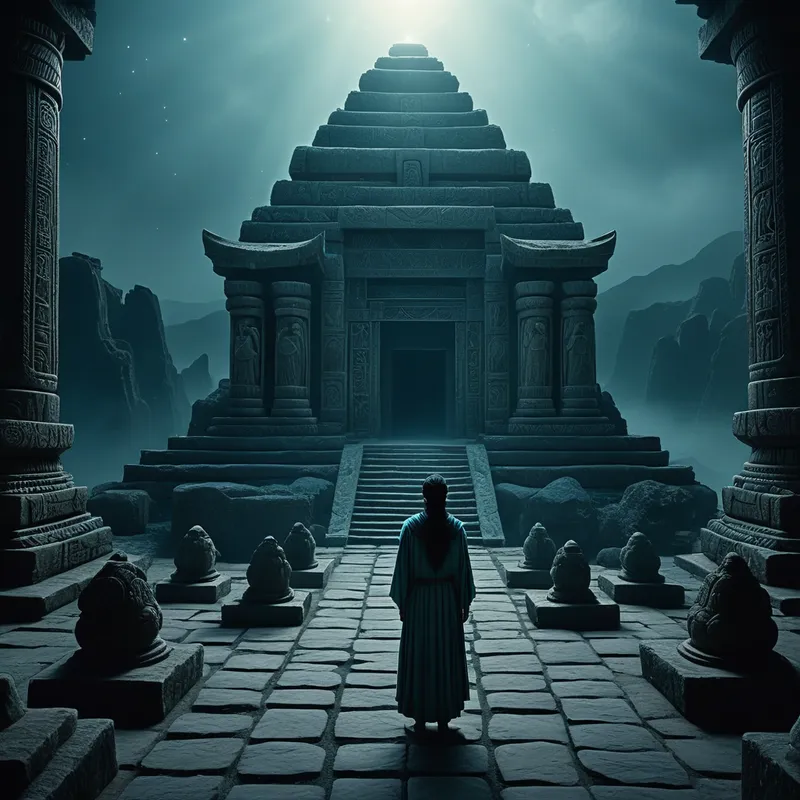
The veneration of the Naiman Eej is deeply rooted in the ancient, pre-Buddhist stratum of Mongolian spirituality, often classified as Tengerism or Tengriism. In this worldview, the supreme masculine sky deity, Tengri, is complemented by the feminine, earthly power of the Eej. They represent the essential duality and balance of the cosmos.
Their worship was not confined to grand temples but was woven into the fabric of daily nomadic life. Specific rituals and offerings were made at natural sites—an unusual rock formation for Gazar Eej, a sacred spring for Usan Eej, a mountain pass for Salkin Eej. The hearth, the absolute center of the domestic sphere, was the primary altar to Gal Eej and Umay Eej. This practice reflects a profound ecological spirituality where the divine is not transcendent from nature, but fully present within it. The "Eight" (Naiman) is itself a potent number in Mongolian cosmology, symbolizing completeness, infinity (as the lemniscate turned on its side), and the cardinal and intercardinal directions that define the steppe-dweller’s world.
With the arrival of Tibetan Buddhism in Mongolia from the 16th century onward, the Naiman Eej were not erased but were often syncretized with Buddhist figures, particularly with the Dakinis or seen as local emanations of protective deities. This allowed their worship to persist, albeit sometimes in a modified form, ensuring their survival in folklore, ritual, and the collective unconscious of the people.
Symbolic Architecture
The Naiman Eej present a complete symbolic system for understanding existence. They are not a hierarchy but a holographic network; each goddess contains an aspect of the others, and together they form an indivisible unity of being. Etugen is the body, but that body is animated by Salkin’s breath, nourished by Usan’s fluids, and warmed by Gal’s metabolism. Jayaγaci provides the narrative arc of that body’s life, and Umay ensures its capacity to generate new life.
They represent the archetypal truth that creation is not a singular act but an ongoing, collaborative process maintained by dynamic tension. The Earth is not just soil, but the interplay of solidity (Gazar), growth (Nogoon), and erosive or shaping force (Salkin, Usan).
Psychologically, they map the internal landscape of the human soul. We each have an inner Etugen—our groundedness and physical presence. An inner Gal—our drive, passion, and transformative energy. An inner Usan—our emotional flow and intuition. The struggle for personal wholeness mirrors the balanced council of the Eight Mothers; illness, whether of body or spirit, can be seen as a disharmony in their internal council, where one mother’s voice drowns out the others.
The Dreamer's Resonance
To encounter the Naiman Eej in the imaginal realm—whether through dream, vision, or deep meditation—is to experience the foundational layers of the psyche. A dream of standing on resilient, flowering earth may signal the nurturing presence of Etugen and Nogoon, suggesting a time for rooting and growth. A dream of a raging, untamable fire might be Gal Eej calling for acknowledgment of repressed power or anger, while a dream of a gentle, protective figure singing to a child clearly echoes Umay.
They appear when the dreamer’s life is out of balance with the natural and psychic orders. The absence of Usan’s water might manifest as emotional aridity; the silencing of Salkin’s wind as stagnation and a lack of new ideas. They challenge the modern, fragmented consciousness by presenting a model of integrated being, where the caregiver (Umay), the ruler (Jayaγaci), the warrior (Gal), and the mystic (all who commune with nature) exist in constant, sacred dialogue within the self.
Alchemical Translation
The alchemical process, at its core, is the journey toward the Rebis, the united whole. The Naiman Eej offer a distinctly feminine-grounded roadmap for this union. Their myth suggests that wholeness is not achieved by conquering or eliminating elements, but by convening them.
The prima materia is the undifferentiated self. The nigredo, or blackening, is the recognition of separation from one or more of these maternal forces—feeling uprooted (Etugen), emotionally frozen (Usan), or fatefully adrift (Jayaγaci). The work of albedo, whitening, is the deliberate invocation and reconciliation with each Mother, honoring her domain within and without.
The final stage, the rubedo or reddening, is not the creation of something new, but the realization of the eternal, living council that has always been present. It is the moment one truly feels the wind on the steppe not as mere weather, but as the breath of Salkin Eej; sees the hearth fire as the gaze of Gal Eej; understands one’s life path as a thread lovingly woven by Jayaγaci Eej. The philosopher’s stone, then, is this conscious, participatory relationship with the eightfold soul of the world.
Associated Symbols
Explore related symbols from the CaleaDream lexicon:
- Earth — The foundational body and ground of all being, representing solidity, nurture, and the physical realm from which life springs and to which it returns.
- Water — The essence of life, emotion, intuition, and the fluid, connecting medium that shapes destiny and cleanses the spirit.
- Fire — The transformative force of spirit, passion, purification, and the sacred hearth that defines community and inner will.
- Mother — The archetypal source of life, protection, and unconditional nurture, embodying the creative and sustaining principle of the universe.
- Goddess — The manifested divine feminine, representing the multifaceted powers of nature, fate, and the sacred immanent in the world.
- Circle — The symbol of wholeness, infinity, and the cyclical nature of life, seasons, and destiny woven by the cosmic mothers.
- Destiny — The patterned tapestry of existence, the interwoven threads of fate and free will that guide the journey of all souls.
- Mountain — The sacred axis and meeting point of earth and sky, a place of power, permanence, and connection to the primordial mothers.
- Hearth — The domestic altar and center of warmth, family, and ritual, where the protective and nurturing fires of the goddess are tended.
- Wind — The invisible shaper, messenger, and breath of change, carrying seeds, voices, and the spirit across the boundless steppe.
- Tree — The living bridge between the underworld, earth, and sky, symbolizing growth, stability, and the interconnected web of life nurtured by the mothers.
- Dream — The realm where the council of the mothers communicates with the individual soul, offering guidance, warning, and visions of deeper harmony.