Naga Basuki
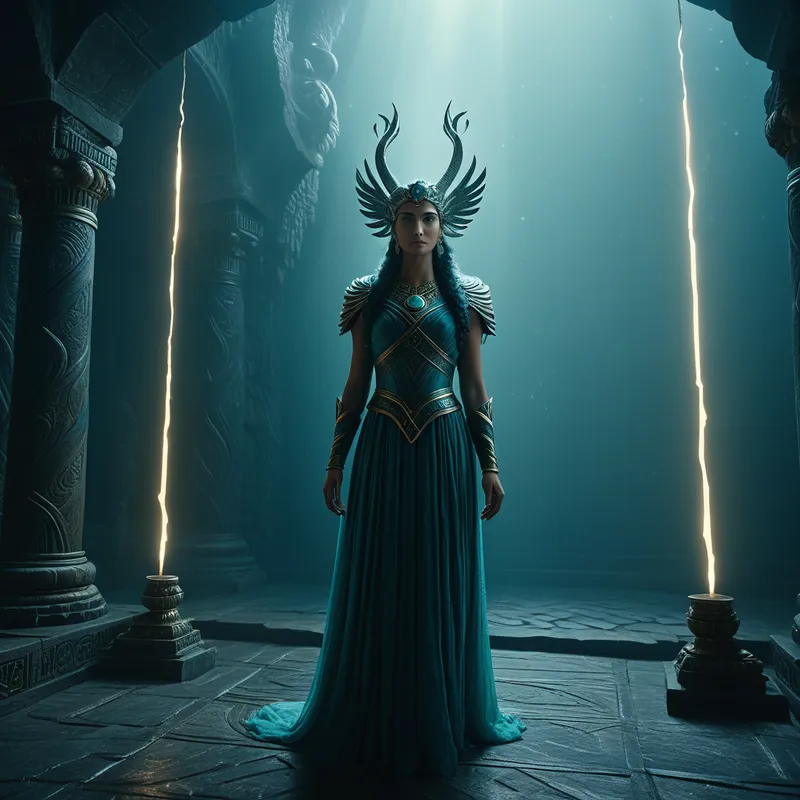
A cosmic serpent deity in Indonesian mythology, Naga Basuki symbolizes balance, protection, and the primordial forces of creation and destruction.
The Tale of Naga Basuki
In the beginning, before the world knew its own shape, there was a churning. Not of water, but of possibility. From this primordial soup of potential, the great serpent, Naga Basuki, was coiled. He was not born, but became—a vast, scaled consciousness encircling the base of the sacred mountain, Mahameru. His body was the living girdle of the world, his scales the plates of the tectonic earth, his breath the mist that rises from deep jungles and volcanic vents.
The gods, in their celestial wisdom, sought to stabilize the churning cosmos. They needed an anchor, a pivot point for the axis of reality. Their gaze fell upon Mahameru. But the mountain was adrift in the cosmic ocean, unstable, a peak without a foundation. They approached Naga Basuki, the eternal one who had witnessed the first light. They did not command, but entreated. Understanding the need for order within the fertile chaos, Basuki offered himself. He wrapped his immense body around the base of the great mountain, not as a chain, but as a living, breathing support. His coils became the roots that sank into the abyss, his strength the counterbalance to the mountain’s aspiration towards the heavens. He became the sustainer.
Yet, his tale is not one of passive burden. In the great epic of Mahabharata, as told in the Javanese wayang tradition, Naga Basuki’s role is tested. The Pandava hero, Arjuna, must undertake a severe meditation to obtain divine weapons. His penance creates a spiritual heat so intense it threatens the equilibrium of the world. The gods, alarmed, send celestial nymphs to distract him. Arjuna resists. In a final test, the god Indra transforms into a ferocious boar that charges the meditating hero. Arjuna and the boar shoot simultaneously. But from the lake emerges Naga Basuki, not as a distant symbol, but as an active, wrathful protector of the sacred site. He had taken the form of a dragon, and it was he whom both arrows had struck. In his pain, he confronts Arjuna, revealing the truth. This moment is a profound knot in the myth: the seeker’s pursuit of power inadvertently wounds the very force that upholds the stability he seeks to defend. Resolution comes not through conquest, but through recognition and healing. Arjuna tends to the Naga’s wound, and in return, Basuki bestows upon him the ultimate weapon, the Pasupati arrow. The protector, even in his agony, fulfills his role, transforming a violent mistake into an initiatory gift.
Cultural Origins & Context
Naga Basuki’s lineage flows from the confluence of deep indigenous Austronesian animism and the later, profound influences of Hindu-Buddhist cosmology arriving in the Indonesian archipelago around the early centuries CE. He is a syncretic being, a perfect example of how foreign mythic elements are not merely adopted, but digested by the local spiritual consciousness and reborn as something uniquely local.
In the indigenous worldview, snakes and serpents were often seen as powerful spirits of the earth, water, and the underworld, associated with fertility, ancestors, and protection. The Hindu-Buddhist concept of the naga—a semi-divine serpent being often associated with water, treasure, and the subterranean realms—found fertile ground here. Basuki, in particular, is often identified with Vasuki, the king of the nagas in the Indian Samudra Manthan (Churning of the Ocean) myth. Yet, in his Javanese, Balinese, and broader Indonesian incarnation, he sheds a purely Indian identity.
He becomes intrinsically linked to the most sacred geography. He is the guardian of Mount Mahameru (identified with Mount Semeru in East Java) and its spiritual counterpart, Mount Meru of cosmology. In Bali, his image is ubiquitous at temple (pura) entrances, especially at pura segara (sea temples) and pura ulun danu (water temple). He is carved into stone candi (temples) as a waterspout, channeling the purifying tirta (holy water) from the underworld into the realm of humans. He is not a distant deity but an architectural and ritual presence, physically holding up the temple as he holds up the world-mountain. His myth is performed in wayang kulit (shadow puppet) and wayang wong (dance drama), where his deep, resonant voice and majestic, undulating movements make the cosmology tangible.
Symbolic Architecture
Naga Basuki is not a symbol of a single thing, but of a dynamic, living relationship. He is the embodied paradox of cosmic order.
He represents the necessary tension between stability and fluidity. The mountain (order, aspiration, the static axis) cannot exist without the serpent’s coiling support (chaos, potential, dynamic force). The axis mundi is not a rigid pole, but a living process sustained by an intelligent, breathing chaos.
His body, encircling the base of reality, forms a great ouroboros. This is not a closed loop of mere repetition, but a generative circuit. The tail-in-mouth signifies the self-sustaining nature of the cosmos: destruction feeds creation, endings are beginnings, and the protector must sometimes be wounded to release new power. His position—neither fully in the underworld waters nor in the celestial heights, but at the interface—makes him the ultimate mediator.
In the tale of Arjuna, Basuki reveals the hidden cost of spiritual ambition. The quest for divine power (the arrow) can inadvertently strike the foundational protector. The subsequent healing is the alchemical moment where the hero’s consciousness expands to include responsibility for the very ground of his being.
He is the archetypal caregiver, but of a cosmic scale. His care is not soft or sentimental; it is the fierce, unwavering commitment of a force of nature to maintain the conditions for life itself. He “holds space” in the most literal, physical sense. His protection is active, involving sacrifice and the capacity to bear wounds inflicted by those he sustains.
The Dreamer's Resonance
To encounter Naga Basuki in the inner landscape of dream or active imagination is to confront the foundational structures of the psyche. He is the dream symbol of the Self’s own supportive infrastructure. When he appears, he asks: What is the Mahameru in your life—your highest aspiration, your core value, your central purpose? And what chaotic, instinctual, deeply ancient force is coiled around its base, allowing it to stand?
Often, modern consciousness prizes the mountain—the peak achievements, the spiritual highs, the visible goals—while demonizing or ignoring the serpentine base: the unconscious, the body, the instincts, the murky waters of emotion and ancestral memory. A dream of Naga Basuki can be a corrective. It may manifest as a feeling of being profoundly supported by an unseen force during crisis, or as an image of a great serpent holding up the crumbling walls of one’s home. Conversely, a wounded or angry Basuki—as in Arjuna’s story—may appear in times when our pursuits are destabilizing our very foundation. Are we, in our drive for success, enlightenment, or order, shooting arrows into the protective, instinctual wisdom that secretly upholds us?
Psychologically, he integrates the role of the chthonic (earthly) mother and the structuring father. He is the nourishing, enveloping support (a maternal quality) that is also strong, disciplined, and boundary-forming (a paternal quality). To integrate Basuki is to find a care for oneself and one’s world that is both nurturing and fiercely resilient, that can bear wounds and transform them into sources of strength.

Alchemical Translation
The alchemical process mirrored in Naga Basuki’s myth is the coagula following the solve. The divine mountain is the sought-after lapis philosophorum (Philosopher’s Stone), the perfected, eternal substance. But it cannot be created without first being dissolved into the prima materia—the primal, chaotic matter represented by the cosmic ocean and the serpent himself. Basuki is that prima materia, the essential, unformed substance that must be engaged with, not rejected.
The serpent’s embrace of the mountain is the alchemical marriage of spiritus (the volatile, airy mountain) and corpus (the fixed, earthly serpent). The resulting stabilized entity is neither one nor the other, but a tertium quid—a third thing that is the balanced world itself.
The wounding by Arjuna’s arrow is a critical stage: the mortificatio or nigredo. The blackening, the putrefaction. The foundational substance must be “killed” or broken open to release its hidden virtue (the Pasupati weapon). In personal transformation, this is the painful deconstruction of old, rigid structures—the wounding of our defensive “protectors”—so that a more authentic power can be released. The healing that follows is the albedo, the whitening, where consciousness (Arjuna) tends to the wounded foundation, leading to illumination and new capacity.
Ultimately, Naga Basuki’s alchemy is about achieving a dynamic, living balance. It teaches that true stability is not rigidity, but a fluid, responsive tension. The goal is not to slay the dragon of chaos, but to secure its cooperation in holding up the mountain of order. The gold to be produced is not a static prize, but the ongoing, breathing equilibrium of a life—or a world—in sustainable, sacred balance.
Associated Symbols
Explore related symbols from the CaleaDream lexicon:
- Serpent — The primordial symbol of cyclical time, instinctual wisdom, and the transformative power of the life force, often guarding hidden knowledge or sacred thresholds.
- Mountain — Representing aspiration, spiritual ascent, and the axis mundi; the stable center of the world that connects earth, heaven, and underworld.
- Water — The element of the unconscious, emotion, potential, and the fluid source of all life, from which the Naga often arises.
- Balance — The state of dynamic equilibrium between opposing forces, where stability is achieved not through stasis but through respectful tension.
- Protection — An active, sustaining force that guards integrity and maintains the necessary conditions for existence, often requiring sacrifice.
- Wound — A rupture that, when tended to with consciousness, becomes a site of initiation, healing, and the release of new power or understanding.
- Circle — Symbolizing wholeness, cyclicality, and the self-contained, self-renewing nature of the cosmos, as seen in the Naga’s ouroboric embrace.
- Temple — The constructed sacred space that mirrors the cosmic order, often physically supported and protected by Naga figures as its foundational guardians.
- Earth — The solid, grounding element that provides substance and form, intimately connected to the chthonic, supportive nature of the serpent deity.
- Sacrifice — The voluntary offering of one’s own substance or comfort for the sake of a greater equilibrium, stability, or cosmic order.