Myiagros Myth Meaning & Symbolism
The myth of Myiagros, a minor deity who wards off pestilent flies, reveals a deep archetype of psychic defense and the purification of the soul's sanctuary.
The Tale of Myiagros
Hear now a tale not of thunderous Zeus or wise Athena, but of a quiet power, a guardian of the threshold. In the days when the scent of incense was as common as the air, and the blood of sacrifice steamed upon sun-warmed stone, there existed a subtle terror. It was not the terror of monsters, but of the profane, the creeping, buzzing defilement that sought to claim what was sacred.
The high sun beat down upon the sanctuary of Zeus at Olympia. The priest, his chiton stained with sweat and solemn duty, had just completed the offering. The rich, iron scent of the sacrifice hung heavy in the still air—a scent meant for the gods, a prayer made aroma. But another congregation gathered. From the shadows of cypress trees, from the dusty earth, they came: a rising drone, a cloud of iridescent green and black. The flies, creatures of decay, drawn by the very essence of life spilled in devotion. They descended upon the altar, a living, crawling veil over the holy meat, threatening to turn prayer into putrefaction, to steal the god’s portion for the realm of rot and dirt.
The priest’s chants faltered. A profound unease, a spiritual nausea, gripped the worshippers. The sacred space was being violated not by a giant, but by a thousand tiny jaws. The connection to the divine was fraying, choked by a swarm of the mundane and the morbid.
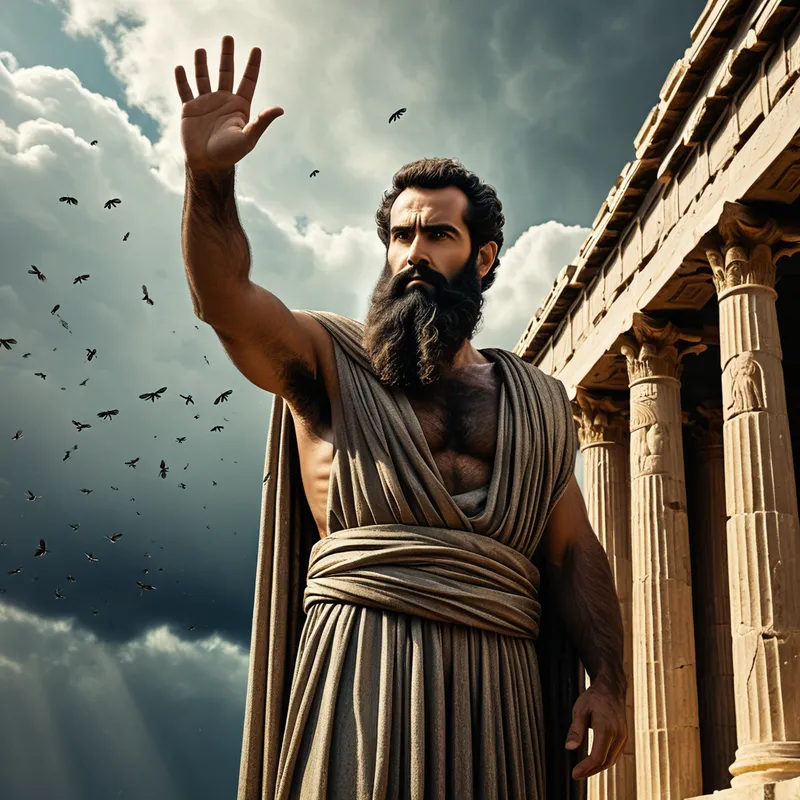
Then, a shift in the air. Not a wind, but a presence. A figure stood at the edge of the sacred precinct, one often unseen, known only by his work. This was Myiagros, the Fly-Chaser. He was not clad in gleaming armor, but in the simple resolve of a shepherd guarding his flock. His face was stern, etched with the patience of one who watches eternally for small, gathering evils. He raised a hand, not in threat, but in command. No bolt of lightning flashed, no earth shook. Instead, a profound aversion spread from him like a ripple in a pond. It was a force of pure boundary.
The buzzing cloud, moments ago a ravenous entity, shuddered. As one, the flies broke their feast. Their droning turned to a confused whine, then to silence as they scattered, driven back into the wilds, away from the hallowed ground. The altar was clean. The offering, once again, was pure. The connection was restored. Myiagros did not smile in triumph; his work was done. He faded back into the periphery, a silent sentinel against the relentless, swarming tide of corruption, ensuring that the channel between human and divine remained clear.
Cultural Origins & Context
Myiagros belongs to the vast periphery of Greek divine beings, a daimon or specialized god whose domain was hyper-specific. His cult was particularly noted at the sanctuary of Zeus in Olympia, a place where the scale of sacrifices during the great Games would have presented a very practical, physical problem. The myth arises from the intersection of profound piety and stark necessity. In a culture where ritual purity was paramount—where the slightest misstep could render a sacrifice void and risk divine displeasure—the intrusion of flies was not merely unsanitary; it was a theological crisis.
The story was likely passed down not in grand epics, but in the practical lore of priests and temple attendants. It functioned as an etiological myth, explaining why such a specific, minor deity was invoked and given offerings. More deeply, it codified a fundamental religious principle: the sacred must be protected from the profane. Myiagros personified the active, vigilant energy required to maintain that separation. He was the divine exterminator, yes, but his role was spiritual hygiene. His presence reassured that the gods received their offerings in a state of perfection, untouched by the agents of decay that governed the mortal world.
Symbolic Architecture
On the surface, Myiagros is a god of pest control. Symbolically, he is an archetype of psychic and spiritual immunity. The flies are not just insects; they are the swarm of the shadow—the buzzing, distracting, corrupting thoughts, impulses, and energies that seek to defile our inner sanctum.
The sanctuary of the self is perpetually under siege by the swarms of the unconscious. Myiagros represents the conscious faculty that says, "This far, and no further."
The altar represents the place of inner sacrifice and commitment—our highest values, our moments of prayer or meditation, our creative hearth. The "blood" of our effort and passion inevitably draws the "flies": self-doubt, envy, resentment, anxiety, addictive impulses, and petty fears. These elements are not inherently evil; like flies, they are part of the ecosystem of life and decay. But their role is not in the sanctuary. Myiagros symbolizes the active, discerning force of the ego-consciousness that must learn to ward them off, to create a boundary that allows the sacred transaction—the connection to the Self (the inner Zeus)—to proceed untainted.
The Dreamer's Resonance
When the pattern of Myiagros stirs in the modern psyche, it often manifests in dreams of infestation and purification. You may dream of your home—a classic symbol of the self—being invaded by insects: flies, ants, or roaches. The feeling is one of profound violation, disgust, and helplessness. Alternatively, you may dream of trying to perform an important task (a presentation, a ritual) that is constantly interrupted by buzzing distractions, technical failures (modern "flies"), or mocking voices.
Somatically, this can correlate with feelings of being "bugged" or irritated by minor things, a skin-crawling anxiety, or a sense that your energy is being "swarmed" and drained by external demands or internal chatter. Psychologically, this dream signals that your psychic boundaries are porous. The "swarm" has breached the perimeter. The dream is a call to awaken the Myiagros function: to consciously identify what is profaning your inner space and to develop the spiritual-psychological authority to ward it off. It is the process of moving from passive victimization by intrusive thoughts to active, mindful discrimination.

Alchemical Translation
The individuation process requires not only integrating the shadow but also learning to manage its constant, buzzing proximity. We cannot and should not "kill" all our flies—they are part of the totality. The alchemical work modeled by Myiagros is transmutation through boundary-setting. It is the operation of Separatio.
First, we must consecrate our inner altar—clarify what is truly sacred to us: our values, our quiet time, our creative work, our relationships. Then, we must acknowledge the inevitable "scent" this sends out into our own psychic ecosystem, attracting the shadow-swarms. The triumph is not in a war of annihilation, but in the establishment of a temenos, a sacred precinct.
The gold of the psyche is forged not only in the fiery crucible of integration but in the cool, clear space of protection. Myiagros holds that space.
The modern individual becomes their own Myiagros by cultivating practices of discernment: the "no" to a draining obligation, the mindfulness meditation that observes anxious thoughts without letting them land, the ritual of a morning pages journal that clears the buzzing clutter before creative work. We learn to raise the hand, not in rage, but in calm, firm authority. We transmute the chaos of the swarm by creating an inviolable circle of attention and intention around what matters most. In doing so, we ensure that our sacrifices—our efforts, our loves, our prayers—reach their intended destination within us, pure and complete, fostering a direct and uncorrupted dialogue with the divine core of our own being.
Associated Symbols
Explore related symbols from the CaleaDream lexicon: