Mwari Creator God Shona Myth Meaning & Symbolism
The story of Mwari, the supreme Shona deity whose voice is the rain, who dwells in a sacred cave, and who connects humanity to the divine through the natural world.
The Tale of Mwari Creator God Shona
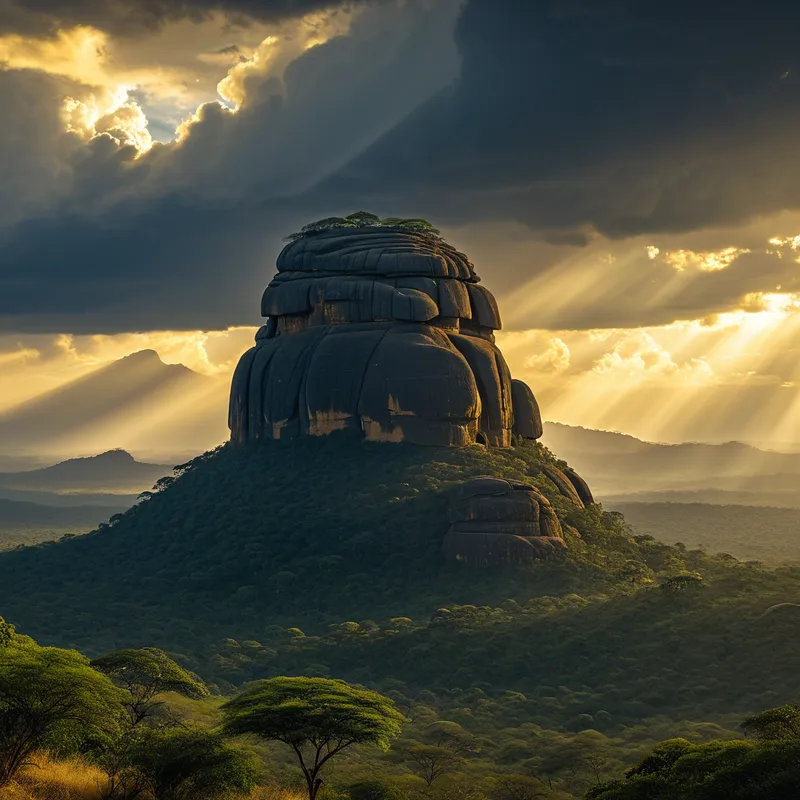
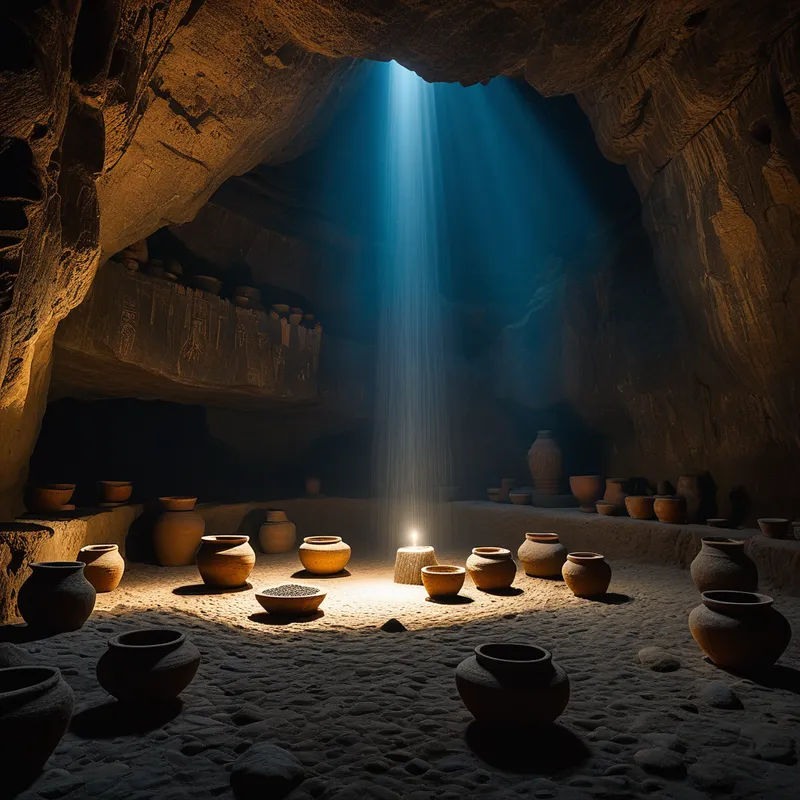
In the beginning, there was only the great, dreaming Mwari. He was not a being of flesh, but of essence—the breath of the sky, the thought behind the mountain, the silence before the word. He dwelt not in a distant heaven, but within the very bones of the earth, in a sacred, echoing chamber deep beneath the ancient, granite domes of the Matobo Hills. This place was called Matonjeni, the place of the ancestors, the navel of the world.
From this dark, moist womb of stone, Mwari dreamed the world into being. With a voice that was not sound but intention, he called forth the first light, and it split the primal darkness. He spoke the Earth into solidity, and it rose in great, weathered humps of rock and rich, red soil. He hummed the rivers into their courses, and they began to sing their journey to the sea. He whispered the names of the trees—the mighty baobab, the whispering mopane—and they pushed green heads towards his sky.
But the world was empty of understanding. So Mwari took the red clay of the riverbank, still cool and soft from his first rains. He shaped it with care, forming two figures—the first man, Mumbu, and the first woman, Mupani. Into their hollow forms, he breathed not just life, but hunhu—the essence of personhood, of morality, of connection. He placed them in the world, not as masters, but as children of the land.
Yet a separation grew. The people multiplied and spread across the land, and the direct voice of Mwari became a memory, a story told by the elders. The people knew hunger when the rains failed. They knew fear in the dark of the night. They felt alone.
So Mwari established the covenant. He would not walk among them, for his presence was too vast. Instead, his voice would come as the life-giving Rain, drumming on the dry earth, filling the rivers, coaxing the seeds to sprout. And to bridge the great divide, he appointed intermediaries. The Mhondoro, the lion spirit of the royal ancestors, would carry the people's praises and petitions. And the Vadzimu, the spirit elders, would listen for his will in the rustle of leaves and the patterns of thrown bones.
The people learned to listen. They would bring offerings of the first fruits, of white mhunga and clay pots of beer, to the mouth of Matonjeni. They would sing, their voices mingling with the wind in the rocks. And from the profound darkness of the cave would come an answer—a deep, resonant echo, the voice of the stone itself, interpreted by the chosen ones. It was not a command from a tyrant, but the guidance of a father, the wisdom of the earth, teaching them how to live in balance, how to honor the circle of life, death, and rebirth. Thus, the connection was forged anew, not through sight, but through sound, through faith, and through the sacred reciprocity of the land.
Cultural Origins & Context
The myth of Mwari is the living heart of the spiritual tradition of the Shona people of Zimbabwe and central Mozambique. It is not a fossilized story in a book, but an oral cosmology breathed into life across generations by elders, spirit mediums, and the community itself. Its transmission is performative and ritualistic, woven into ceremonies, rain-making rituals (mukwerera), and the guidance of the svikiro oracles.
Historically, the cult of Mwari was central to the political and ecological stability of the region. The oracle at Matonjeni served as a supreme spiritual authority, mediating disputes, legitimizing chiefs, and, most crucially, interpreting the divine will concerning agriculture and rain. This myth functioned as the ultimate societal blueprint, encoding laws of environmental stewardship, social harmony, and respect for ancestral wisdom. It explained the origin of the world (zvisikwa), the nature of the divine, and humanity's place within a sacred, interconnected system. The myth was the foundational narrative that answered the profound questions of existence, community, and survival in a landscape where the arrival of the rains meant the difference between life and death.
Symbolic Architecture
At its core, the myth of Mwari maps a profound psychological architecture of creation, separation, and sacred reconnection. Mwari is not an external craftsman but the immanent creative principle itself, the unconscious prima materia from which consciousness and form emerge.
The sacred cave is not a hiding place, but the inner sanctum of the psyche, the unconscious womb where the raw material of the Self awaits the formative word.
The Cave of Matonjeni symbolizes the deep, collective unconscious—the dark, fertile ground of all potential. From this interiority, the creative Logos (the Voice) manifests the world of differentiated forms. The initial unity of creator-within-creation represents a primordial, unconscious wholeness. The subsequent "spreading out" of humanity mirrors the ego's emergence from the unconscious: a necessary development that carries the inherent risk of alienation, of forgetting our source.
The central symbol of the Rain-as-Voice is a masterstroke of symbolic thought. It represents divine communication as something essential, nourishing, and cyclical. It is not a one-time dictation of law, but an ongoing, relational dialogue with the environment. The intermediaries—the Mhondoro and Vadzimu—symbolize the psychic faculties of intuition and ancestral memory (the personal and collective unconscious) that we must develop to interpret the often-subliminal messages from our deeper Self.
The Dreamer's Resonance
When this mythic pattern stirs in the modern dreamer, it often signals a profound process of re-sourcing. One may dream of standing before a vast, dark opening in the earth, feeling both dread and irresistible pull. This is the psyche presenting the entrance to its own Matonjeni—the call to descend into the ignored or feared aspects of the unconscious.
Dreams of desperate thirst in a parched landscape, or conversely, of being cleansed and renewed by a warm, gentle rain, speak directly to the Mwari archetype. They indicate a spiritual or creative drought—a disconnection from the nourishing voice of the inner creator. The somatic experience can be one of literal dryness in the mouth or a deep, wordless yearning. To dream of hearing a powerful, disembodied voice from stones or trees is an encounter with the archetypal Voice itself, a direct (if unsettling) transmission from the deep psyche, urging the dreamer to listen to a wisdom beyond rational thought. The process is one of moving from a state of psychic isolation (the scattered people) towards re-establishing a living dialogue with the inner source.

Alchemical Translation
The individuation journey modeled by this myth is not one of heroic conquest, but of sacred realignment and attentive listening. The initial, unconscious unity with the creator (the unio mystica of infancy) is lost as the ego-complex forms. We become "Mumbu and Mupani spread far afield," conscious but orphaned from our ontological ground, living in a state of psychic drought.
The work is not to build a tower to heaven, but to learn the language of the rain, to become porous to the messages that fall upon the roof of consciousness from the greater sky of the Self.
The alchemical nigredo, the dark night, is represented by the journey to the cave—the conscious confrontation with the inner darkness, the personal and collective shadow we have avoided. Bringing our "offerings"—our acknowledged grief, our authentic questions, our neglected talents—to this inner shrine is the beginning of the dialogue. The Vadzimu within us is our cultivated intuition, our ability to interpret dreams, synchronicities, and bodily feelings as messages.
The ultimate transmutation is the realization that the Voice we seek is not external. It is the very process of life speaking through us. The goal is to become like the fertile earth after the rain: a vessel that receives the nourishing influence of the Self and allows it to bring forth new life, creativity, and a sense of profound belonging to a meaningful, animate cosmos. We move from being orphans of the divine to becoming conscious participants in an ongoing creation, where our own voice, in harmony with the greater Voice, finds its true purpose.
Associated Symbols
Explore related symbols from the CaleaDream lexicon:
- Creator — The supreme, immanent creative force, Mwari, who dreams the world into being from within the earth, representing the archetypal source of all form and consciousness.
- Rain — The divine voice and blessing of Mwari, symbolizing nourishing communication from the unconscious, the grace that ends psychic drought, and the cyclical nature of inspiration.
- Cave — The sacred dwelling of Mwari, Matonjeni, representing the deep unconscious, the womb of potential, and the inner sanctum where one must go to hear the true voice of the Self.
- Voice — The primary means of Mwari's creative action and ongoing communication, embodying the formative power of the Logos and the imperative to listen to non-rational, archetypal wisdom.
- Earth — The physical manifestation of Mwari's creation and his ongoing dwelling place, symbolizing groundedness, fertility, and the sacredness of the material world as an expression of the divine.
- Spirit — The essence of life (hunhu) breathed into humanity by Mwari, and the realm of the ancestors (Vadzimu), representing the invisible connective tissue between the divine, the human, and the natural world.
- Stone — The ancient granite of the Matobo Hills and the substance of the sacred cave, symbolizing permanence, memory, and the foundational, enduring truth of the psyche's structure.
- Circle — The cyclical relationship of offering and blessing, rain and growth, life and death, representing the holistic, interconnected system of existence maintained through sacred reciprocity.
- Mountain — The Matobo Hills themselves, the majestic, enduring landscape that houses the divine, symbolizing a sacred center, a place of revelation, and a bridge between earth and sky.
- Seed — The potential for life buried in the earth, activated by the rain-voice of Mwari, representing latent creativity, new beginnings, and the hidden possibilities within the unconscious waiting to be called forth.
- Ritual — The ceremonies of offering and prayer at Matonjeni, symbolizing the conscious, repeated acts necessary to maintain the connection between the ego and the Self, turning everyday life into a sacred dialogue.
- Ancestor — The Vadzimu who serve as intermediaries, representing the accumulated wisdom of the personal and collective past, a guiding link in the chain of being connecting humanity to the creator.