Muse Myth Meaning & Symbolism
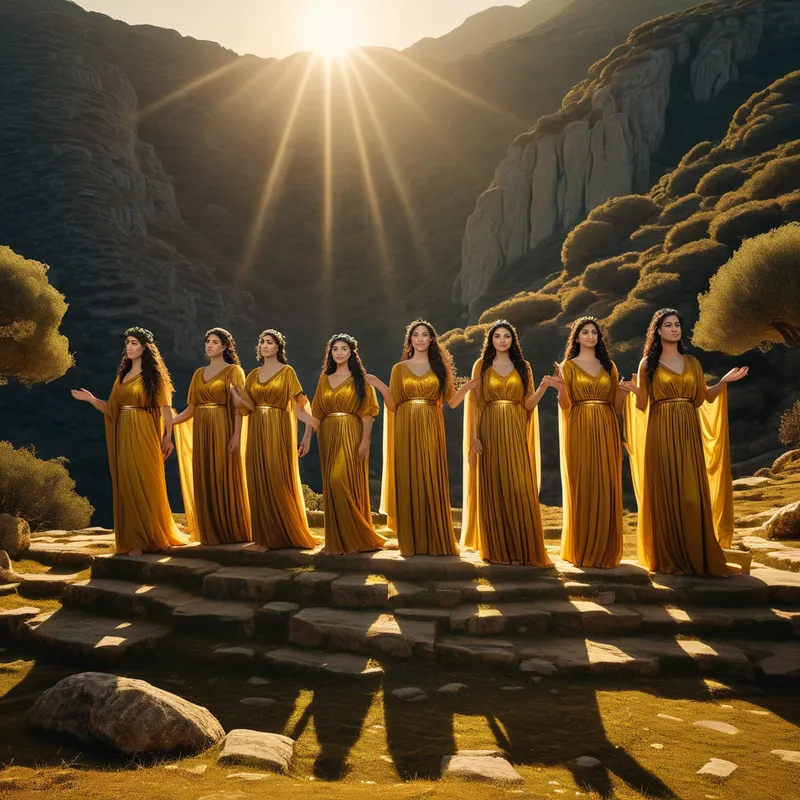
The nine Muses, daughters of Memory, embody the divine source of inspiration, channeling the raw chaos of creation into the ordered arts of humanity.
The Tale of Muse
Hear now, and listen well, for I will sing of the beginning of song itself.
Before the first lyre was strung, before the first epic was spoken into the firelight, there was only silence—a vast, waiting silence. Then, from the mist-wrapped peaks of Mount Helicon and the clear, cold springs of Hippocrene, a sound arose. It was not one voice, but nine. It was the sound of water over stones, of wind through high pines, of stars grinding in their celestial tracks. It was the Muses.
They are the daughters of Mnemosyne, whose name is Memory, and Zeus, whose will is power. For nine nights, the Sky-Father lay with the Titaness of the deep past, and from that union of cosmic authority and ancestral remembrance, nine sisters were born. They are not gentle sprites. Their home is the wild mountain, their playground the chasm between chaos and form.
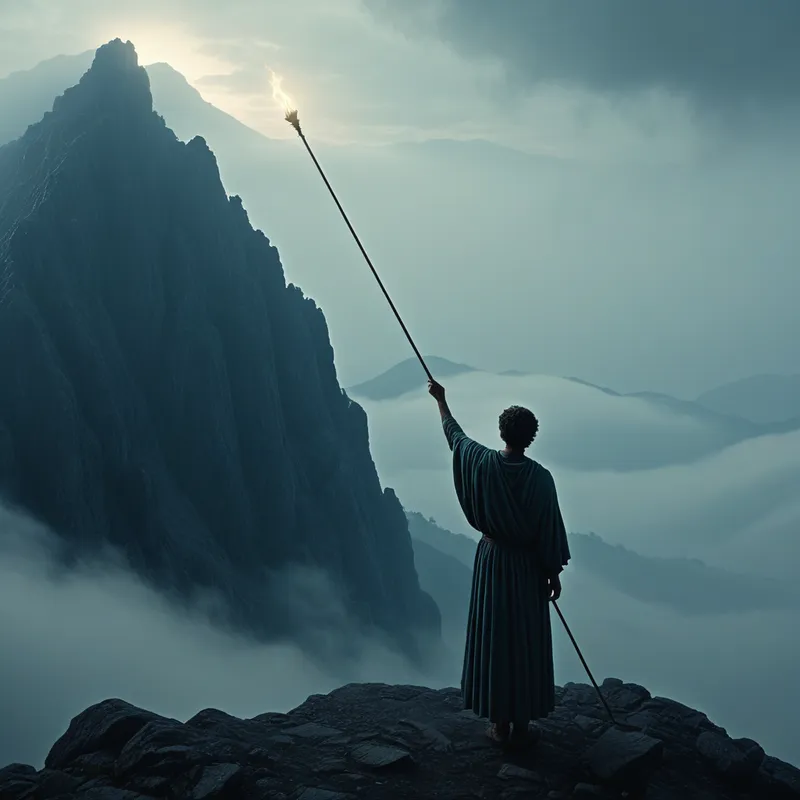
They came to a shepherd once, a man named Hesiod, as he tended his flocks in the shadow of the holy mountain. The air grew thick and sweet. A shimmering mist descended, and within it, the shapes of the nine. They breathed upon him. They placed a staff of sturdy laurel in his hand, and then they spoke—a voice like a river of honey and gall.
“Shepherds of the field, wretched things of shame, mere bellies! We know how to speak many false things that seem true, but we know, when we wish, how to utter the truth.”
With those devastating, electrifying words, they filled him. The raw stuff of the world—the clash of Titans, the birth of Aphrodite from the sea-foam, the intricate genealogies of gods—coursed into him, not as disorder, but as divine verse. They did not give him a story. They gave him the ability to shape story from the void. The shepherd became a vessel. The field became a temple. His simple song of sheep and grass was swept away, replaced by the Theogony, the song of how all things came to be. The Muses vanished as they came, leaving behind only the echoing command: Sing.
Cultural Origins & Context
The cult of the Muses was not mere ornamentation for the Greeks; it was a foundational pillar of their intellectual and spiritual world. Their worship centered on key sites like Mount Helicon in Boeotia and, later, the sacred grove of Pieria near Delphi. They were a collective, the Mousai, almost always spoken of in the plural, emphasizing that inspiration is a multifaceted, communal force from the divine realm.
Every significant creative or intellectual endeavor began with an invocation to the Muses. From Homer’s “Sing, Goddess, of the wrath of Achilles…” to the opening of epic poems, historical works, and even philosophical discourses, the creator acknowledged they were not the sole source of their work. They were a channel. The Muse was the necessary intermediary between the chaotic, unknowable divine and the ordered, human world of art, science, and history. In symposiums and schools, libations were poured to them. They were the divine patrons of the Mouseion, from which our modern “museum” and “music” derive—places and arts dedicated to the products of inspired mind.
Symbolic Architecture
The Muses represent the sacred anatomy of inspiration itself. They are not one vague “spirit,” but a differentiated system, a psychic map. Each sister governs a specific domain: Calliope (epic poetry), Clio (history), Erato (love poetry), Euterpe (music), Melpomene (tragedy), Polyhymnia (hymns), Thalia (comedy), Urania (astronomy), and Terpsichore (dance). This tells us that the raw creative impulse must be directed into a form. Chaos must be given a name, a structure, a discipline.
Inspiration is not a gentle whisper from the void; it is the terrifying and glorious moment when the unformed contents of the collective psyche demand to be born into the light of conscious form.
Their parentage is the ultimate clue. As children of Zeus (cosmic order, authority, light) and Mnemosyne (deep memory, the unconscious, the past), they symbolize the creative act as the marriage of conscious will and unconscious content. We do not invent from nothing. We remember—we draw from the vast well of ancestral memory, cultural patterns, and personal experience (Mnemosyne) and, through the focused application of our skill and intellect (Zeus), we give it new shape. The Muse is the personification of that moment of connection, the lightning strike between the two realms.
The Dreamer's Resonance
When the pattern of the Muse stirs in the modern psyche, it rarely appears as a classical goddess. Instead, dreams may speak of a sudden, overwhelming download of information—a flood of images, sounds, or emotions that feels alien yet intimately pressing. One might dream of a forgotten room in their house filled with strange, beautiful instruments they feel compelled to play, or of a faucet that, when turned, releases not water but a torrent of indecipherable symbols.
Somatically, this can feel like a rising pressure in the chest or head, a restless energy with no clear outlet. Psychologically, it is the unconscious signaling that a content has matured and seeks expression. The conflict in the dream often mirrors Hesiod’s encounter: the mundane self (the shepherd) is confronted by a numinous, awe-inspiring, and sometimes critical force (the Muses’ harsh words). The dreamer is being called out of identification with “mere bellies”—pure material existence—and into a role as a vessel for something larger. The anxiety in such dreams is the terror of the responsibility: Can I hold this? Can I form this?
Alchemical Translation
The individuation process modeled by the Muse myth is the alchemical solve et coagula—dissolve and coagulate—applied to the psyche. First, the old, solid identity (the shepherd) must be dissolved by the encounter with the divine. The Muses’ initial words are a corrosive, shattering the dreamer’s mundane self-conception. This is the solve.
Then begins the coagula, the re-forming. The staff they give Hesiod is not a magic wand; it is a tool for support and measurement. It represents the discipline of the craft—the metered verse, the historical method, the musical scale, the logical proof. The raw, inspired content (from Mnemosyne’s realm) must be painstakingly shaped by the ordering principle of consciousness (Zeus’s realm).
To become a creator is to consent to be a crucible where the chaos of the unconscious and the order of consciousness are fused, under great heat and pressure, into a third thing: a work that is uniquely yours, yet speaks a universal tongue.
The modern seeker’s task is not to wait passively for a goddess to appear. It is to cultivate the inner conditions of the sacred spring—to practice the memory-work (anamnesis) that taps the deep well, and to hone the disciplined skill that can give that material form. The Muse is not an external entity to be petitioned, but an internal dynamic to be embodied. We invoke the Muse, ultimately, by beginning the work. In the diligent, humble act of shaping the chaos within us, we become, for a moment, the very channel through which the divine sings itself into the world.
Associated Symbols
Explore related symbols from the CaleaDream lexicon: