Muramura Spirit Ancestors Myth Meaning & Symbolism
The myth of the Muramura, the creative Spirit Ancestors of the Dreamtime, who sang the world into being and left their essence in the land.
The Tale of Muramura Spirit Ancestors
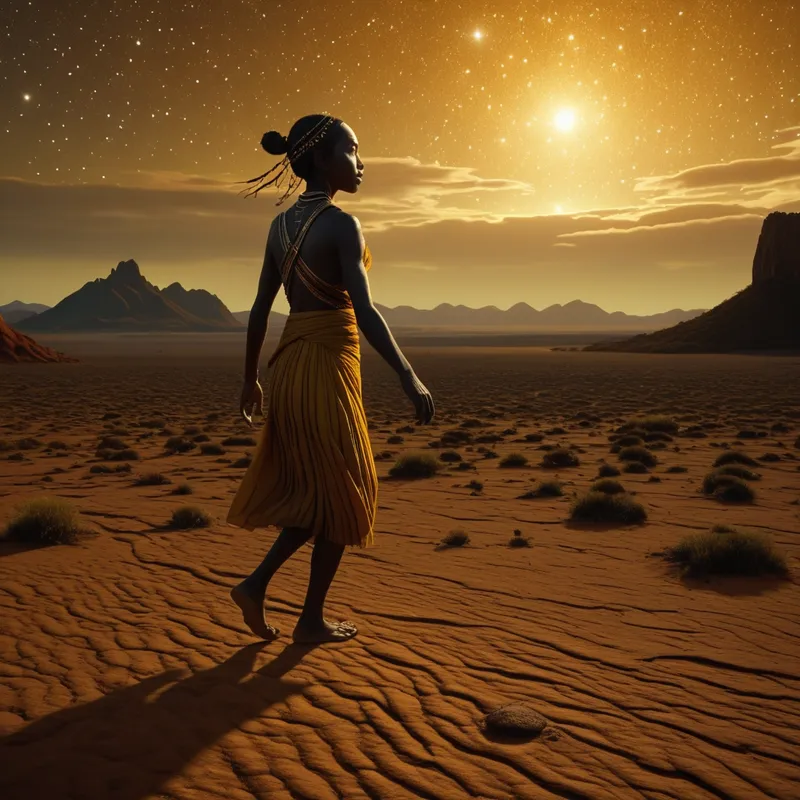
In the beginning, there was the Dreaming. Not a time of sleep, but a time of awakening. The world lay soft and unformed, a plain of potential waiting for a name. Then, from the great, silent Sky, they descended, or perhaps they emerged from the deep, dreaming heart of the Earth itself. They were the Muramura.
They were not gods as others know gods. Some took the forms of the great Rainbow Serpent, moving in sinuous, earth-carving power. Others were the first Kangaroo, the first Emu, the first witchetty grub. Some were like people, but vaster, their bodies charged with the power of the elements. They did not command the world; they sang it. Their journeys were their creation.
Feel the dry, cracked earth thirsting. Then comes Kurukuru, digging with his powerful claws. Where he scrapes, a gully forms. Where he rests, a waterhole springs forth, cool and life-giving. Hear the first song rise from that new water, a melody that binds that place forever to his essence.
Witness the conflict not of battle, but of differentiation. Two Muramura brothers travel the land. One is orderly, placing hills in neat rows, straightening rivers. The other is wild, throwing up mountain ranges in his passion, twisting creek beds into secret, wandering paths. Their disagreement is not a war; it is the world finding its balance between order and the fertile chaos of life. In their parting, the diversity of the landscape is born.
The rising action is the great traverse. The Muramura walk, crawl, and slide across the entire face of the continent. With every footfall, a songline is etched into the land. They perform the first rituals, establish the first laws of kinship and ceremony. They hunt, they celebrate, they mourn. And when their creative work at a particular site is complete, they do not die. They transform. Some sink into the earth, becoming the very rock of a sacred monolith. Others ascend to the sky, becoming stars that guide the people. Their bodies become the land, but their life-force, their spirit, remains, dreaming within it.
The resolution is not an end, but an eternal present. The world is now fully awake, patterned with the stories of its making. The Dreaming does not recede into the past; it lies just beneath the surface of the now. The Muramura are asleep within the landscape, and every waterhole, every stone, every tree hums with the memory of their journey. The world is alive because it is sung. It is law because it is lived. It is sacred because it is the living body of the Ancestors.
Cultural Origins & Context
This is the cosmology of many Aboriginal Australian peoples, particularly those of the Lake Eyre basin and central desert regions, such as the Diyari. The myths of the Muramura are not mere stories for entertainment; they are the constitutional documents of existence, encoding law, ecology, morality, and identity. They were—and are—passed down through meticulous oral tradition, sung and enacted in elaborate ceremonies by initiated elders.
The telling is a sacred act of custodianship. Knowledge is not owned, but held in trust for country and community. Specific stories are the responsibility of specific kinship groups, tied to specific tracts of land. The societal function is total: the myths map the physical and spiritual geography, dictate social structure through totemic clans (you are a Emu person because your Muramura was Emu), and provide the ritual technology to maintain the world's fertility and balance. To sing the Muramura's song is to re-activate their creative power, to "keep the world fresh."
Symbolic Architecture
At its core, the myth presents a universe where consciousness—in the form of the Muramura—is the primary substance. Matter is solidified spirit; geography is frozen narrative.
The world is not a place where miracles sometimes happen. The world itself is the miracle, the permanent testament of an ancestral dream.
The Muramura represent the archetypal forces of the psyche in their pure, creative state. Their journeys are the process of the unconscious becoming conscious, of potential taking form. The songline is a profound symbol of the connecting thread of meaning—the narrative of a life or a culture that links disparate events into a coherent, purposeful whole. The transformation of the Muramura into landscape signifies the incarnation of spirit into matter, the moment an insight or a trauma becomes a permanent structure in our psychological makeup.
Psychologically, the Muramura are the internal Ancestral Spirits—the inherited patterns, instincts, and creative potentials that shape our personal "inner landscape." Their conflicts, like that of the orderly and wild brothers, mirror the internal tensions between our persona (the structured self) and our shadow or creative daemon (the wild, untamed self).
The Dreamer's Resonance
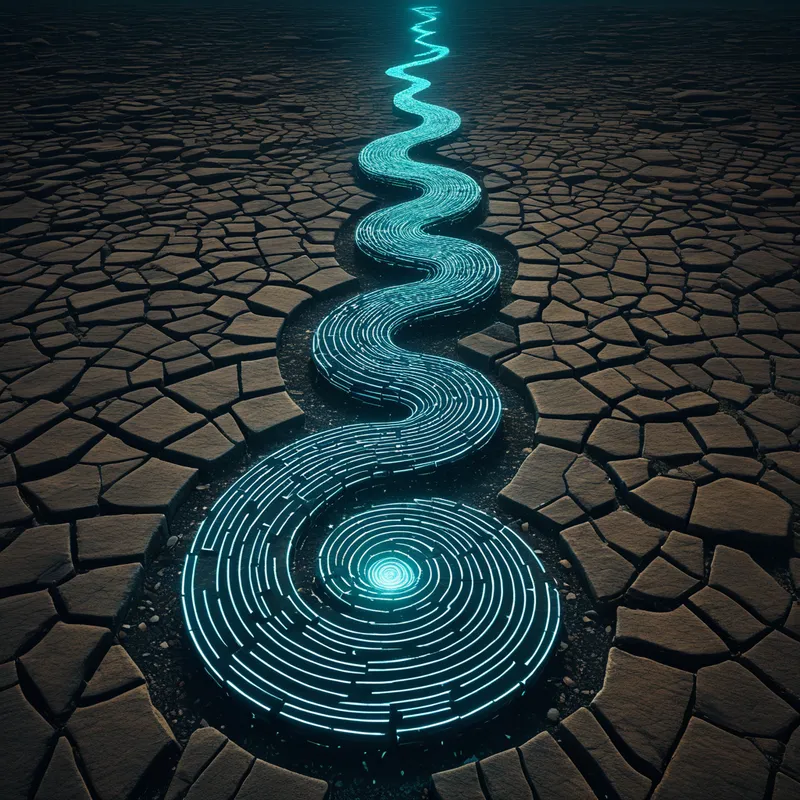
When this mythic pattern stirs in the modern dream, it often manifests as dreams of profound, meaningful landscapes. One might dream of discovering a hidden path (songline) through a familiar place, of a stone or tree that pulses with significance, or of meeting an ancient, animal-like guide who shows the dreamer their true name.
Somatically, this can feel like a deep, grounding resonance—a feeling of belonging to a story larger than one's individual biography. The psychological process is one of connecting to the collective unconscious, to the ancestral layers of the psyche. It is the ego's discovery that it is not the author of itself, but a character in a much older, vaster narrative. This can initially bring feelings of awe, but also of disorientation or a sacred responsibility: "What is my song? What landscape have I been shaped by, and what am I here to shape?"
Alchemical Translation
The individuation process modeled by the Muramura myth is not one of heroic conquest, but of attentive pilgrimage and creative embodiment.
Individuation is not about becoming someone new, but about becoming fully what you always were—a unique verse in the eternal song of the ancestors.
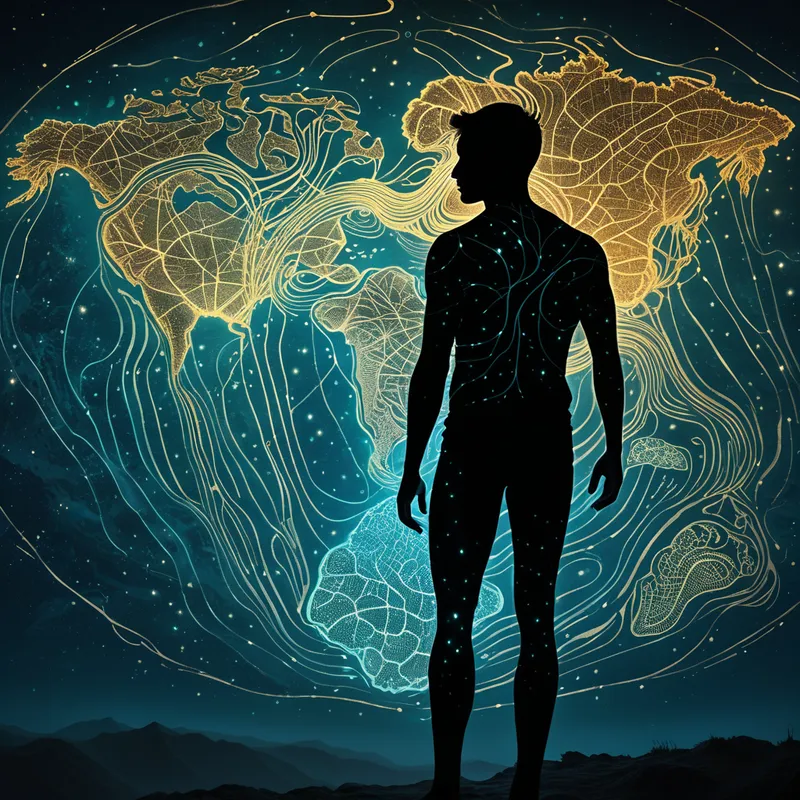
First, one must acknowledge the featureless plain—the undifferentiated state of unconsciousness. The call comes as a longing for meaning, for a journey. The modern seeker must then become their own Muramura, walking their inner terrain. This involves tracing the songlines of one's own life: the patterns of relationship, the sites of trauma (wound) and joy, the inherited family myths (Fable of Ancestors). Each insight, each confronted complex, is a act of singing a place into being—naming it, understanding its law.
The core alchemical work is the Muramura's final transformation. We are asked not to escape our humanity, but to embody our spirit so fully that our very life becomes a sacred site. Our habits become rituals; our choices become law; our creativity becomes a waterhole for others. The "resolution" is the realization that your conscious life is the dreaming of your deeper, ancestral Self. You are both the walker and the landscape, the singer and the song. To live authentically is to maintain the songlines of your soul, keeping the connection between your daily actions and the origin of your being vibrantly alive. In doing so, you participate in the eternal Dreaming, keeping the world—both inner and outer—fresh.
Associated Symbols
Explore related symbols from the CaleaDream lexicon:
- Ancestor — The Muramura are the ultimate Ancestors, not merely human forebears but the primordial beings whose creative acts established the very template of life, law, and land.
- Songline — This is the literal and spiritual path carved by the Muramura, representing the narrative thread of creation that connects sacred sites and encodes ancestral law into the geography.
- Dreaming — The foundational, eternal dimension of time and reality from which the Muramura emerged and into which they returned, representing the unconscious source of all form and story.
- Earth — The living, responsive body shaped by the Muramura; not inert matter but the solidified form of ancestral spirit and the ultimate recipient of their transformative power.
- Journey — The central action of the myth; the Muramura's traverse is not an exile but the creative process itself, modeling the necessary movement that brings potential into manifestation.
- Water — A primary creation of the Muramura, often formed from their actions; symbolizes life, spiritual sustenance, and the gathering places of ancestral power within the landscape.
- Stone — The transformed body of a Muramura or a feature they created; represents permanence, sacred memory, and the incarnation of spirit into enduring, tangible form.
- Spirit — The essential, creative life-force of the Muramura that persists within the land after their physical transformation; the animating principle of the world.
- Origin — The Muramura myth is fundamentally a story of Origin, explaining the source of all natural features, social laws, and tribal identities, rooting the present in a sacred beginning.
- Rainbow Serpent — A specific and powerful manifestation of a Muramura, a creator being associated with water, fertility, and the profound, shaping power of the deep earth and sky.