Mount Olympus Banquet Hall Myth Meaning & Symbolism
The celestial court of the gods, where ambrosia flows and cosmic order is affirmed through sacred ritual, conflict, and divine hospitality.
The Tale of Mount Olympus Banquet Hall
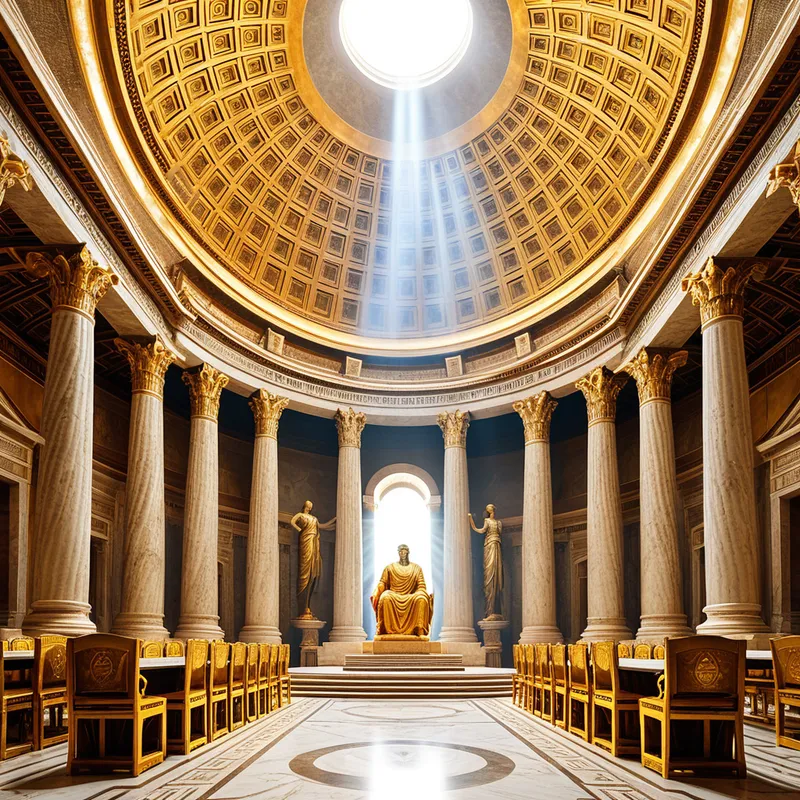
Breathe the air of the world’s peak. It is not thin, but thick with the scent of immortality—of crushed ambrosia, of nectar like distilled sunlight, of ozone from a gathering storm. Here, above the veil of clouds that hides the suffering and striving of mortals, the marble of Mount Olympus is not quarried stone but living crystal, singing with a low, harmonic hum. This is the Banquet Hall, not built, but manifested.
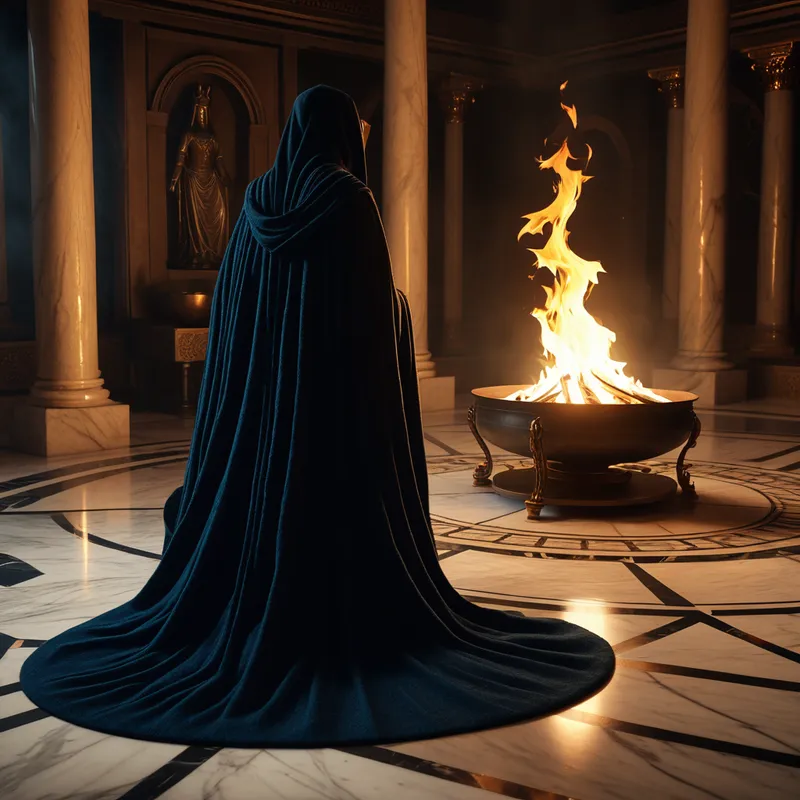
At the hall’s heart, a fire burns that was never lit and will never die. This is the hearth of Hestia, and its warmth is the first law of this place: the sacred center, the anchor of community. Around its glow, thrones are set, not of equal size, but in an order as precise as the orbits of the stars. Upon the highest, carved from storm-cloud and eagle’s feather, sits Zeus. His gaze holds the weight of kingship, the terrible burden of maintaining the balance. Beside him, Hera sits with regal composure, her eyes missing nothing.
They gather, the shining ones. Apollo enters, and the very air thrums with the promise of a lyre’s chord. Athena follows, her presence a cool, clarifying logic. The laughter of Aphrodite precedes her, a scent of roses and the sea. Hephaestus limps to his place, his strength in his hands, not his feet. The cupbearer, Ganymede, moves with eternal youth, pouring nectar that sparkles like liquid gold.
This is the symposium of the cosmos. Here, the Fates themselves might be discussed as one discusses the weather. Here, the destinies of heroes are weighed like cuts of meat. The feast is eternal, but it is not static. For conflict is the spice of the gods. A jest from Ares may draw a sharp rebuke from Athena. A pointed comment from Hera about a mortal lover may cause Zeus’s brow to darken, and a low rumble to echo through the hall. The golden scales of Themis hang in the conceptual space above them all, trembling with every decision.
And sometimes, the hall is breached. A supplicant, bold or desperate—a hero like Heracles seeking apotheosis, or a cunning mortal seeking favor. They stand in the divine radiance, feeling both immense privilege and crushing insignificance. To be granted a seat, even for a moment, is to touch the architecture of reality. To be cast out is to fall back into the chaos of the mortal world. The banquet continues, an everlasting ritual of power, kinship, rivalry, and order, its rhythms the very heartbeat of a universe held in balance by will, wine, and the unwavering fire at its center.
Cultural Origins & Context
The image of the gods feasting in their hall is not the plot of a single, codified myth, but a pervasive backdrop woven throughout the epic poetry of Homer and the hymns and fragments of countless other bards. It was the assumed stage for divine life. For the ancient Greeks, this was not mere fantasy, but a necessary theological concept. The gods were not abstract principles; they were personalities with appetites, emotions, and a social structure that mirrored—and magnified—the human world.
The primary vessels for this myth were the aoidoi (singers) and later the rhapsodes, who performed at aristocratic feasts and public festivals. In reciting the Iliad or the Odyssey, they would invoke scenes on Olympus to explain the machinations behind human events. When Achilles and Agamemnon quarrel, we cut to Zeus and Hera arguing about it. The banquet hall was the divine council chamber and the royal court. Its societal function was multifaceted: it justified the hierarchical structure of Greek society (as ruled by a king and his council), it explained the often-capricious nature of fate (as the outcome of divine debates), and it reinforced the cultural supreme value of xenia (sacred hospitality). If the gods themselves honored the guest-host relationship at their own table, how much more imperative was it for mortals?
Symbolic Architecture
The Banquet Hall of Olympus is not merely a setting; it is a complete symbolic map of a functioning psyche that has achieved a degree of cosmic order.
The hearth is the central, still point of consciousness; the thrones are the archetypal complexes vying for attention; the feast is the nourishing energy of a life lived in alignment.
The hall itself represents the achieved temenos—a sacred, bounded space of the Self. It is the inner sanctum where one’s personal pantheon of drives, talents, and values (the gods) are acknowledged and given their due place. Hestia’s eternal flame symbolizes the core of identity, the essential "I am" that must be tended above all else. The hierarchical seating arrangement speaks to the necessity of internal governance. Not all impulses can be king. The rational wisdom of Athena must sometimes temper the passionate wrath of Ares; the creative harmony of Apollo must balance the disruptive ecstasy of Dionysus. Zeus on his throne is the ego in its most mature form: not a tyrant, but a sovereign executive function that mediates between these powerful inner forces, aiming for a cosmos (ordered world) rather than chaos.
The ambrosia and nectar are the substances of self-actualization—the unique vitality and insight that flows when this inner council is in session. The conflicts that arise are not failures, but the essential dynamics of a living psyche.
The Dreamer's Resonance
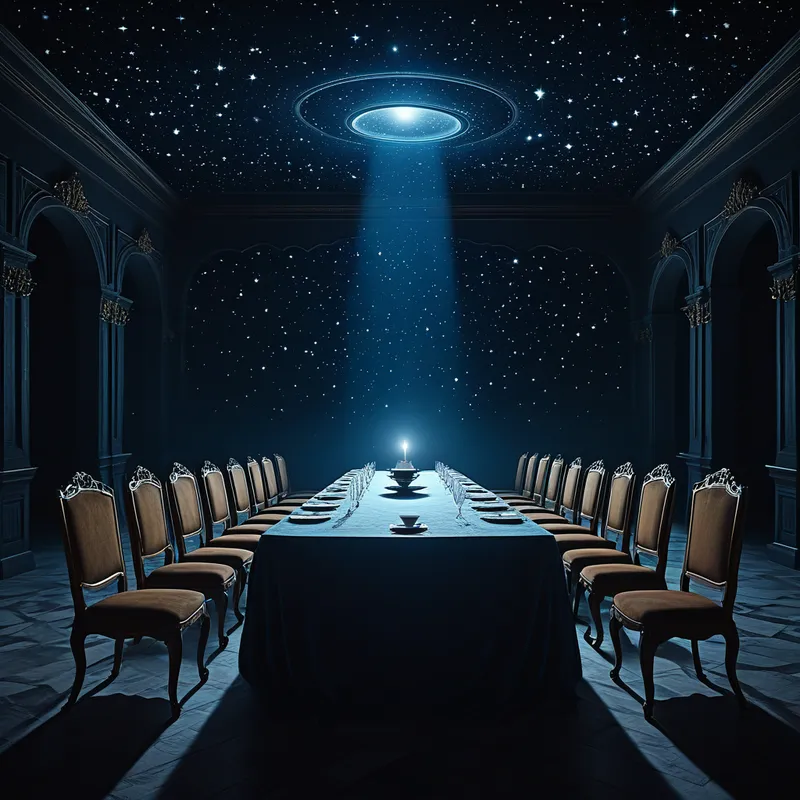
When the Mount Olympus Banquet Hall appears in modern dreams, it rarely manifests as a literal scene from a vase painting. Instead, it surfaces as an experience of sublime order, exclusion, or evaluation. One might dream of a magnificent, endless boardroom at the top of a skyscraper, or a grand family dinner where the relatives feel like powerful, archetypal forces.
To dream of being a guest invited to such a hall suggests the dreamer is undergoing a process of profound self-recognition. They are being "called up" to acknowledge their own latent divinity—their highest potentials and talents—and to integrate them into their conscious life. The somatic feeling is often one of awe, expansion, and perhaps anxiety ("Do I belong here?").
Conversely, to dream of being a servant in the hall (like Ganymede), or of watching the feast from outside a window, points to a sense of one's gifts being in service to an internal or external authority that is not fully one's own. The psyche feels its value but has not yet claimed its throne. To dream of the hall in disarray—the hearth cold, the thrones empty or overturned—is a powerful signal of a psychic hierarchy in collapse, where no inner authority is steering the ship, leading to existential chaos.
Alchemical Translation
The journey to individuation is, in one sense, the long labor of building one’s own Banquet Hall and learning to preside over it. The alchemical process mirrored here is coagulatio—the bringing together of disparate elements into a stable, lasting form.
The prima materia is the chaotic swarm of unconscious drives and inherited complexes. The banquet hall is the lapis philosophorum—the Philosopher's Stone of an integrated personality.
The first step is kindling Hestia’s flame: establishing a practice of centering, of returning to the core self amidst life’s storms. Then comes the difficult work of inviting the "gods" to the table—facing the powerful archetypes within. This means acknowledging the inner Ares (one’s capacity for aggression and boundary-setting), not repressing him, but giving him a defined, subordinate seat. It means honoring the inner Aphrodite (the capacity for love and sensual pleasure) without letting her dominate the proceedings.
The alchemical "king," the conscious ego (Zeus), does not eliminate these forces; it learns their language, negotiates their conflicts, and allocates their energy. The feast—the experience of meaning, creativity, and vitality—is the result of this successful governance. The conflicts that erupt are the nigredo and albedo phases of the work, the necessary darkening and purifying that test the stability of the inner order. To achieve a state where one’s inner pantheon can debate, feast, and create in relative harmony is the triumph of psychic alchemy. It is to become, in one’s own sphere, the ruler of a cosmos, nourished by the ambrosia of self-knowledge and presiding from a throne built not by force, but by wise and sacred integration.
Associated Symbols
Explore related symbols from the CaleaDream lexicon: