Mount Fuji at Dawn Myth Meaning & Symbolism
A goddess descends to quench a mountain's eternal fire, her sacrifice transforming the peak into a symbol of sacred dawn and tranquil beauty.
The Tale of Mount Fuji at Dawn
Listen, and let the mists of time part. In the age when [the world](/myths/the-world “Myth from Tarot culture.”/) was younger and the gods walked closer to [the earth](/myths/the-earth “Myth from Hindu culture.”/), there stood a mountain unlike any other. But it was not the serene sentinel we know today. This mountain was a creature of fury, a great kami of [the earth](/myths/the-earth “Myth from Hindu culture.”/) whose heart was a raging, eternal fire. Flames licked its slopes, and rivers of molten stone carved scars down its sides. Its name was Fuji, and its breath was a plume of ash that blotted out the sun, casting the lands below in a perpetual, fearful twilight. The people whispered that the mountain was in a pain so deep it could only scream with fire.
The celestial beings looked down upon this suffering. Among them was Konohanasakuya-hime, whose spirit was as delicate and resilient as the cherry blossom for which she was named. She saw not just a destructive force, but a profound anguish—a divine being trapped in its own fiery agony. While other gods debated how to chain or punish the mountain, she felt a different call, a pull of compassion deeper than the roots of the earth itself.
One evening, as the bloody light of the burning peak stained the clouds, she descended. She did not come with thunder or decree, but with silent footsteps on the scorched rock. The mountain groaned beneath her, sensing a new presence. She climbed past vents that roared like dragons, through fields of glassy, cooled stone that crackled like bones. The heat was a physical wall, a breath that sought to wither her divine form. Yet, she pressed on, her resolve as clear as a mountain stream.
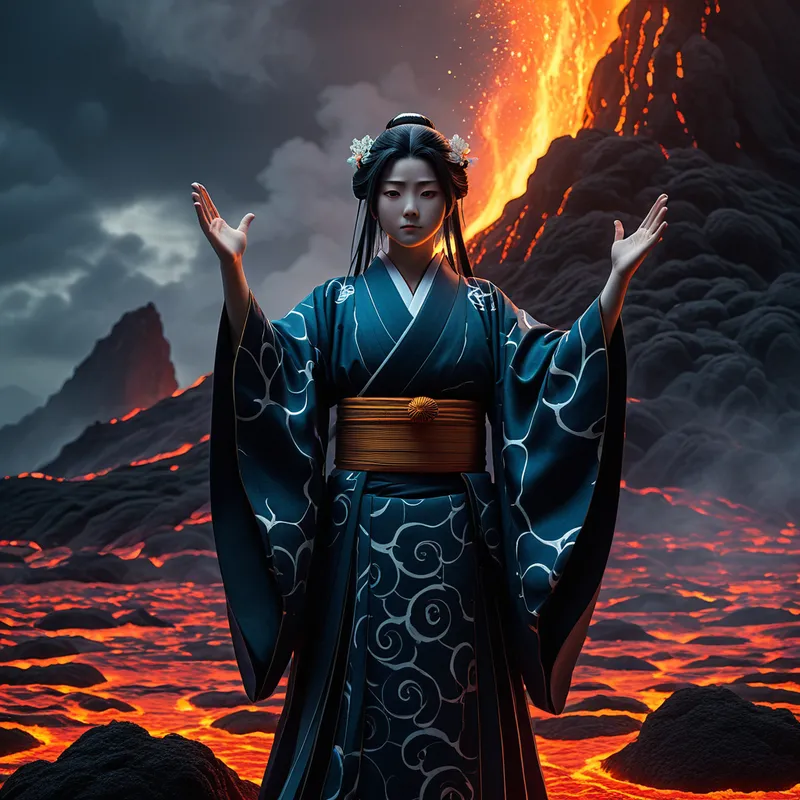
At [the summit](/myths/the-summit “Myth from Taoist culture.”/), within a caldera of churning, luminous fire, she stood. She did not raise her hands to command or subdue. Instead, she opened them, an offering. She began to speak, not in the language of gods, but in the silent tongue of empathy—of understanding pain, of acknowledging rage, of seeing the lonely spirit beneath the cataclysm. She sang of the cool dew on morning grass, of the silent fall of snow, of the patient, deep sleep of stones in riverbeds.
As she sang, she wept. Her tears, born of pure, selfless compassion, were not [water](/myths/water “Myth from Chinese culture.”/) as we know it. They were the very essence of tranquility, of cooling grace. They fell into the inferno. And where they fell, the fire did not hiss and steam in defiance; it sighed. The molten rock darkened, not to dead stone, but to a rich, fertile black. The furious cracks in the earth sealed over, not with scars, but with ridges that held the first, fragile dustings of future soil.
Through the long, agonizing night, she poured her essence into the mountain’s heart. Her form grew faint, her luminous vitality transferring into the rock. It was not a battle, but a merging, a healing. As the last of the central fire was quenched into a deep, slumbering warmth, the first true edge of dawn touched the eastern horizon.
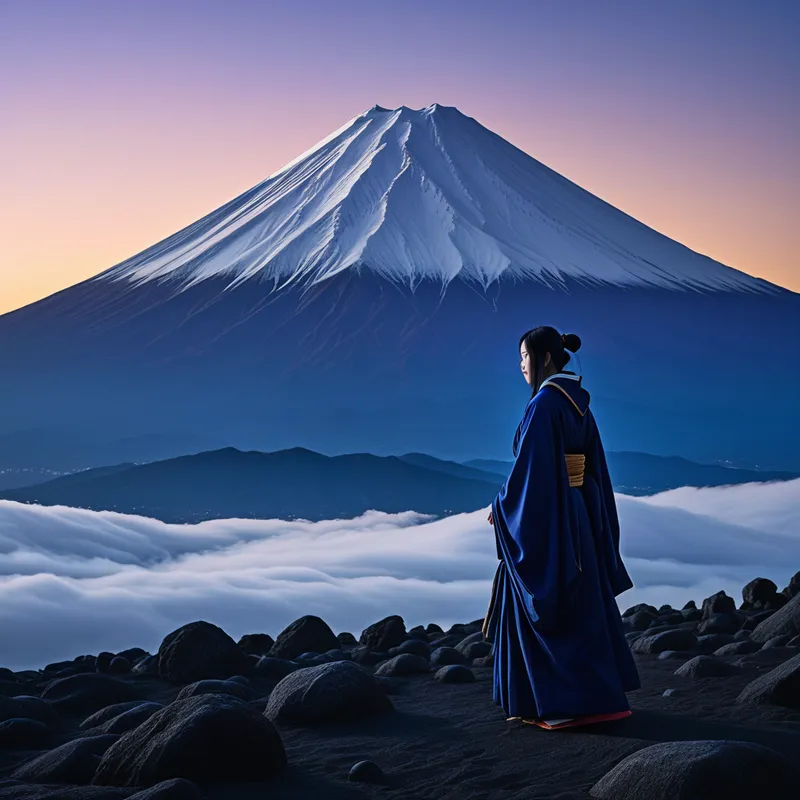
The people below, awakening from a sleep no longer haunted by the mountain’s roar, looked up. They saw a miracle. Where there had been a pillar of smoke and terror, now stood a perfect, silent cone, its upper slopes painted in the most delicate hues of pink and gold—the colors of Konohanasakuya-hime’s blossoms, the colors of a promise kept. The first dawn light crowned Fuji, not as a conqueror’s trophy, but as a sacred seal. The mountain was tranquil, its fire transformed, its agony alchemized into a majestic, enduring peace. From that day forth, it was known as Fuji-san, the most revered kami, who wears the dawn as a sacred garment.
Cultural Origins & Context
The story of [Mount Fuji](/myths/mount-fuji “Myth from Japanese culture.”/)’s pacification is not a single, codified myth from one ancient text, but a tapestry woven from strands of Shinto belief, folk tradition, and later literary reverence. Fuji itself has been worshipped as a potent kami since ancient times, likely by the Ainu as well as the Yamato people. Its volcanic nature made it a direct conduit to the powerful, chthonic forces of the earth, both creative and destructive.
The association with Konohanasakuya-hime, the blossom-princess goddess, is deeply significant. She appears in the Kojiki and Nihon Shoki as a symbol of delicate life, resilience, and fidelity. While these texts do not explicitly narrate her pacifying Fuji, the folkloric and devotional link is powerful. As the goddess of volcanoes and also of blooming life, she became the natural divine custodian of Fuji. The myth likely evolved orally among the [yamabushi](/myths/yamabushi “Myth from Japanese culture.”/) (mountain ascetics) and local communities who lived in Fuji’s shadow, serving to explain its sacred, awe-inspiring beauty and to frame its dormant state not as death, but as a sacred, watchful sleep. The tale functioned as an etiological myth (explaining the mountain’s form), a devotional narrative honoring the goddess, and a societal lesson on the power of compassionate engagement over violent confrontation with the powerful forces of nature—and, by extension, within the human community.
Symbolic Architecture
At its core, this is a myth of radical transformation through [empathy](/symbols/empathy “Symbol: The capacity to understand and share the feelings of others, often manifesting as emotional resonance or intuitive connection in dreams.”/), not conquest. The [mountain](/symbols/mountain “Symbol: Mountains often symbolize challenges, aspirations, and the journey toward self-discovery and enlightenment.”/) represents the untamed, raw, and often destructive power of the unconscious or the [psyche](/myths/psyche “Myth from Greek culture.”/) in a state of [trauma](/symbols/trauma “Symbol: A deeply distressing or disturbing experience that overwhelms the psyche, often manifesting in dreams as unresolved emotional wounds or psychological injury.”/) or unintegrated rage. It is a primal force, burning itself and its surroundings in its [agony](/symbols/agony “Symbol: Intense physical or emotional suffering, often representing unresolved pain, internal conflict, or profound transformation.”/).
Konohanasakuya-hime represents the conscious principle of care—not a weak sentimentality, but an active, courageous, and self-sacrificing engagement. She does not fight fire with fire. She does not seek to extinguish the mountain’s essential [nature](/symbols/nature “Symbol: Nature symbolizes growth, connectivity, and the primal forces of existence.”/) (its fiery [heart](/symbols/heart “Symbol: The heart symbolizes love, emotion, and the core of one’s existence, representing deep connections with others and self.”/)), but to relate to it, to understand its pain, and to offer the complementary element that can transmute its [expression](/symbols/expression “Symbol: Expression represents the act of conveying thoughts, emotions, and individuality, emphasizing personal communication and creativity.”/).
The greatest alchemy begins not with the will to change the other, but with the courage to be changed by the encounter.
The [dawn](/symbols/dawn “Symbol: The first light of day, symbolizing new beginnings, hope, and the transition from darkness to illumination.”/) is the resulting [symbol](/symbols/symbol “Symbol: A symbol can represent an idea, concept, or belief, serving as a powerful tool for communication and understanding.”/) of this alchemical union. It is not merely the [arrival](/symbols/arrival “Symbol: The act of reaching a destination, marking the end of a journey and the beginning of a new phase or state.”/) of light after darkness, but the [birth](/symbols/birth “Symbol: Birth symbolizes new beginnings, transformation, and the potential for growth and development.”/) of a new state of being. The mountain integrated, its fiery core cooled to a fertile warmth, becomes a [vessel](/symbols/vessel “Symbol: A container or structure that holds, transports, or protects something essential, representing the self, emotions, or life journey.”/) for the transcendent light. The [dawn](/symbols/dawn “Symbol: The first light of day, symbolizing new beginnings, hope, and the transition from darkness to illumination.”/) light upon Fuji is the visual representation of [consciousness](/symbols/consciousness “Symbol: Consciousness represents the state of awareness and perception, encompassing thoughts, feelings, and experiences.”/) illuminating a once-chaotic inner [landscape](/symbols/landscape “Symbol: Landscapes in dreams are powerful symbols representing the dreamer’s emotional state, personal journey, and the broader context of life situations.”/), resulting in a serene majesty that inspires awe rather than fear. The myth maps the [journey](/symbols/journey “Symbol: A journey in dreams typically signifies adventure, growth, or a significant life transition.”/) from chaotic, self-destructive affect (the erupting mountain) to contained, [life](/symbols/life “Symbol: The symbol of ‘Life’ represents a journey of growth, interconnectedness, and existential meaning, encompassing both the joys and challenges that define human experience.”/)-giving power (the sacred peak), facilitated by the mediating, compassionate function of the psyche.
The Dreamer’s Resonance
When this mythic pattern stirs in the modern dreamer, it often signals a profound somatic and psychological process of containment and integration. To dream of a violent, erupting volcano—especially one that is familiar, like a local hill or even the dreamer’s own body transforming—points to a psyche under extreme pressure. This could be repressed rage, a tidal wave of grief, or the seething anxiety of a life situation felt to be unsustainable. The eruption is the unconscious’s last resort, a catastrophic communication that the old ways of suppression have failed.
Conversely, dreaming of a serene, majestic mountain at dawn, particularly one that was previously threatening, marks a pivotal moment in inner work. It signifies that the dreamer’s conscious ego (the Konohanasakuya-hime function) has successfully engaged with the inner turmoil. This is not an intellectual understanding, but a felt, somatic process of “sitting with” the pain, offering the “cooling tears” of acknowledgment and compassion. The resulting dream image is a testament from the unconscious that the process is working; the fire is being integrated, the psyche is moving from a state of emergency to one of sacred order. The feeling upon waking is often one of deep peace, relief, and awe—a somatic echo of the myth’s resolution.

Alchemical Translation
For the individual on the path of individuation, the myth of Mount Fuji at Dawn is a master blueprint for psychic transmutation. It models the process not as a heroic slaying of inner demons, but as a sacred caregiving.
The first step is Confrontation with the Inferno: Acknowledging the volcanic material within—the repressed anger, the shame, the primal fear. This is the “night” of the myth, where one must climb into the heart of one’s own darkness.
The critical, alchemical stage is The Descent of the Caregiver: This is where the conscious ego must shift from a stance of defense or eradication to one of compassionate witnessing. It is the practice of active imagination, of journaling, of therapy, of meditation—any discipline where one turns toward the pain with the question, “What are you trying to protect? What is your hurt?” This is Konohanasakuya-hime’s song. It requires a sacrifice of [the ego](/myths/the-ego “Myth from Jungian culture.”/)’s desire for immediate comfort or control.
The fire is not put out; it is transformed into the warmth that sustains life. The shadow is not destroyed; it becomes the fertile soil from which consciousness grows.
The final stage is The Dawn of the Integrated Self: The result of this compassionate engagement is not the elimination of one’s powerful nature, but its redemption. The fiery passion becomes focused conviction. The chaotic emotion becomes deep empathy for others. The once-destructive force becomes the stable, awe-inspiring core of one’s personality—the “mountain” of [the Self](/myths/the-self “Myth from Jungian culture.”/). One wears one’s history and complexity not as scars, but as the serene, majestic lines of a sacred peak, forever capable of reflecting the transcendent light of awareness. The myth teaches that our greatest trials, when met with conscious, compassionate care, become the very structures of our most profound beauty.
Associated Symbols
Explore related symbols from the CaleaDream lexicon: