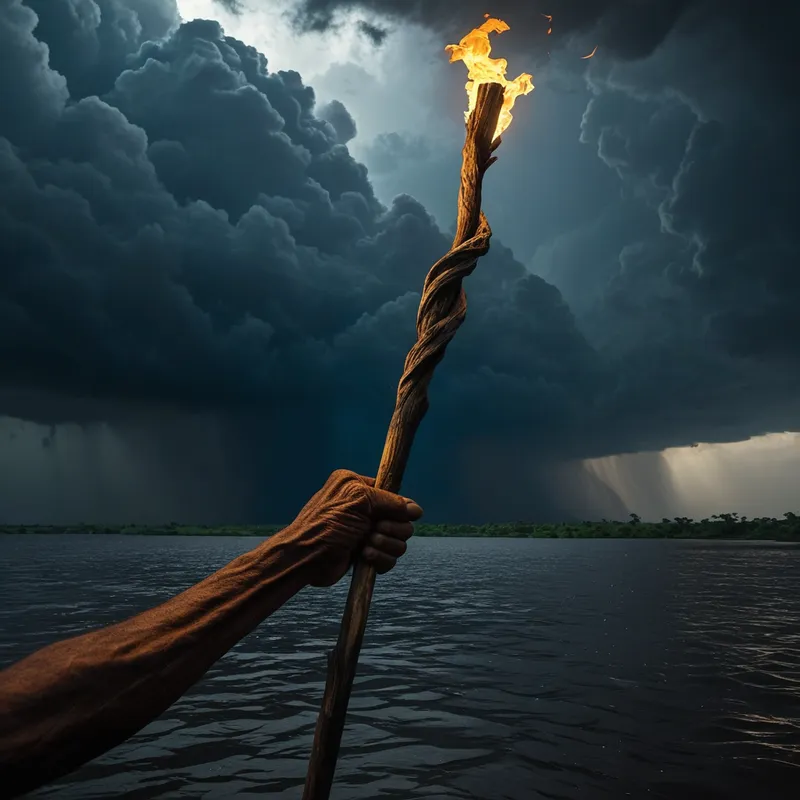
Moses' Staff Myth Meaning & Symbolism
A shepherd's ordinary rod becomes the instrument of divine power, transforming doubt into authority and leading a people from bondage to liberation.
The Tale of Moses’ Staff
Hear now the tale of the rod that was and was not, the instrument of a god who speaks from burning bushes and a man who spoke only of his own inadequacy.
In the stark, heat-hazed wilderness of Midian, a man named [Moses](/myths/moses “Myth from Biblical culture.”/) tended another man’s sheep. He was a fugitive, a prince turned shepherd, his hands now familiar with the rough grain of wood, not the smooth gold of a scepter. His staff was an extension of his arm, a tool for guiding flocks and fending off predators—dead, inert, a piece of [the wilderness](/myths/the-wilderness “Myth from Biblical culture.”/) he wandered. It was the symbol of his reduced life.
Then came the voice from the flame that did not consume. From the heart of a thornbush, the god of his fathers, YHWH, called him by name. The command was impossible: “Go. Bring my people out of Egypt.” Moses protested, a litany of doubt: “Who am I? They will not believe me. I am slow of speech.” His identity was shattered, his authority nonexistent.
The deity’s response was not a crown or an army. It was an object lesson. “What is that in your hand?” the voice asked.
“A staff,” Moses replied. The most ordinary [thing](/myths/thing “Myth from Norse culture.”/) in [the world](/myths/the-world “Myth from Tarot culture.”/).
“Throw it on the ground.”
He did. And the dead wood writhed, coiling into a hissing serpent. Moses recoiled, stumbling backward in primal terror. The tool of his daily labor had become the embodiment of his deepest fears—the chaotic power that could strike him down. “Reach out your hand and take it by the tail,” came the command. A act of supreme trust, to grasp the very source of danger. He did. And in his grip, the serpent stiffened, cooled, and became once more the familiar staff. But it was familiar no longer.
This was the first sign. This staff, now humming with a latent potency, would strike the Nile and turn its life-giving waters into blood. It would summon plagues of frogs, lice, and locusts. It would call down hail and palpable darkness. At the climax, with the army of [Pharaoh](/myths/pharaoh “Myth from Egyptian culture.”/) thundering behind and the uncrossable sea ahead, this same staff would be stretched out over the waters. And [the sea](/myths/the-sea “Myth from Greek culture.”/) would not merely part; it would be driven back by a mighty east wind all that night, forming walls of [water](/myths/water “Myth from Chinese culture.”/) like liquid glass, a path of damp earth opening through the very heart of the deep. The staff was no longer a shepherd’s crook. It was the axis upon which creation itself turned, the conduit for a will that liberates and judges.
Later, in the arid desert of rebellion, when the people thirsted and doubted, this staff would strike bare rock, and water would gush forth. And in a final, quiet miracle of confirmation, this staff—laid in the Tent of Meeting—would bud, blossom, and produce ripe almonds overnight, a silent, living proof that the chosen vessel bears life even in the place of testimony.

Cultural Origins & Context
This narrative is woven into the foundational epic of [the Israelites](/myths/the-israelites “Myth from Abrahamic culture.”/), the Torah. It functions as a core element of the Exodus saga, a story crafted and recited to forge a national identity distinct from the imperial powers of Egypt and Canaan. Passed down orally through generations before being codified, the tale was told at gatherings, during pilgrimages, and at the Passover meal, answering the essential question: “Who are we, and how did we become a people?”
The staff served a critical societal function. In a world where kings and pharaohs wielded ornate scepters as symbols of their own divine or inherited power, this myth subverts that imagery. The ultimate symbol of authority is not taken from a palace armory but from the hand of a disgraced shepherd. It democratizes—or rather, theocratizes—power. True authority comes not from lineage or military might but from a divine commission enacted through the most humble of instruments. It validated the leadership of Moses and, by extension, the priestly and prophetic traditions that followed, all while insisting that the power was never in the man or the stick, but flowed through them from a transcendent source.
Symbolic Architecture
At its [heart](/symbols/heart “Symbol: The heart symbolizes love, emotion, and the core of one’s existence, representing deep connections with others and self.”/), the myth of the staff is a profound [drama](/symbols/drama “Symbol: Drama signifies narratives, emotional expression, and the exploration of human experiences.”/) of [identity](/symbols/identity “Symbol: Identity represents the sense of self, encompassing personal beliefs, cultural background, and social roles.”/) and instrumentality. The staff represents the raw [material](/symbols/material “Symbol: Material signifies the tangible aspects of life, often representing physical resources, desires, and the physical world’s influence on our existence.”/) of [the self](/myths/the-self “Myth from Jungian culture.”/)—one’s inherent abilities, one’s [history](/symbols/history “Symbol: History in dreams often represents the dreamer’s past experiences, lessons learned, or unresolved issues that continue to influence their present.”/), one’s perceived limitations. In Moses’ hand, it is initially just “what he has,” the defining tool of his exiled, anonymous [life](/symbols/life “Symbol: The symbol of ‘Life’ represents a journey of growth, interconnectedness, and existential meaning, encompassing both the joys and challenges that define human experience.”/).
The serpent is the shadow of the staff, the latent, terrifying power within the ordinary that must be confronted and integrated, not fled.
The transformation from staff to [serpent](/symbols/serpent “Symbol: A powerful symbol of transformation, wisdom, and primal energy, often representing hidden knowledge, healing, or temptation.”/) and back is the core alchemical [image](/symbols/image “Symbol: An image represents perception, memories, and the visual narratives we create in our minds.”/). The serpent, in the ancient Near Eastern context, was a [symbol](/symbols/symbol “Symbol: A symbol can represent an idea, concept, or belief, serving as a powerful tool for communication and understanding.”/) of [chaos](/symbols/chaos “Symbol: In Arts & Music, chaos represents raw creative potential, uncontrolled expression, and the breakdown of order to forge new artistic forms.”/), [danger](/symbols/danger “Symbol: The symbol of ‘Danger’ often indicates a sense of threat or instability, calling for caution and awareness.”/), and also (as seen in the later bronze serpent) healing and wisdom. To see his staff become a serpent is for Moses to witness the chaotic, unpredictable potential of his own life and calling. His [flight](/symbols/flight “Symbol: Flight symbolizes freedom, escape, and the pursuit of one’s aspirations, reflecting a desire to transcend limitations.”/) is [the ego](/myths/the-ego “Myth from Jungian culture.”/)’s retreat from its own daunting power. Grasping the serpent by the [tail](/symbols/tail “Symbol: A tail in dreams can symbolize instincts, connection to one’s roots, or the hidden aspects of personality.”/)—the most dangerous way to seize it—is the act of conscious [integration](/symbols/integration “Symbol: The process of unifying disparate parts of the self or experience into a cohesive whole, often representing psychological wholeness or resolution of internal conflict.”/). He must take hold of his own fear, his own chaotic potential, and master it. When it becomes a staff again, it is the same, yet utterly changed. It is now a consecrated [instrument](/symbols/instrument “Symbol: An instrument symbolizes creativity, communication, and the means by which one expresses oneself or influences the world.”/).
Psychologically, the staff symbolizes the ego’s [connection](/symbols/connection “Symbol: Connection symbolizes relationships, communication, and bonds among individuals.”/) to the Self, the central, organizing principle of the [psyche](/myths/psyche “Myth from Greek culture.”/) (the Self). When disconnected, it is just a dead [piece](/symbols/piece “Symbol: A ‘piece’ in dreams often symbolizes a fragment of the self or a situation that requires integration, reflection, or understanding.”/) of [wood](/symbols/wood “Symbol: Wood symbolizes strength, growth, and the connection to nature and the environment.”/)—a functional ego with no greater [purpose](/symbols/purpose “Symbol: Purpose signifies direction, meaning, and intention in life, often reflecting personal ambitions and core values.”/). When connected to the transpersonal [energy](/symbols/energy “Symbol: Energy symbolizes vitality, motivation, and the drive that fuels actions and ambitions.”/) of the unconscious (the voice of YHWH), it becomes a [vessel](/symbols/vessel “Symbol: A container or structure that holds, transports, or protects something essential, representing the self, emotions, or life journey.”/) for transformative power. The plagues represent the necessary, often destructive, upheaval required to break the [psyche](/myths/psyche “Myth from Greek culture.”/) free from entrenched patterns (Pharaoh’s hardened heart). The parting of the sea is the miracle of finding a [path](/symbols/path “Symbol: The ‘path’ symbolizes a journey, choices, and the direction one’s life is taking, often representing individual growth and exploration.”/) through what seems an insurmountable [barrier](/symbols/barrier “Symbol: A barrier symbolizes obstacles, limitations, and boundaries that prevent progression in various aspects of life.”/) of the unconscious, a way forged not by force but by a reconciling wind from the east—the [direction](/symbols/direction “Symbol: Direction in dreams often relates to life choices, guidance, and the path one is following, emphasizing the importance of navigation in personal journeys.”/) of [dawn](/symbols/dawn “Symbol: The first light of day, symbolizing new beginnings, hope, and the transition from darkness to illumination.”/) and new beginnings.
The Dreamer’s Resonance
When this myth stirs in the modern dreamer, it often manifests as a profound crisis of agency and authenticity. You may dream of being handed a simple, even shabby, object—a pen, a key, a tool—and told you must use it to perform a monumental task. A feeling of overwhelming inadequacy floods the dream. This is the “Who am I?” of Moses at the bush.
Alternatively, you might dream that a familiar, trusted object in your hand suddenly transforms into something frightening—a writhing creature, a weapon, a source of uncontrollable energy. This is the serpent moment. The somatic response is often one of freezing or fleeing, a literal paralysis in the dream body. This signals a confrontation with your own shadow power: a talent you’ve denied, a anger you’ve suppressed, a creative force that feels too big or dangerous to own. The psychological process here is [the threshold](/myths/the-threshold “Myth from Folklore culture.”/) of integration. The dream is presenting the chaotic, raw material of your own potential and asking if you have the courage to reach out and take hold of it, to transform terror into tool.
Alchemical Translation
The journey of Moses’ staff is a perfect map for the individuation process. It begins with the [nigredo](/myths/nigredo “Myth from Alchemical culture.”/), the blackening: Moses in [the desert](/myths/the-desert “Myth from Biblical culture.”/), a man whose previous identity (Egyptian prince) has been incinerated by his own actions. He is in the ashes, holding only the dead wood of his current, meaningless existence.
The call from [the burning bush](/myths/the-burning-bush “Myth from Christian culture.”/) is the stirring of the Self, the invitation to a new, terrifying wholeness. The refusal is necessary; the conscious ego must feel its inadequacy to make space for the transpersonal.
The miracle is not that the staff becomes a serpent, but that the serpent can become the staff again—that the integrated shadow becomes the vehicle for the will of the Self.
The act of throwing down the staff is the [solutio](/myths/solutio “Myth from Alchemical culture.”/), a dissolution of the old, rigid form. The serpent is the liberated, chaotic content of the unconscious rising up. Grasping it is the coagulatio—re-forming that chaotic energy into a new, purposeful structure under the guidance of the Self. The staff that results has passed through its own death and rebirth.
For the modern individual, this translates directly. Your “staff” is your profession, your art, your voice, your role in your family—the primary instrument through which you engage the world. The alchemical work is to “throw it down,” to allow its ordinary, ego-bound identity to dissolve and reveal the chaotic, creative, frightening power within it (the serpent of inspiration, responsibility, or change). Then, you must find the courage to reintegrate that power consciously. The consecrated staff that follows is your same life, but now lived with authenticity and authority. It can now “part seas”—navigate deep emotional or life crises—and “strike water from rock”—find sustenance and meaning in barren, difficult periods. It is the tool that turns a personal exodus from bondage to internalized pharaohs (addiction, fear, oppression) into a journey toward a promised, more whole self.
Associated Symbols
Explore related symbols from the CaleaDream lexicon: