Moses at Meribah Myth Meaning & Symbolism
A leader's moment of frustrated rage at a rock denies him entry to the promised land, a story of sacred responsibility and human limitation.
The Tale of Moses at Meribah
The sun was a hammer on an anvil of stone. For forty years, the dust of [the wilderness](/myths/the-wilderness “Myth from Biblical culture.”/) had become their bread, the whisper of sand their only song. The people of Israel, a river of complaint flowing through a desert of despair, gathered once more against [Moses](/myths/moses “Myth from Biblical culture.”/) and his brother Aaron. Their throats were parchment, their tongues swollen. “Why have you brought the assembly of YHWH into this wilderness, that we should die here, we and our cattle?” they cried. “And why have you brought us up out of Egypt, to bring us to this evil place? It is no place for grain, or figs, or vines, or pomegranates; and there is no [water](/myths/water “Myth from Chinese culture.”/) to drink.”
The weight of their longing was a physical yoke on Moses’s neck. He turned from their sun-blistered faces and fell with Aaron before the entrance of the [Tabernacle](/myths/tabernacle “Myth from Biblical culture.”/). The glory of YHWH appeared, a presence not of light, but of profound, silent pressure. The voice was not in [the wind](/myths/the-wind “Myth from Various culture.”/), but in the stillness that followed it.
“Take the staff, and assemble the congregation, you and Aaron your brother. Tell the rock before their eyes to yield its water. You shall bring water out of the rock for them, so you shall give the congregation and their cattle drink.”
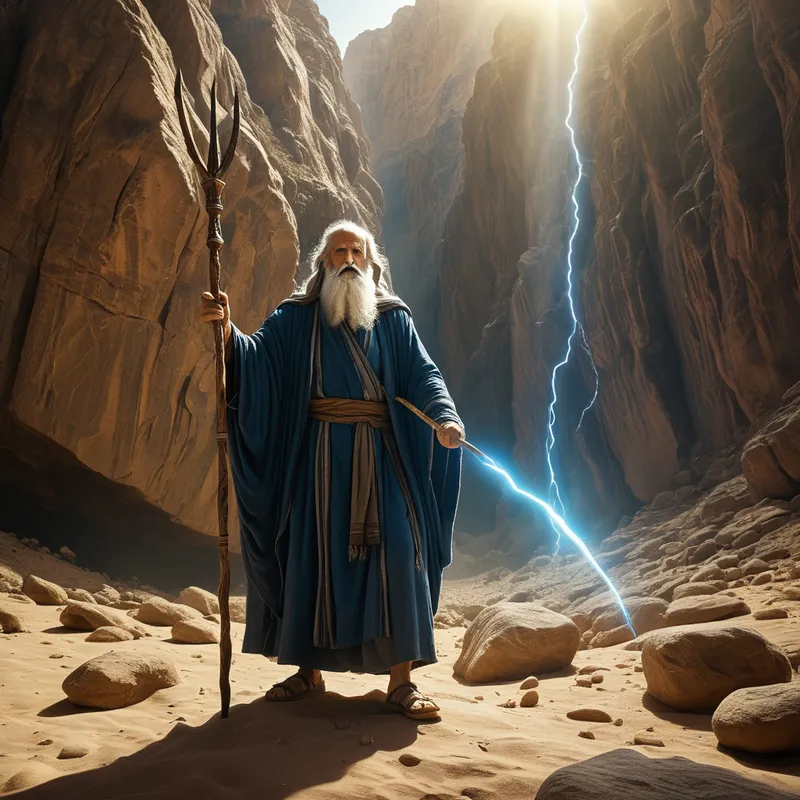
Moses took the staff—the same rod that had turned the Nile to blood, that had parted [the Sea](/myths/the-sea “Myth from Greek culture.”/) of Reeds. It was heavy with memory. He gathered the people before the great rock at Meribah. The multitude watched, a sea of desperate eyes. The heat shimmered. The rock stood, silent and implacable, a testament to the barrenness of their journey.
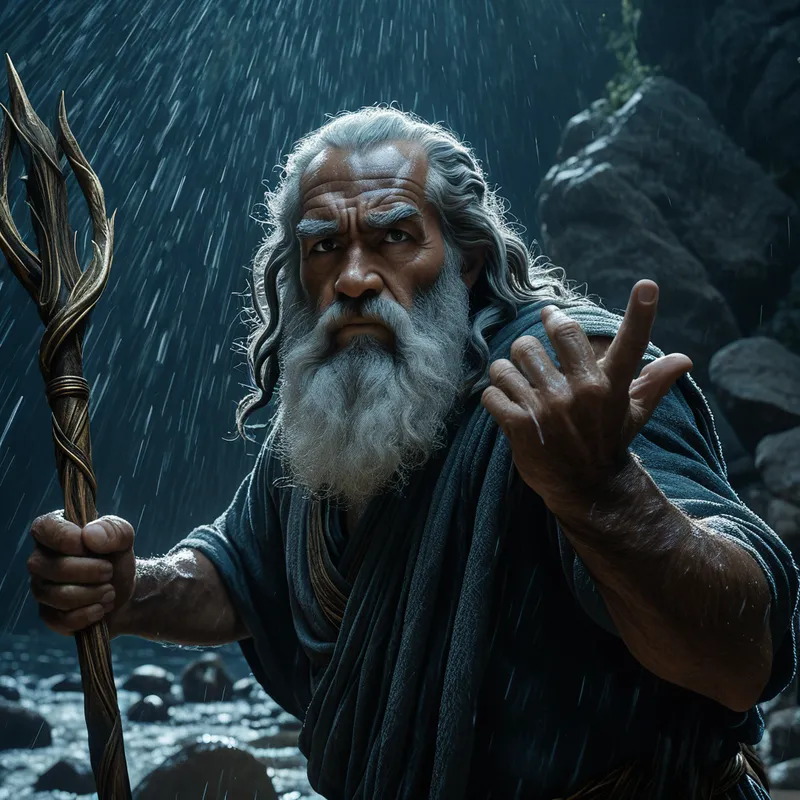
And in that moment, a crack appeared not in the stone, but in the prophet. A lifetime of bearing this stiff-necked people, of mediating between a holy terror and human need, surged within him. Was it fury at their endless testing? Was it a weariness so deep it felt like contempt? He raised the staff, not as a conduit, but as a weapon. “Hear now, you rebels!” his voice thundered, raw with a human anger that shook the sacred air. “Shall we bring water for you out of this rock?”
He struck. Once. Twice. The crack of wood on stone echoed through the canyon like a judgment. And then, the miracle in spite of the man: water gushed forth. A torrent of life from the heart of death. The people rushed forward, drinking, laughing, the crisis forgotten.
But the silence that followed the water’s roar was deeper. The voice of YHWH spoke to Moses and Aaron, and its words were colder than any desert night. “Because you did not believe in me, to uphold me as holy in the eyes of the people of Israel, therefore you shall not bring this assembly into the land that I have given them.”
The water of Meribah became their salvation and his sentence. The one who had drawn life from stone was denied the milk and honey. The journey would end at [the threshold](/myths/the-threshold “Myth from Folklore culture.”/).
Cultural Origins & Context
This narrative is preserved in the book of Numbers, chapter 20. It belongs to the Pentateuch, a core text shaped during the Babylonian Exile and after, though its roots are far older. It functions as an etiological tale, explaining a place name (Meribah means “quarreling”), but its primary role is theological and national.
Told and retold by priestly custodians, it served a critical function for a people defining their relationship with a transcendent, holy deity. It established a stark principle: the authority of the leader is entirely derivative, flowing from YHWH. The community’s survival depends on this sacred conduit remaining clear. Moses’s act was not merely one of anger, but of confusion—he positioned himself (“shall we bring water”) at the center of the miracle, obscuring the divine source. In a culture building a identity separate from the divine-king models of Egypt and Mesopotamia, this story was a brutal reminder that no human, not even the greatest prophet, is above [the law](/myths/the-law “Myth from Biblical culture.”/) of holiness. His failure was a public lesson in divine sovereignty.
Symbolic Architecture
The rock is the central [symbol](/symbols/symbol “Symbol: A symbol can represent an idea, concept, or belief, serving as a powerful tool for communication and understanding.”/). It is the unyielding fact of existence, the hardened [problem](/symbols/problem “Symbol: Dreams featuring a ‘problem’ often symbolize internal conflicts or challenging situations that require resolution and self-reflection.”/), the externalized burden of the [community](/symbols/community “Symbol: Community in dreams symbolizes connection, support, and the need for belonging.”/)‘s need. It represents the unconscious, the [lapis](/symbols/lapis “Symbol: A deep blue stone historically revered as a celestial connection and symbol of wisdom, truth, and spiritual enlightenment.”/), the stony [heart](/symbols/heart “Symbol: The heart symbolizes love, emotion, and the core of one’s existence, representing deep connections with others and self.”/) of a [situation](/symbols/situation “Symbol: The ‘situation’ symbolizes the junction between the subconscious and conscious realms, often reflecting the current challenges or dynamics in the dreamer’s waking life.”/) that must be transformed.
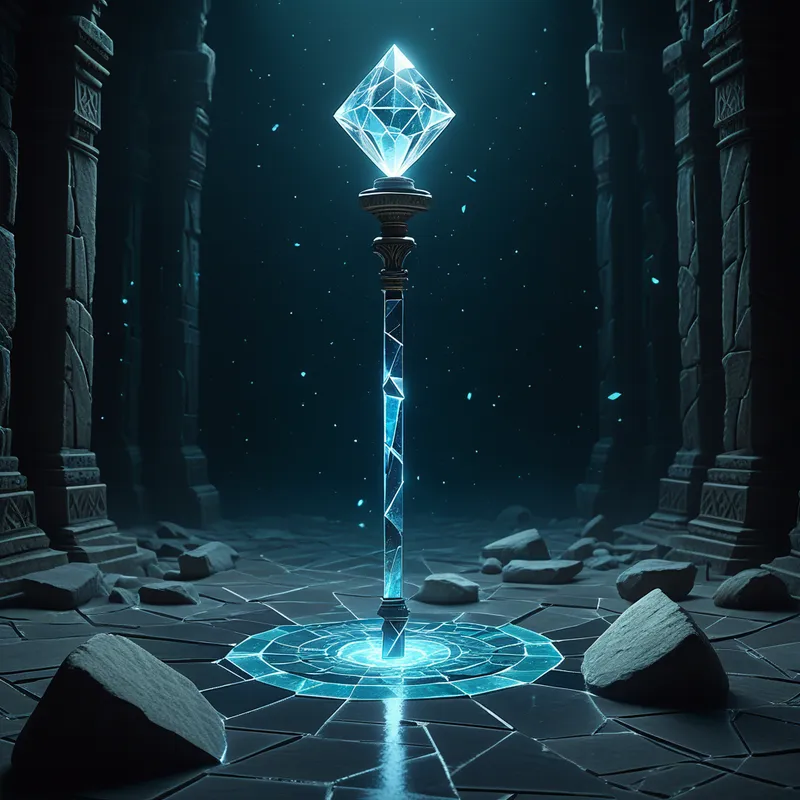
The staff is the symbol of authorized power, of [connection](/symbols/connection “Symbol: Connection symbolizes relationships, communication, and bonds among individuals.”/) to the transcendent. It is the tool for miracles, but when wielded in [the ego](/myths/the-ego “Myth from Jungian culture.”/)‘s rage, it becomes a club.
The water is the life that waits within the stone, the grace that flows despite the flawed vessel. It is the unconscious becoming conscious, but its gushing forth in this context is tinged with tragedy.
Moses embodies the [archetype](/symbols/archetype “Symbol: A universal, primordial pattern or prototype in the collective unconscious that shapes human experience, behavior, and creative expression.”/) of the [leader](/symbols/leader “Symbol: A leader signifies authority, responsibility, and guidance; representing aspirations for achievement or fear of following.”/) who has carried the [projection](/symbols/projection “Symbol: The unconscious act of attributing one’s own internal qualities, emotions, or shadow aspects onto external entities, people, or situations.”/) of the people for too long. His strike is the failure of the ego to relinquish control, to trust in a process beyond force. He confuses his [role](/symbols/role “Symbol: The concept of ‘role’ in dreams often reflects one’s identity or how individuals perceive their place within various social structures.”/) as the channel with being the [source](/symbols/source “Symbol: The origin point of something, often representing beginnings, nourishment, or the fundamental cause behind phenomena.”/). Meribah is the [moment](/symbols/moment “Symbol: The symbol of a ‘moment’ embodies the significance of transient experiences that encapsulate emotional depth or pivotal transformations in life.”/) the [persona](/symbols/persona “Symbol: The social mask or outward identity one presents to the world, often concealing the true self.”/) cracks, and the [shadow](/symbols/shadow “Symbol: The ‘shadow’ embodies the unconscious, repressed aspects of the self and often represents fears or hidden emotions.”/)—in this [case](/symbols/case “Symbol: A case often signifies containment, protection of personal matters, and the need for organization in one’s life.”/), his [frustration](/symbols/frustration “Symbol: A feeling of being blocked or hindered from achieving a goal, often accompanied by irritation and powerlessness.”/) and pride—leaks into the sacred [space](/symbols/space “Symbol: Dreaming of ‘Space’ often symbolizes the vastness of potential, personal freedom, or feelings of isolation and exploration in one’s life.”/). The [punishment](/symbols/punishment “Symbol: A dream symbol representing consequences for actions, often tied to guilt, societal rules, or internal moral conflicts.”/) is severe not out of cruelty, but because the archetypal law is impersonal: the one who misaligns the [conduit](/symbols/conduit “Symbol: A passage or channel that transfers energy, information, or substance from one place to another, often hidden or structural.”/) between the [human](/symbols/human “Symbol: The symbol of a human represents individuality, complexity of emotions, and social relationships.”/) and the divine must be removed from the [system](/symbols/system “Symbol: A system represents structure, organization, and interrelated components functioning together, often reflecting personal or social order.”/), lest the entire [structure](/symbols/structure “Symbol: Structure in dreams often symbolizes stability, organization, and the framework of one’s life, reflecting how one perceives their environment and personal life.”/) be corrupted.
The Dreamer’s Resonance
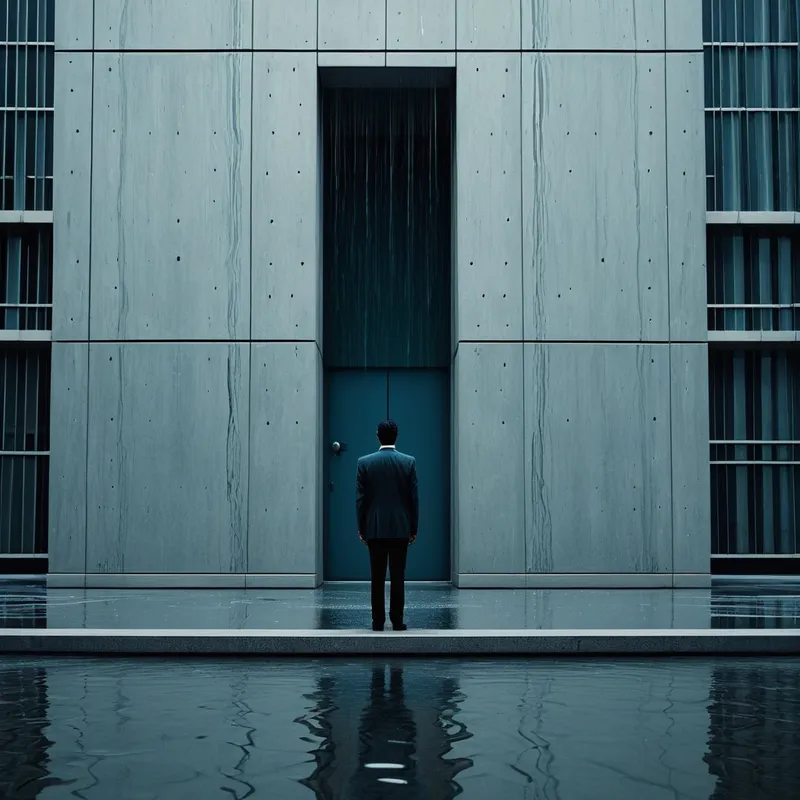
When this myth stirs in the modern soul, it often manifests in dreams of profound frustration at a task or responsibility. The dreamer may be before an immovable object—a locked door that won’t open, a computer that won’t boot, a person who won’t listen. They have the “right tool” (a key, a command, an argument), but it fails. In their rising panic and anger, they lash out—they hit the door, they smash the keyboard, they shout.
The somatic experience upon waking is often one of clenched jaws, tight shoulders, and a residue of impotent fury. Psychologically, this signals a point of transition where an old mode of operation—force, willpower, personal authority—is meeting its limit. The dream is showing the [psyche](/myths/psyche “Myth from Greek culture.”/) that the current identity, the “Moses-self” that has led them through their own wilderness, is being called to a deeper obedience. The thirst of the “people” (inner needs, family, colleagues) is real, but [the way](/myths/the-way “Myth from Taoist culture.”/) to answer it must change. The dream is the rock, refusing the old strike.
Alchemical Translation
The alchemy of Meribah is the transmutation of the leader’s ego. [The promised land](/myths/the-promised-land “Myth from Biblical culture.”/) represents a new stage of psychic wholeness, a state of flowing integration (milk and honey). To enter it, one must undergo a final, crucial dissolution.
The old Moses—the lawgiver, the miracle-worker, the one who does—cannot cross over. His method is one of forceful intervention, even if divinely sanctioned. At Meribah, that method reveals its flaw: it contains a seed of personal identification with the power that flows through him.
The alchemical instruction was clear: “Speak to the rock.” This is the move from acting upon to communing with. It is the shift from the extroverted, heroic deed to the introverted, receptive word. It is faith in the latent life within the seemingly dead matter of one’s circumstances.
Striking the rock twice is a regression to an earlier, more primitive mode. It works—the water flows—but it is a copper miracle in a moment calling for gold. The psychic transmutation requires the leader to die to the need for personal agency and become a pure vessel. Moses’s death on Nebo is the necessary mortificatio of the old ruler archetype. His viewing of the land he cannot enter is the bittersweet prize of [the alchemist](/myths/the-alchemist “Myth from Various culture.”/): to see the goal clearly, to understand its reality, but to know that your particular consciousness is not the one that will inhabit it. Your work was to make the journey possible for the next generation of [the self](/myths/the-self “Myth from Jungian culture.”/). The water from the rock sustains them for the final crossing. In the end, the leader’s greatest sacrifice is not his life, but his entry. His [triumph](/myths/triumph “Myth from Roman culture.”/) is the community’s survival, and his legacy is the law that outlives him, pointing toward a land where the struggle with stones is over.
Associated Symbols
Explore related symbols from the CaleaDream lexicon: