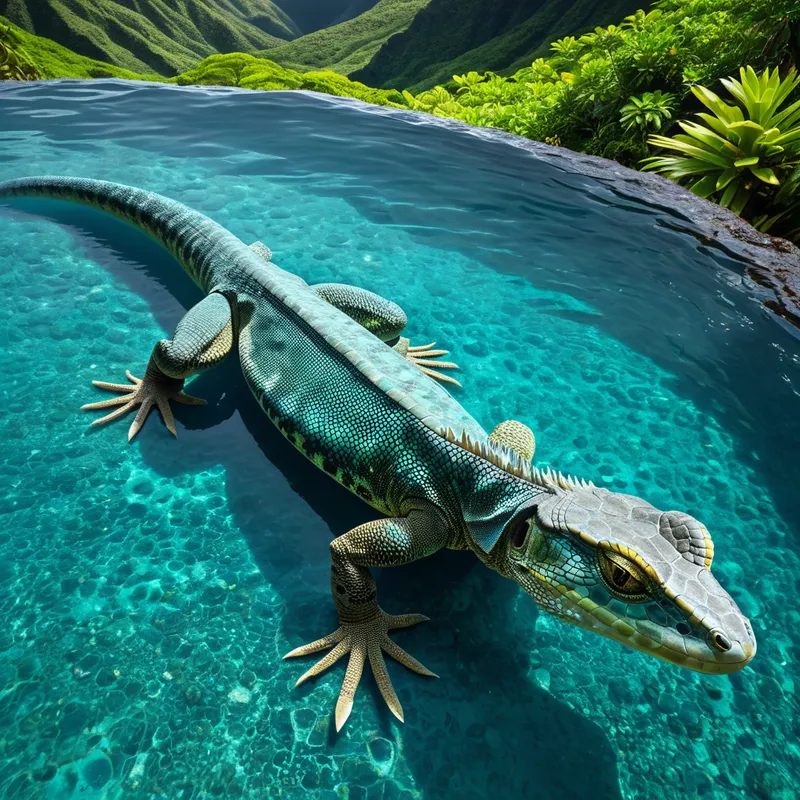
Mo'o Myth Meaning & Symbolism
A myth of the great water lizard, Mo'o, embodying primal power, ancestral guardianship, and the deep, transformative currents of the unconscious psyche.
The Tale of Mo'o
Listen. The land does not forget. The water remembers. In the deep, shadowed valleys where the mist clings to the wai puna, and the silence is thick with the breath of growing things, there dwells an ancient memory. It is the memory of Mo'o.
Before the first great voyagers carved their canoes, before the chants named the stars, Mo'o was there. She was the pulse in the deep spring, the cool darkness under the waterfall's roar. Her body was the curve of the riverbed, her scales the slick, dark stones polished by centuries of flow. She was not a beast of mindless hunger, but a consciousness as old as the basalt bones of the islands themselves—a mana made flesh, cold and patient and profound.
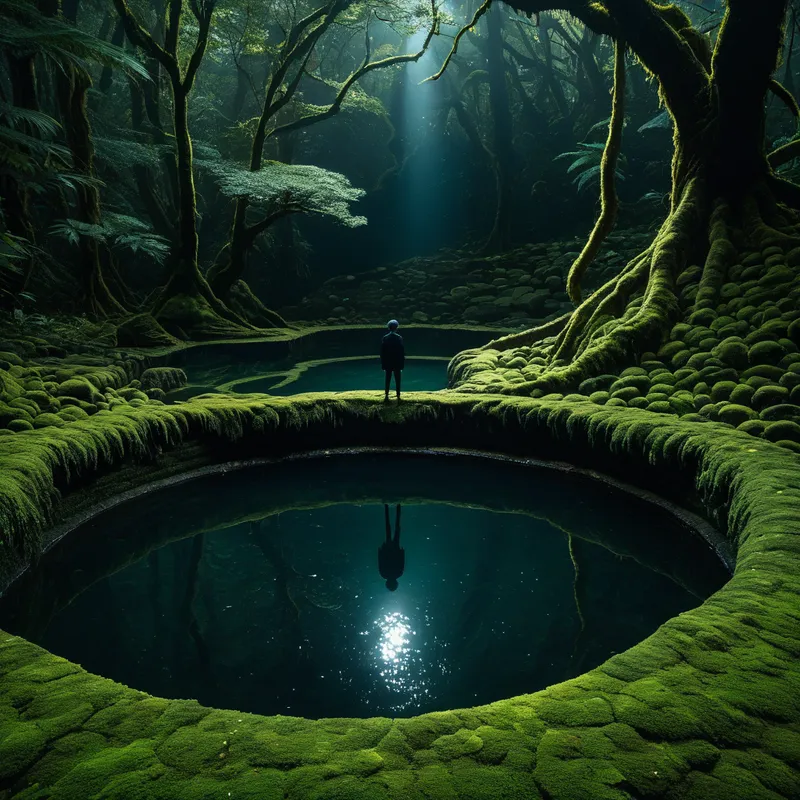
The people knew. They came to her pools not to conquer, but to ask. A mother with a sick child would lay a simple offering of ki leaves upon the still water. A fisherman, seeking bounty, would whisper a prayer to the depths before casting his net. Mo'o watched, her great lidless eyes seeing not just the surface plea, but the truth of the heart behind it. To the respectful, she granted her blessing: the water remained sweet, the fish plentiful, the children safe. Her presence was the balance, the guardian of the boundary between the world of light and the world of the deep, unseen springs.
But balance is a thread easily severed by pride. There came a man, strong-armed and loud-voiced, who saw not a guardian but a monster. He saw her sacred pool as a mere resource, a thing to be claimed. "I will rid this valley of its demon," he boasted, and with a spear fashioned from hardened wood, he descended to her realm. He did not lay offerings. He did not chant. He struck the water, shattering its mirrored silence.
The pool, once clear and calm, darkened as from a spilled ink of night. The water did not rage; it thickened, becoming heavy and cold. From the abyss, a shape uncoiled—not with the fury of a predator, but with the terrible, slow certainty of geologic force. Mo'o rose. Her form was vast, a tapestry of liquid shadow and stone. The man’s spear shattered against her hide. His courage, born of arrogance, turned to water in his veins. He was not eaten; he was received. The pool closed over him, and the water grew still once more. Not as a grave, but as a restoration. The silence returned, deeper now, holding a new truth within its memory. The land had defended its law. The guardian remained, her watchfulness now etched with a somber lesson.
Cultural Origins & Context
The Mo'o is not a singular monster from a forgotten tale, but a pervasive and deeply rooted spiritual reality across the Polynesian triangle, from Hawaiʻi to Aotearoa (where it is known as taniwha), to Tahiti and the Marquesas. These narratives were not mere bedtime stories but vital strands in the kapu system of ecological and social order. They were passed down through moʻokūʻauhau and moʻolelo by kāhuna and storytellers.
The Mo'o functioned as a genius loci, a spirit of a specific place—a particular pool, bend in a river, or stretch of coastline. This localized nature made the myth immediate and practical. It taught environmental ethics: certain waters were not for casual use; they were the body of an ancestor. The Mo'o could be an ancestral guardian (ʻaumakua) for some lineages, offering protection and wisdom. For others, it was a neutral but potent force that demanded respect. The myth enforced a worldview where the landscape is alive, conscious, and in a reciprocal relationship with humanity.
Symbolic Architecture
Psychologically, the Mo'o is an archetypal representation of the primal, instinctual layer of the unconscious—not as a chaotic id, but as a structured, ancient intelligence. It is the psyche's deep, autonomous life, older than the personal ego.
The guardian of the pool is not blocking the treasure, but protecting the fool from drowning in waters he does not understand.
The Mo'o symbolizes the autochthonous spirit—the psychic energy that belongs to the "land" of the Self before the "I" was built upon it. Its reptilian nature connects us to our evolutionary and biological depths, the cold-blooded, patient wisdom of survival and adaptation. As a creature of fresh water, it represents the source of emotional and psychic life, the wellspring of intuition and ancestral memory.
The conflict with the arrogant hero is not a hero's journey, but an ego-inflation's catastrophe. The Mo'o does not represent a "dragon" to be slain for gold, but a threshold guardian of the deep Self. To approach it without reverence (without integrating one's shadow, acknowledging one's smallness) is to be dissolved by it. The Mo'o’s victory is the psyche's self-regulating function, eliminating a hostile, inflated consciousness that threatens the integrity of the whole system.
The Dreamer's Resonance
When the Mo'o glides into modern dreams, it signals an encounter with this foundational, autonomous layer of the psyche. It is not typically a dream of fear, but of profound, awe-filled unease or mesmerizing fascination.
You may dream of a dark, incredibly still body of water in an urban park or your backyard—a place where it should not be. Something immense moves just beneath its opaque surface. You feel watched, known in a way that bypasses your personal history. This is the somatic signal of the unconscious asserting its reality, its otherness. The dreamer is at the brink of recognizing a power within themselves that is not under their control: a deep creative drive, a long-buried trauma that shapes their life, or an ancestral pattern playing out through them. The Mo'o dream is a call to approach this inner "pool" with respect, to make a symbolic offering of attention, and to relinquish the ego's demand for conquest or complete understanding.

Alchemical Translation
The alchemical process mirrored in the Mo'o myth is not the coniunctio of lovers, but the nigredo—the descent into the primal, undifferentiated waters. The goal is not to slay the creature and take its hoard, but to establish a conscious relationship with it, to recognize it as part of the Self's ecology.
The modern individual's "arrogant hero" is the rational, hyper-conscious ego that seeks to drain the psychic swamps, to pave over the inner springs for development. Individuation, in this context, requires a humbling. One must go to the edge of one's own deep, instinctual waters—the pool of rage, of grief, of archaic longing—and sit. Not to fight, not to analyze, but to acknowledge.
The offering of a green leaf is the ego's first act of service to the greater Self.
This is the alchemical translation: the transmutation of ignorance into reverence, and of fear into awe. By honoring the Mo'o within—the ancient, non-human intelligence of our bodies, our inherited traumas, our deepest creative urges—we do not become it. We allow it to be the guardian of our depths. We integrate its cold, patient wisdom into our conscious life. The pool remains, dark and profound, but now the ego knows it is there, knows its laws, and receives its blessings: the steady flow of authentic life, protected from the droughts of superficiality. The guardian and the conscious self exist in a tense, sacred reciprocity, and the individual becomes, like the valley itself, a whole and living system.
Associated Symbols
Explore related symbols from the CaleaDream lexicon: