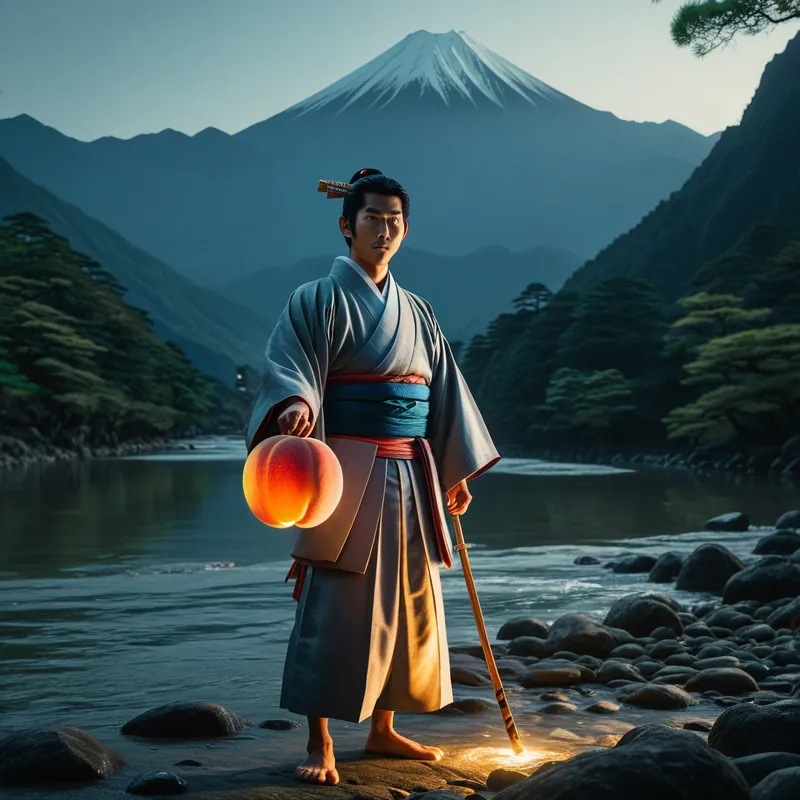
Momotarō Myth Meaning & Symbolism
A divine child arrives from a peach, gathers loyal companions, and conquers the demonic island, embodying the journey of the destined hero.
The Tale of Momotarō
Listen, and hear the tale that flows like the river.
In a time when the mountains were young and the spirits walked closer to the world, there lived an old man and an old woman by the banks of a great, rushing river. Their backs were bent from years of honest toil, and their hearts, though kind, held a quiet, unspoken sorrow—the silence of a hearth without a child’s laughter. One day, as the old woman went to the river to wash clothes, she saw a miracle. Drifting toward her, not with the current’s chaos but with a purpose all its own, was a single, enormous peach. It glowed with the blush of a summer sunset, a fruit so impossibly large and perfect it could only be a gift from the kami.
With great effort, she brought the heavenly fruit home. As her husband took a knife to split it open, the peach fell apart of its own accord. And there, in the sweet, fragrant center, was a baby boy, radiant and strong, who cried out with a voice that promised greatness. “A child granted to us from the Takamagahara itself!” they wept, naming him Momotarō, the “Peach Boy.”
He grew not as ordinary children do. His strength was the strength of the mountain stone; his spirit, the clarity of the river from which he came. When he reached the age of a young man, a fire kindled in his eyes. He spoke to his foster parents, his voice firm: “The land suffers. From the distant island of Onigashima, the Oni come to steal, burn, and terrorize our people. This is my destiny. I must go and break their power.”
With tears of pride and fear, the old woman prepared for him the finest kibidango millet dumplings, food for the long road. And so Momotarō set out, a solitary figure on the path to the unknown eastern sea.
His journey was a gathering of allies, a weaving of a destined fellowship. First, a fierce dog barred his way, baring its teeth. “Give me one of your dumplings, or I will bite you!” Momotarō saw not a threat, but a potential companion. “Join me to subdue the Oni,” he offered, “and you shall have this and more.” The dog bowed its head in loyalty. Next, a chattering monkey swung down from the trees, and then a proud pheasant descended from the sky. To each, Momotarō offered the same pact: a dumpling for a pledge, strength for a shared purpose.
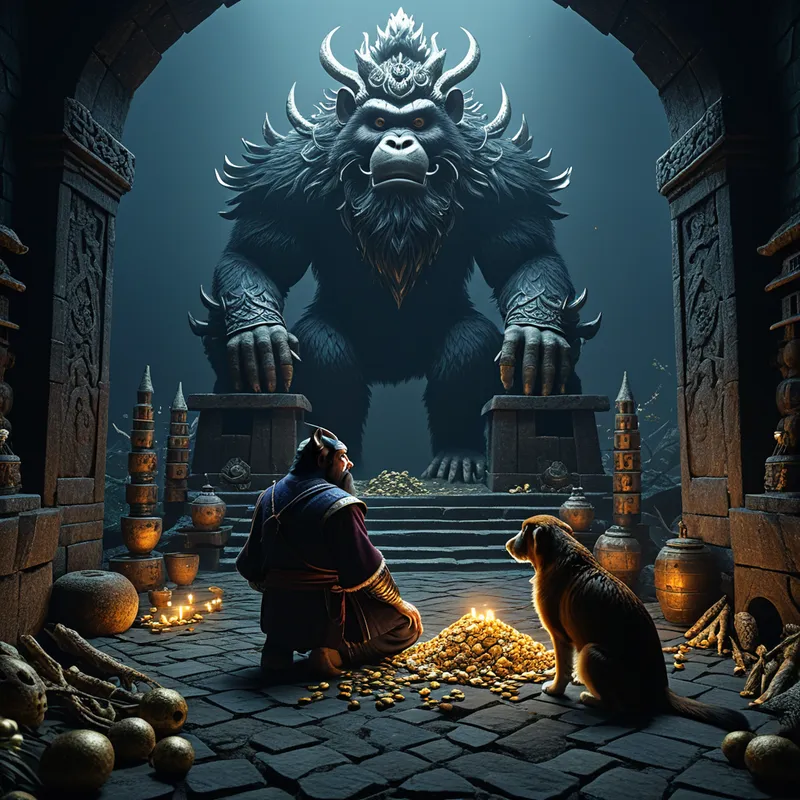
Together, this unlikely band—the loyalty of the dog, the cunning of the monkey, the far-seeing eyes of the pheasant—crossed the sea to the grim shores of Onigashima. The fortress was a nightmare of black rock and iron gates, echoing with the roars of the brutish Oni. The pheasant flew over the walls, pecking at the demons’ heads. The monkey slipped through bars and latches, throwing the gates into chaos. The dog charged, biting at their heels. And Momotarō, the peach-born hero, strode into the heart of the stronghold, his very presence a force of order against the chaos.
He faced the Oni chieftain, a monstrous being of horn and muscle. The battle was not just of strength, but of will. Momotarō, embodying the mandate of heaven and the love of his people, prevailed. The demons surrendered, swearing never to plague the land again. They yielded up their hoarded treasure—gold, silks, jewels—the wealth they had stolen from the world. With his companions and the reclaimed bounty, Momotarō returned home. The old couple wept for joy, not for the treasure, but for the return of their son, the hero who had made the world safe. And so, peace was restored, born from a peach and forged in a righteous conquest.
Cultural Origins & Context
The tale of Momotarō is a mukashibanashi, a story from the ancient past, with roots likely stretching back to the Edo period. It was not a text confined to aristocracy but a story told by the hearth, passed from grandparents to children, its rhythms honed by countless tellings. This oral tradition places it firmly within the realm of communal folklore, designed to entertain, instruct, and reinforce social values.
Its societal function is multifaceted. On one level, it is a straightforward parable of good triumphing over evil, teaching children about bravery, perseverance, and justice. On another, it reflects historical anxieties and cultural geography. The Oni of Onigashima, arriving from across the sea, can be seen as a folk memory of external threats or marauders. Momotarō’s journey from the inland mountains to the coastal demon island maps a psychic journey from the known, cultivated heartland to the unknown, dangerous periphery—a classic folktale structure.
The story also reinforces core Shinto and Confucian values: respect for elders (his care for the old couple), the importance of fulfilling one’s duty (his destined quest), and the virtue of strategic alliance (his recruitment of the animals). Momotarō is not a rebel, but a restorer of the proper, harmonious order that the Oni have disrupted. His divine yet humble origins—born from a peach to a childless couple—make him an accessible, aspirational figure for every common person, a promise that greatness and divine favor can emerge from the most ordinary of circumstances.
Symbolic Architecture
Beneath its adventurous surface, the myth of Momotarō is a profound map of the emerging psyche. The hero is not born of human union, but arrives fully formed from nature—a fruit. This signifies the arrival of the Self as a sudden, numinous gift to the aging, weary ego (the old couple). It is the call to a higher destiny that breaks into a life of mere routine.
The hero is not made, but recognized. He arrives from the unconscious, a whole and perfect seed, and his journey is the labor of bringing that wholeness into the conscious world.
The three animal companions are not mere helpers; they are the integration of instinctual powers. The dog embodies loyal, terrestrial strength and the sense of smell—the ability to track down what is hidden. The monkey represents agile intelligence, trickery, and the capacity to climb and see from new perspectives. The pheasant symbolizes visionary sight, connection to the spirit (the air), and the ability to attack problems from above. Momotarō does not conquer through brute force alone, but by wisely integrating these disparate aspects of his own animal nature—the loyal, the clever, and the far-seeing—into a coordinated force.
Onigashima is the island of the shadow, the fortress of the shadow complex. The Oni, with their horns, crude strength, and hoarded treasure, represent the untamed, brutish, and greedy potentials within the psyche that have been split off and allowed to fester in isolation. The conquest is not annihilation, but subjugation and reclamation. The treasure is the vital energy, the creative power, and the latent talents that were held captive by unconscious, shadowy behaviors (greed, aggression, laziness). Momotarō’s victory is the ego, aligned with the Self, reclaiming this lost wealth for the service of the whole personality.
The Dreamer's Resonance
When the motifs of Momotarō stir in the modern dreamer, it signals a powerful phase of psychic mobilization. To dream of a miraculous fruit or child may indicate the nascent emergence of a new potential or calling—the “peach seed” of the Self seeking to be born into one’s life. There is often a feeling of destined arrival, of a gift from the depths that demands attention.
Dreams of gathering animal companions speak to the process of assembling one’s inner resources. Perhaps the dreamer meets a loyal dog when they need steadfastness, or a clever monkey when a problem requires cunning. These are not external allies, but facets of the dreamer’s own instinctual intelligence that are now becoming available for a conscious project.
The central dream of approaching a formidable, isolated place—a fortress, an island, a dark castle—parallels the journey to Onigashima. This is the somatic and psychological process of confronting one’s own “demon island,” the repository of repressed anger, shame, fear, or denied ambition. The tension in such a dream is palpable; it is the ego preparing to face what it has long avoided. The resolution, whether successful or not in the dream, charts the progress of this inner confrontation. To defeat the “Oni” and bring back “treasure” in a dream is a powerful symbol of successful shadow integration, where previously wasted or hostile energy is transformed into a source of personal power and enrichment.
Alchemical Translation
The myth of Momotarō is a precise alchemical recipe for individuation. The prima materia, the base substance, is the ordinary life of the old couple—a life of lack and longing. The catalyst is the peach, the lapis, the philosopher’s stone that arrives unexpectedly, containing the divine child, the latent Self.
The first alchemical operation is separatio: Momotarō must leave home. He distinguishes himself from his origins, consciously accepting his unique destiny. The journey itself is the coniunctio, the sacred marriage. Here, the conscious mind (Momotarō) does not battle the unconscious instincts (the animals) but negotiates with them, offering the nourishing kibidango of conscious attention and purpose. This forges the unus mundus, the one world of the integrated psyche, where all inner forces are aligned.
The conquest of the demon is the nigredo, the blackening—the necessary confrontation with the darkest, most rejected parts of oneself. It is in this putrefaction that the gold is found.
Onigashima is the alchemical vessel where this crucial dissolution occurs. The battle is the violent agitation needed to break down the hardened complexes of the shadow. The surrendered treasure is the aurum non vulgi, the gold of the philosophers—not literal wealth, but the retrieved psychic energy, the unique talents and vital force that were imprisoned by neurosis and avoidance.
The return home is the final stage, rubedo (reddening) and multiplicatio. The transformed hero, now in full possession of his integrated power (his animal allies and the reclaimed treasure), returns to his point of origin. But he does not return as the foundling; he returns as the king of his own inner realm. He brings wholeness and abundance back to the “old couple”—the earlier, incomplete state of the ego—thus completing the cycle. For the modern individual, this translates to the process of leaving unconscious conformity, courageously facing one’s inner darkness, integrating one’s raw instincts into a disciplined force, and ultimately returning that hard-won wisdom to enrich one’s daily life and community. The myth teaches that our demons guard our greatest treasures, and our destiny is to sail to that island and claim them.
Associated Symbols
Explore related symbols from the CaleaDream lexicon: