
Momiji Myth Meaning & Symbolism
A myth of a noble spirit transformed into the brilliant, fleeting beauty of autumn leaves, embodying the soul's journey through loss and radiant change.
The Tale of Momiji
Listen, and I will tell you of the time when the mountains bled fire and the world held its breath in awe.
In the deep, sacred mountains of Yamato, where the air is thin and the silence speaks of ages, there lived a spirit of surpassing grace. She was not born of stone or stream, but of the very essence of the high places—a being of such profound beauty and dignity that the cedars bowed as she passed and the mountain springs sang clearer in her presence. She was the guardian of the lofty realms, a keeper of solitude and purity.
Yet, her heart was not of stone, but of something more vulnerable. From her solitary peak, she would watch the world below—the villages in the valleys, the laughter of mortals around their fires, the simple, profound drama of love and life. A deep longing stirred within her, a yearning not for the world’s noise, but for its warmth. It was a love not for a single person, but for the fleeting, beautiful tragedy of existence itself. This love became her secret and her sorrow, for a spirit of the mountain is bound to its heights; to descend is to unravel.
But the heart, once awakened, knows no chains of station. Drawn by an ache she could not name, she began to walk the lower slopes. She would linger at the edge of meadows, her form half-hidden in the twilight, watching lovers meet and part, families gather and scatter, lives bloom and fade like summer flowers. This witnessing filled her with a bittersweet joy, a profound empathy for all that is destined to end.
The kami of the mountain, stern and immutable, saw this change. They saw her essence, once as clear and fixed as a mountain peak, becoming soft, mutable, touched by mortal sorrow. In their eyes, this was a dangerous dilution, a betrayal of her celestial nature. A spirit who feels too deeply for the transient world becomes lost to it.
They confronted her on a windswept ledge. “You have let the world’s dust cloud your spirit,” they intoned, their voices like grinding stone. “You have traded eternity for a sigh. This cannot be.”
The spirit did not deny it. Her love for the fleeting world was her truth. Seeing her resolve, the mountain kami pronounced not a punishment of darkness or banishment, but a transformation of essence. “If you so love the dying world,” they declared, “you shall become its most beautiful dying. You will no longer walk as a guardian of the eternal, but as the herald of an end. Your form will be scattered, your beauty will be a farewell.”
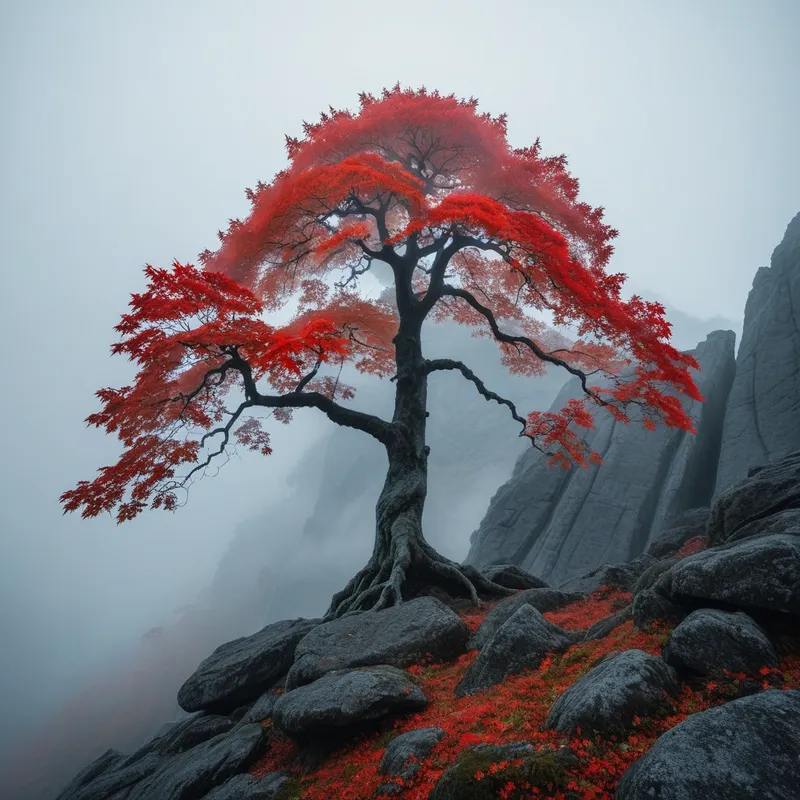
And so, they worked their will. Her noble form dissolved not into nothing, but into a thousand thousand fragments of radiant color. Her spirit infused the leaves of the maple trees across the land. Where once she stood as a single entity, she now lived as a collective sigh of breathtaking beauty. Each autumn, when the world begins its turn toward sleep, she returns. She paints the mountainsides in violent, weeping crimsons, passionate oranges, and weeping golds. It is not a death, but a magnificent, full-throated song of love for a world that must pass. She is Momiji, the brilliant falling leaf, the beauty that is defined by its end, the love that manifests most powerfully as loss.
Cultural Origins & Context
The appreciation of Momiji is a cornerstone of Japanese aesthetic sensibility, deeply intertwined with the concept of mono no aware. While the specific myth of the mountain spirit transformed is a folkloric crystallization, the practice of momijigari—the ritual of traveling to view the autumn leaves—has ancient roots in the Heian period (794-1185). Court nobles would compose poetry (waka) while gazing upon the cascading colors, seeing in them a mirror of their own elegant, transient lives.
The tale was not codified in a single sacred text like the Kojiki, but was passed down as a mukashibanashi (folktale), often told in regions famous for their autumn vistas. It served a societal function beyond mere explanation of the seasons. It taught a spiritual lesson: that profound beauty is often born of sacrifice, that the highest love is sometimes expressed through release, and that to be deeply touched by the world’s transience is not a weakness, but a different, poignant form of strength. It naturalized the feeling of bittersweet melancholy, making it not a personal failing, but a shared, seasonal human experience woven into the landscape itself.
Symbolic Architecture
At its core, the myth of Momiji is an alchemical map of the soul’s encounter with the reality of impermanence. The mountain spirit represents the part of the psyche that identifies with permanence, purity, and lofty isolation—the spiritual ego that believes it can remain above the fray of earthly emotion and change.
The descent from the peak is never a fall, but a courageous journey toward the heart. To love what dies is to finally understand what it means to be alive.
Her “love for the fleeting world” is the awakening of the feeling function in its most profound sense. It is the Eros principle, not merely romantic love, but the force of connection, empathy, and relatedness. This awakening creates the central conflict: the immutable Self versus the empathetic Heart. The transformation into the autumn leaves is not a destruction, but a diffusion of this loving consciousness into the fabric of the world itself. She becomes immanent rather than transcendent.
The brilliant red of the maple leaf is the color of blood, of passion, of vital life force—and also of sacrifice. It symbolizes the heart fully exposed, beating its last and most beautiful beats against the cold blue sky of approaching winter. The act of momijigari (leaf-viewing) is thus a symbolic pilgrimage to witness this sacred sacrifice, to consciously partake in the beauty of letting go.

The Dreamer's Resonance
When the pattern of the Momiji myth stirs in the modern dreamer, it often signals a profound somatic and psychological process of necessary release. To dream of standing in a forest of breathtaking, falling crimson leaves may feel simultaneously euphoric and heartbreaking.
Somatically, this can correlate with a release of held tension in the chest and heart center—a literal and figurative unclenching. Psychologically, the dreamer is likely navigating a conscious or unconscious ending: the close of a relationship, a career phase, an identity, or an outdated way of being. The dream is not portraying this as a failure, but as an alchemical ritual. The intense, almost painful beauty of the leaves in the dream is the psyche’s way of valorizing the process, of insisting, “See how magnificent this release can be! See the color in the goodbye!”
Conversely, dreaming of trying to catch the leaves or keep them from falling points to resistance to this natural cycle, a clinging that causes suffering. The myth, and the dreams it inspires, teach that the power lies not in preservation, but in the full-hearted participation in the cycle of release.

Alchemical Translation
For the modern individual on the path of individuation, the Momiji myth models the critical transition from a spirituality of transcendence to one of immanent, embodied wisdom. Many begin their psychic journey seeking the “mountain peak”—a state of perfect enlightenment, emotional detachment, or idealized purity. This is the spirit in her original form: beautiful, but isolated and unrelated.
The alchemical work is in the descent—allowing oneself to be touched, wounded, and emotionally involved with the fleeting, imperfect world. This is the “love for the fleeting.” The conflict with the inner “mountain kami” (the internal critic, the spiritual superego that demands perfection) is inevitable. It will accuse you of becoming mundane, of losing your way.
The triumph is not in winning the argument, but in undergoing the transformation. The peak is not abandoned; it is dissolved into a thousand points of connection, coloring every leaf of your experience.
The “fiery transformation” into Momiji is the individuated outcome. It is the realization that your spiritual essence does not diminish through connection and loss; it is expressed through it. Your consciousness becomes like the autumn color—not a single, fixed point of enlightenment, but a pervasive quality of depth, empathy, and poignant appreciation that colors your entire engagement with life. You learn to hold your most beautiful moments lightly, knowing their power is inextricably linked to their passing. You become a living practice of momijigari, forever capable of finding breathtaking, heart-rending beauty in the perpetual autumn of the changing self.
Associated Symbols
Explore related symbols from the CaleaDream lexicon: